
Research Symposium
26th annual Undergraduate Research Symposium, April 1, 2026
Olivia Eberhardt Poster Session 1: 9:30 am - 10:30 am / Poster #285

BIO
Olivia Eberhardt is a second-year junior at Florida State University, double majoring in Political Science and Economics with a minor in Business on a pre-law track. She is a first-generation college student and, upon graduation, will receive her Bachelor of Science in Political Science. She currently serves as a member of the FSU Campus Recreation Board, tying together her passions of wellness and leadership. Post-graduation, Olivia plans to attend law school and has a strong interest in studying entertainment law, particularly intellectual property and contracts. She is eager to explore opportunities that bridge legal studies and the creative industries. Through her coursework, internships, and extracurricular involvements, she has gained vital skills in research, communication, and leadership.
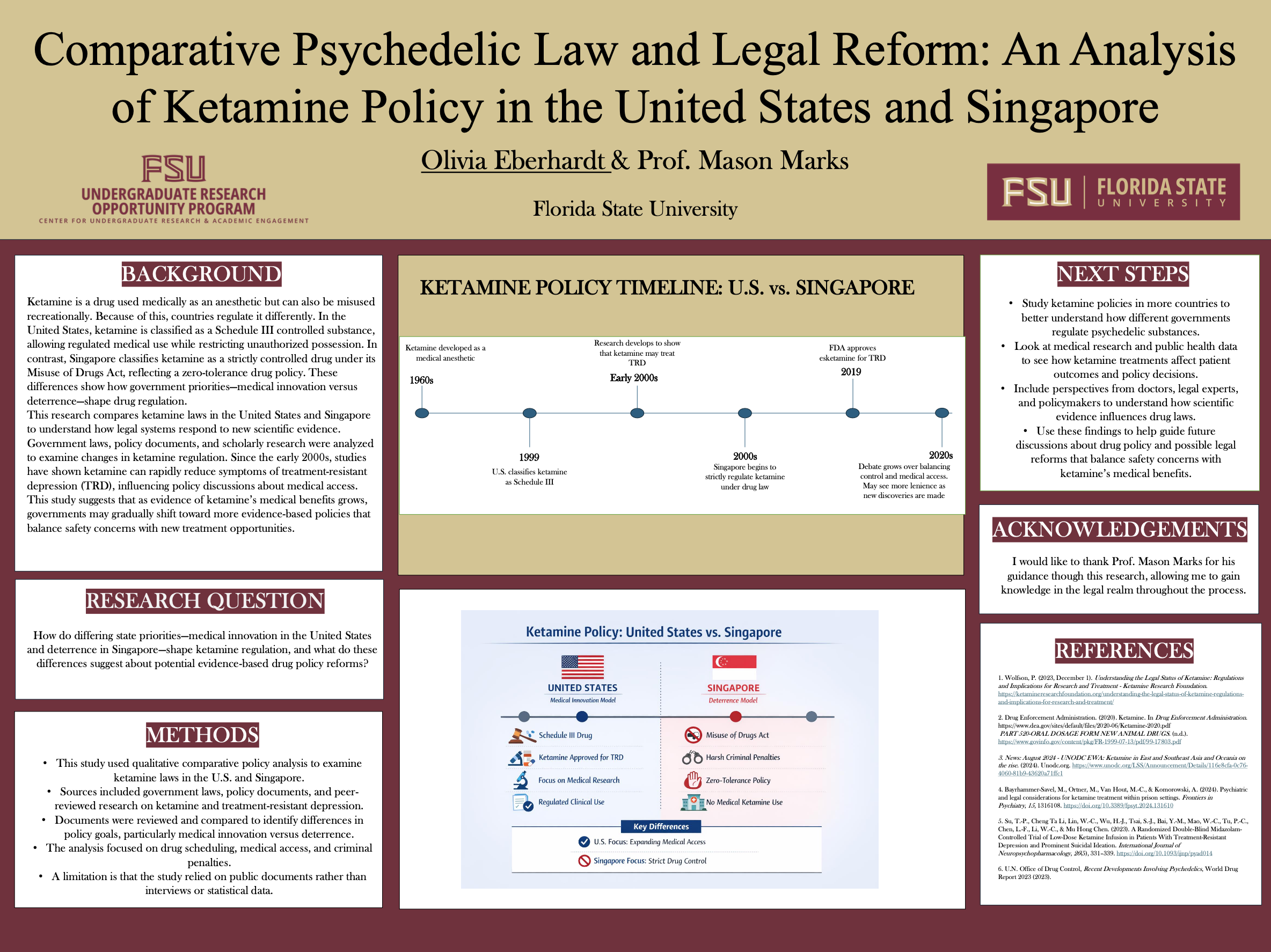
Comparative Psychedelic Law and Legal Reform: An Analysis of Ketamine Policy in the United States and Singapore
Authors: Olivia Eberhardt, Mason MarksStudent Major: Political Science
Mentor: Mason Marks
Mentor's Department: Health Law Mentor's College: College of Law Co-Presenters:
Abstract
Ketamine is a dissociative anesthetic with established medical uses and potential for recreational misuse, resulting in varied regulatory approaches worldwide. In the United States, ketamine is classified as a Schedule III controlled substance, permitting regulated medical use while restricting unauthorized possession and distribution. In contrast, Singapore classifies ketamine as a strictly controlled drug under its Misuse of Drugs Act, reflecting a zero-tolerance, deterrence-based drug policy framework. These contrasting approaches illustrate how state priorities—medical innovation versus deterrence—shape ketamine policy design and regulatory outcomes.
This research analyzes international and comparative drug law by examining ketamine regulation in the United States and Singapore. Through qualitative analysis of government laws, policy documents, and scholarly literature, the study evaluates how differing legal systems respond to emerging scientific evidence, particularly regarding ketamine’s use in treating treatment-resistant depression (TRD). Since the early 2000s, growing clinical evidence of ketamine’s rapid antidepressant effects has increasingly pressured governments to reconsider scheduling decisions and expand supervised therapeutic access.
Beyond descriptive comparison, this study develops normative recommendations regarding potential national and international legal reform. It argues that evolving scientific evidence should play a significant role in shaping drug scheduling and regulatory frameworks, though the degree of reform will vary depending on underlying policy philosophies. As psychiatric research advances, drug policy may gradually shift toward more evidence-based, health-centered approaches that balance misuse concerns with therapeutic potential.
Keywords: Policy, Psychedelic, Law