
Research Symposium
26th annual Undergraduate Research Symposium, April 1, 2026
Justice Ulrich Poster Session 3: 1:45 pm - 2:45 pm / Poster #201

BIO
Justice Ulrich is a second-year Finance major with an interest in business and international politics. She is on the Dean's List and gained additional research experience as the Managing Editor of the FSView & Florida Flambeau, an independent, student-run publication, for the 2025-26 academic year. Her research mentors, Lt. Col. Joel Barnes and G. Kurt Piehler, taught her to analyze documents through the eyes of an intelligence officer and a historian, respectively. This research project was significant to her as a photographer with a passion for people impacted by humanitarian crises.
The Antietam Project: Examining the Civil War’s Bloodiest Battle from a New Lens
Authors: Justice Ulrich, Lt. Col. Joel Barnes and G. Kurt PiehlerStudent Major: Finance
Mentor: Lt. Col. Joel Barnes and G. Kurt Piehler
Mentor's Department: History Mentor's College: Arts and Sciences Co-Presenters: Ryley Reid
Abstract
Many written documents surfaced over the course of the Civil War that outline the Confederacy’s inability to adequately resource its troops with necessities like shoes. This research aims to evaluate the extent to which these written claims align with what can be seen on the battlefield through photographic evidence. Findings related to military logistics and economics in 1862 parallel modern warfare as they explain the methodology behind soldiers’ utilization of the government’s allocation of scarce resources.
Photographic galleries, letters, diaries, books, and Confederate reports were uncovered through open-source databases such as the National Archives and various educational institutions. Each resource was analyzed for the appearance or mention of clothing items, foodstuffs, and other resources. Findings were then contextualized through the economics, fashion trends, weather patterns, and social norms of 1862.
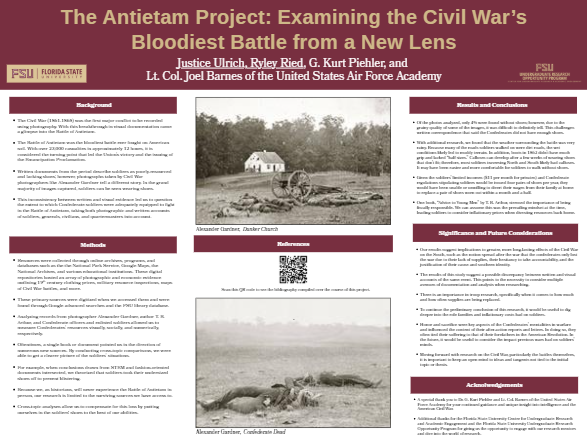
It was found that the weather surrounding the battle likely muddied the roads. Additionally, shoes in 1862 didn’t come in half sizes. It was determined that a possible solution to muddy routes and blistering boots was to take off one’s shoes; this was seen when photographers like Alexander Gardner captured images of dead, shoeless Confederate soldiers. This points to a reluctance to spend money replacing shoes in light of heavy inflation and the cultural teachings of avoiding unnecessary expenditures.
A thorough understanding of the relationship between troops’ wages and the wellbeing of their families on the home front transcends into modern warfare as an indication of how and how often storehouses and supplies should be inspected and replaced.
Keywords: Antietam; War; Resources; Economics; Civil War