
Research Symposium
26th annual Undergraduate Research Symposium, April 1, 2026
Bethsaida Cius Poster Session 3: 1:45 pm - 2:45 pm / Poster #269

BIO
Bethsaida Cius is an undergraduate student at Florida State University majoring in Public Health, with aspirations of becoming a neurosurgeon. She is passionate about understanding the connection between health, society, and the human experience, and she hopes to use both medical practice and research to make a meaningful impact in underserved communities. In addition to her interest in medicine, Bethsaida explores questions of faith, history, and culture through her academic work. Her research focuses on ancient texts such as the Book of Enoch, examining how literature reflects social and political realities and serves as a voice for marginalized communities. She is particularly interested in themes of identity, resilience, and the use of language as a tool for expression and resistance. Bethsaida is committed to academic excellence and lifelong learning. She plans to pursue medical school after completing her undergraduate degree and hopes to combine her background in public health with neurosurgery to improve patient outcomes and advance health equity.
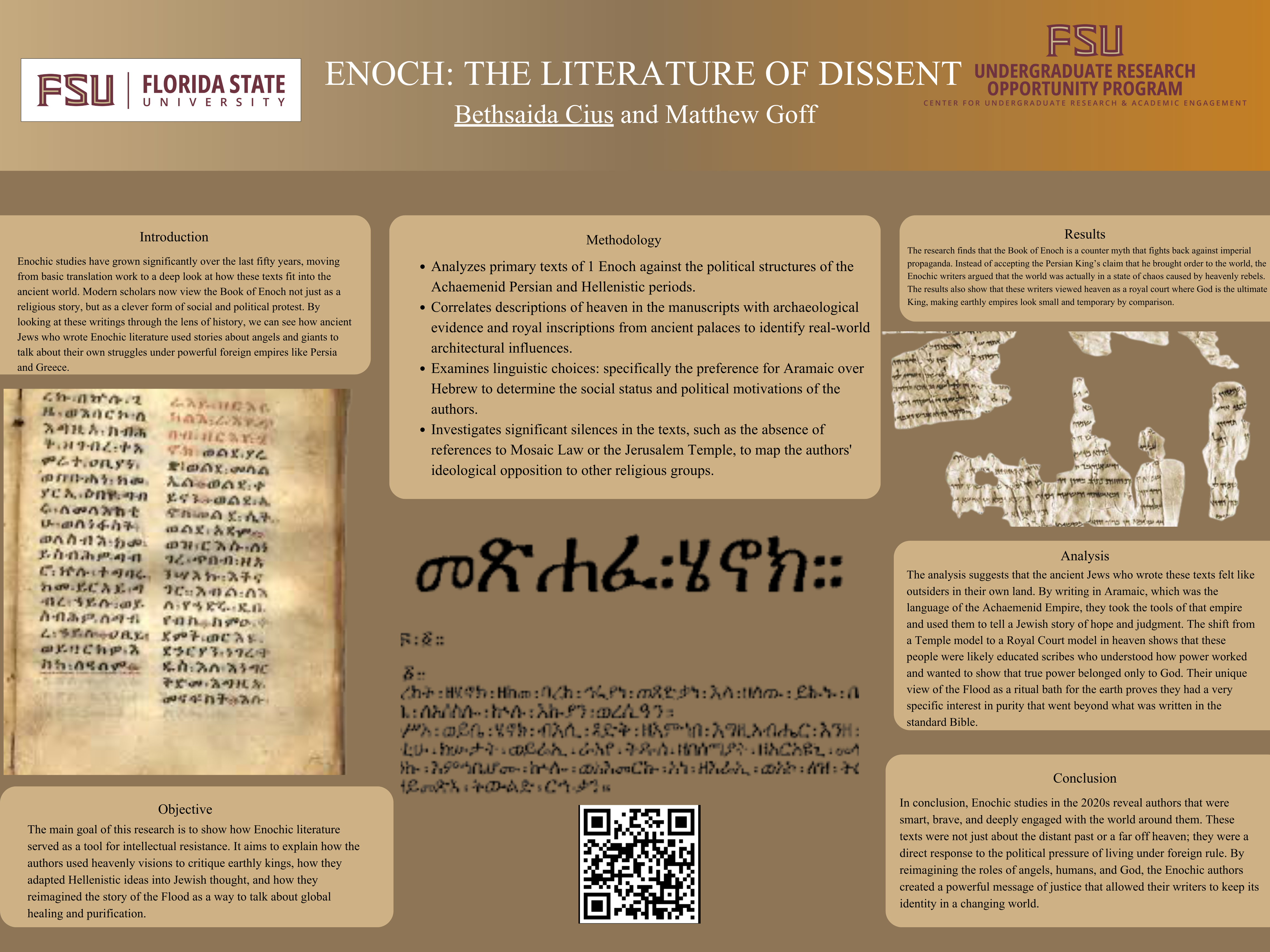
Enoch: The Literature of Dissent
Authors: Bethsaida Cius, Matthew GoffStudent Major: Public Health
Mentor: Matthew Goff
Mentor's Department: Religion Mentor's College: College of Arts and Sciences Co-Presenters:
Abstract
This study examines the Book of Enoch as a form of intellectual and literary resistance within the political context of the Achaemenid Persian and Hellenistic periods. While traditionally viewed as a religious or apocalyptic text, this research argues that Enochic literature also reflects the social and political realities of ancient Jewish communities living under foreign rule. By analyzing primary sections of 1 Enoch, this project explores how themes of divine judgment, heavenly authority, and cosmic order challenge earthly systems of power. The methodology combines textual analysis with historical and linguistic approaches. Descriptions of heaven are compared with royal imagery and architectural influences from ancient Near Eastern empires, while language choices, such as the use of Aramaic, are examined to better understand the authors’ social positioning. Attention is also given to notable silences in the text, including the absence of emphasis on the Jerusalem Temple or Mosaic Law, which may indicate ideological distinctions from other Jewish traditions. The findings suggest that Enochic authors used symbolic narratives and visions to critique imperial authority and reframe power as belonging solely to God. These texts provided a framework for expressing identity, hope, and resistance among marginalized communities. Ultimately, this research highlights the Book of Enoch as both a theological and political work that contributed to shaping alternative worldviews in a time of cultural and imperial dominance.
Keywords: Book of Enoch, Apocalyptic Literature, Intellectual Resistance