
Research Symposium
26th annual Undergraduate Research Symposium, April 1, 2026
Nina Wallenburg Poster Session 2: 10:45 am - 11:45 am / Poster #198
BIO
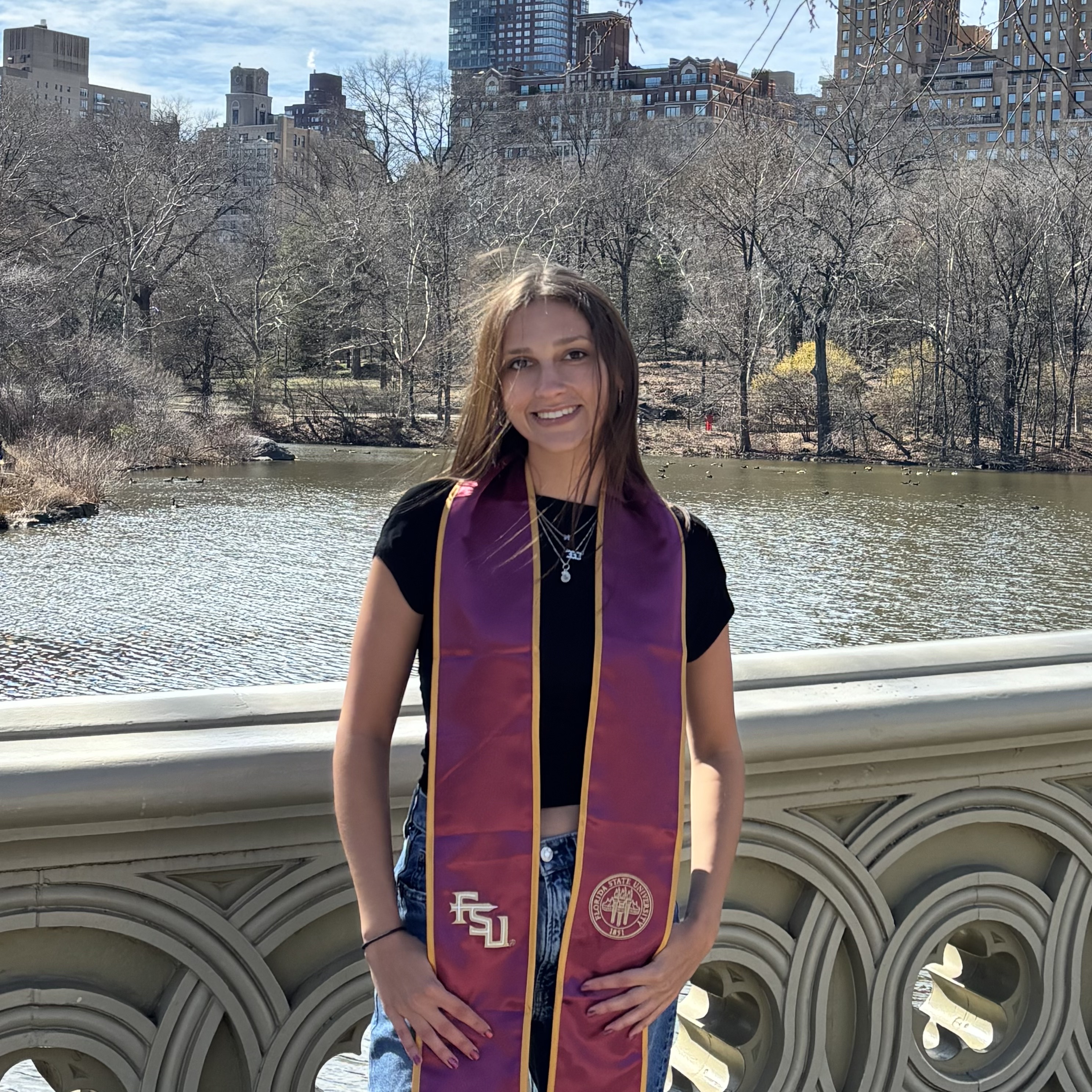
Nina Wallenburg is from Merritt Island, Florida. She is a senior Environmental Chemistry major in the Department of Chemistry & Biochemistry with a double minor in Mathematics and History. She has been in Dr. Emily Stewart's lab since 2024 and has been a General Chemistry 1 Lab TA in her time at FSU. Her work has been presented at the Triple-Joint Section meeting of the Geological Society of America. She hopes to continue research work involving isotopic analysis and geochemistry in the future.
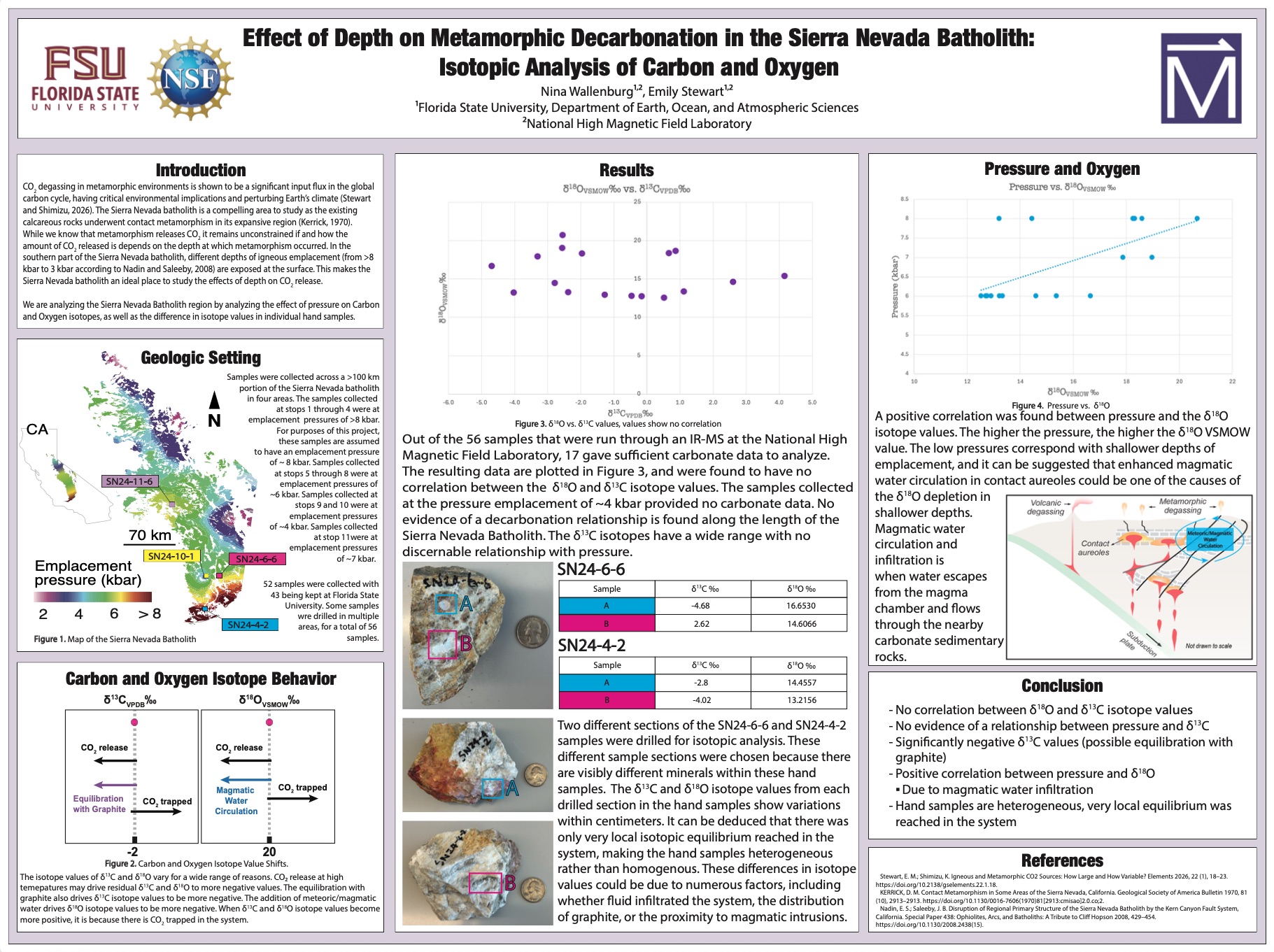
Effect of Depth on Metamorphic Decarbonation in the Sierra Nevada Batholith: Isotopic Analysis of Carbon and Oxygen
Authors: Nina Wallenburg, Emily StewartStudent Major: Environmental Chemistry
Mentor: Emily Stewart
Mentor's Department: Earth, Ocean, and Atmospheric Sciences Mentor's College: Arts & Sciences Co-Presenters:
Abstract
CO2 degassing in metamorphic environments is shown to be a significant input flux in the global carbon cycle, having critical environmental implications and perturbing Earth’s climate (Stewart et al, 2026). The Sierra Nevada batholith is a compelling area to study as the existing calcareous rocks underwent contact metamorphism in its expansive region (Kerrick, 1970). While we know that metamorphism releases CO2, it remains unconstrained if and how the amount of CO2 released depends on the depth of metamorphism. In the southern part of the Sierra Nevada batholith, different depths of igneous emplacement (from >8 kbar - 3 kbar according to Nadin and Saleeby, 2008) are exposed at the surface. This makes the Sierra Nevada batholith an ideal place to study the effects of depth on CO2 release.
We aim to test the hypothesis that as rocks undergo metamorphism at greater depths, the amount of CO2 degassed is smaller, as more of the CO2 is trapped. Through analysis by mass spectrometry at the National High Magnetic Field Laboratory and geochemical techniques, we will report the 13C and 18O isotope values across a range of samples from different depths (3 kbar - >8 kbar). We will compare the isotope values between samples and literature values, interpreting that samples with higher positive isotope values degassed less CO2 and/or experienced less interaction with magmatic fluid. We hypothesize that the samples that underwent metamorphism at deeper depths (>8 kbar) will record higher positive isotope values than those that underwent metamorphism at shallower depths (3-5 kbar).
Keywords: Chemistry, Geology, Metamorphic Petrology, Geochemistry, Isotopes