
Research Symposium
26th annual Undergraduate Research Symposium, April 1, 2026
Samantha Bell Poster Session 2: 10:45 am - 11:45 am / Poster #50

BIO
Samantha Bell is an undergraduate researcher in inorganic and materials chemistry at Florida State University under Dr. Geoffrey Strouse, working on high-entropy materials for catalysis and induced chiral quantum dot systems. Her research integrates materials synthesis with advanced characterization techniques, including SEM/EDS, powder X-ray diffraction (pXRD), X-ray fluorescence (XRF), Fourier Transform Infrared Spectroscopy (FTIR), Ultraviolet–visible (UV-Vis) spectroscopy and Circular Dichroism (CD) spectroscopy, to investigate structure- property relationships in functional materials. She is currently pursing a Bachelor of Science in Biochemistry. Samantha is currently pursuing a Bachelor of Science in Biochemistry and plans to continue her studies with a PhD in Materials Science at the University of North Carolina at Chapel Hill, specializing in inorganic and physical chemistry.
Synthesis of High-Entropy Metal Sulfide Nanocrystals from Prussian Blue Analogues for Water-Splitting Catalysis
Authors: Samantha Bell, Dr. Geoffrey StrouseStudent Major: Biochemistry
Mentor: Dr. Geoffrey Strouse
Mentor's Department: Professor, Chemistry and Biochemistry. Director, Institute of Molecular Biophysics Mentor's College: College of Arts and Science Co-Presenters:
Abstract
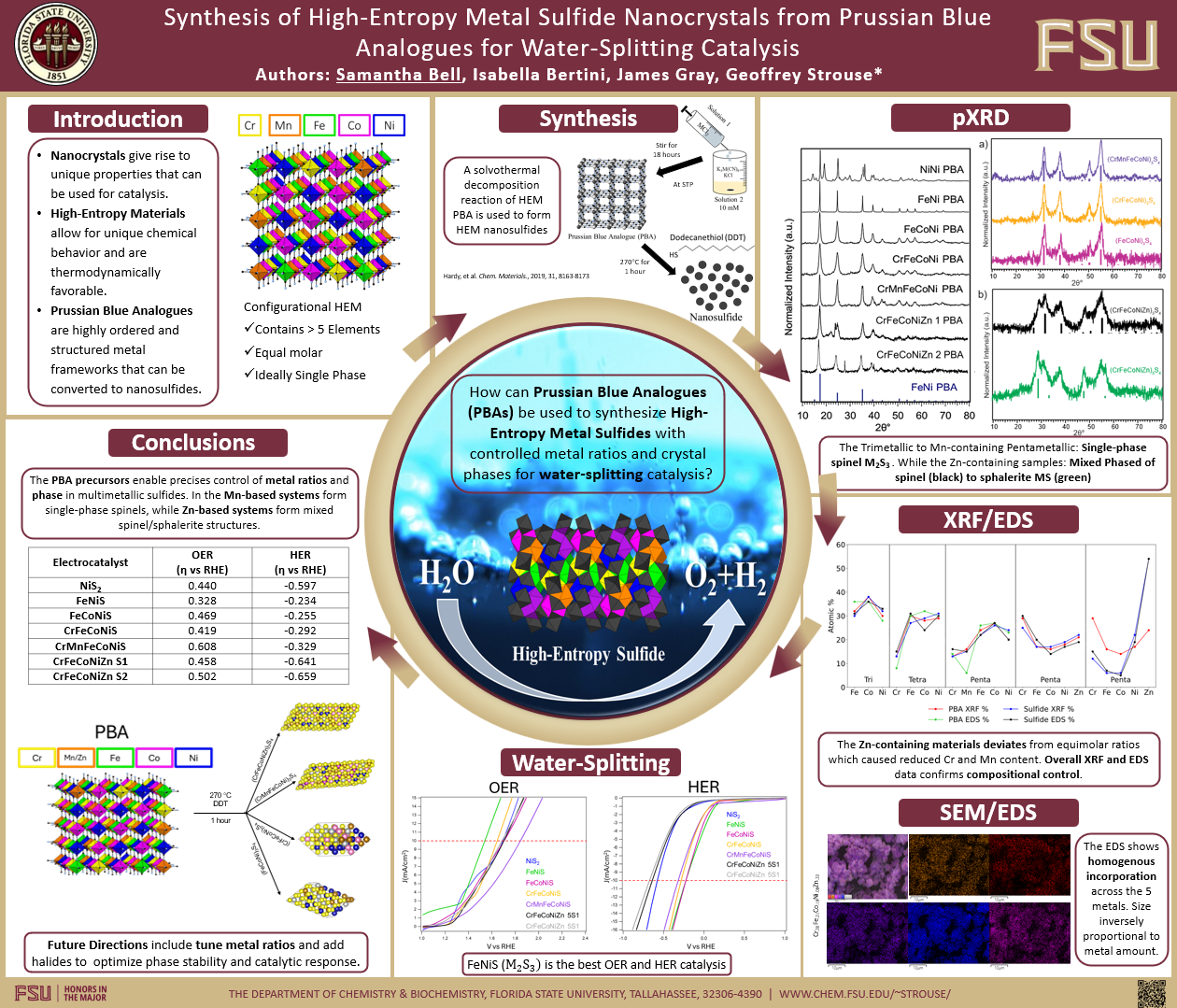
High-entropy (HE) metal sulfides are emerging as promising electrocatalysts due to their tunable composition and synergistic multimetal interactions. Here, we report a colloidal strategy for synthesizing spinel-phase HE sulfide nanocrystals via high-temperature decomposition of equimolar Prussian blue analogues (PBAs) in dodecanethiol. This single-source precursor approach preserves metal stoichiometry from precursor to product, enabling precise compositional control across mono- to quintametallic systems.
CrMnFeCoNi sulfides form a single-phase spinel structure, while incorporation of Zn induces composition-dependent mixed spinel/sphalerite phases. Density functional theory (DFT) calculations support the thermodynamic stabilization of these multicomponent systems and indicate that phase evolution is governed by enthalpic contributions. Electrocatalytic measurements reveal that simpler compositions, particularly FeNiS, exhibit superior HER activity under equimolar conditions, emphasizing the importance of phase purity and composition over increasing configurational complexity alone.
Substitution of Mn with Zn produces distinct trends in catalytic behavior, with Zn-containing systems showing improved HER and OER overpotentials relative to their Mn analogues. These results highlight the critical role of specific metal identity and composition, demonstrating that catalytic performance arises from both elemental effects and multimetal interactions rather than high-entropy design alone.
These results establish HE-PBAs as versatile and scalable precursors for the synthesis of multimetal sulfide nanocrystals with tunable composition and phase, providing a foundation for the rational design of next-generation catalytic materials.
Keywords: High-entropy, Sulfides, Water-splitting, Catalysis