
Research Symposium
26th annual Undergraduate Research Symposium, April 1, 2026
Julia Martin Poster Session 1: 9:30 am - 10:30 am / Poster #135
BIO
Julia Martin is a senior biomedical engineering student from Auburn, New Hampshire, with a strong interest in biomedical device development and instrumentation. Experienced in signal processing and experimental design, including participation in the 2025 National High Magnetic Field Laboratory REU.
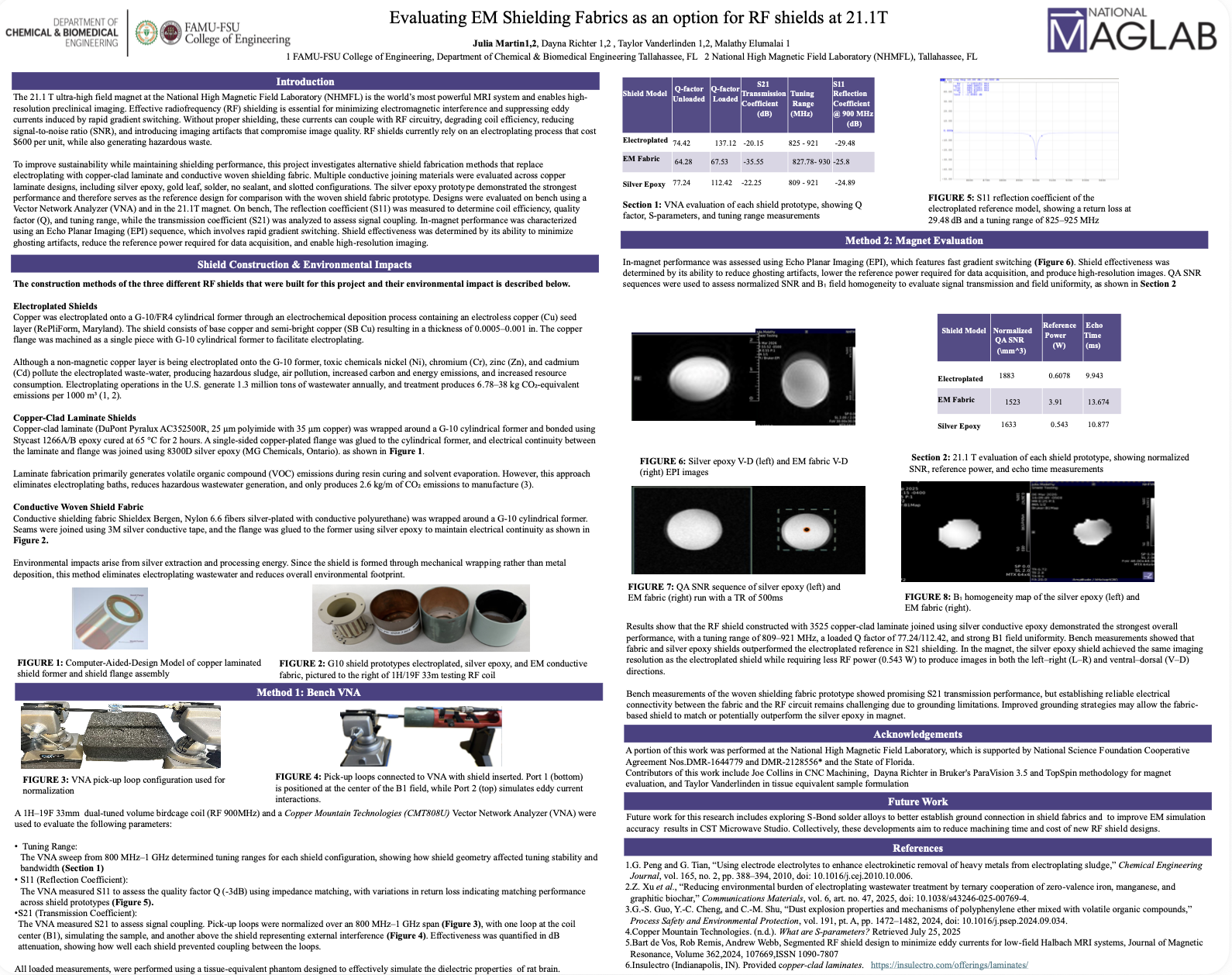
Evaluating EM Shielding Fabrics as an option for RF shields at 21.1T
Authors: Julia Martin, Malathy ElumalaiStudent Major: Biomedical Engineering
Mentor: Malathy Elumalai
Mentor's Department: CIMAR/NMR Mentor's College: National High Magnetic Field Laboratory Co-Presenters:
Abstract
The 21.1T at NHML is the world’s strongest magnet for MRI. This project focuses on alternatives to $600 electroplated RF shields used in MRI coils. Effective RF shielding minimizes electromagnetic interference and suppresses eddy currents induced by rapid gradient switching. Without shielding, eddy currents couple with RF circuitry which leads to low SNR, reduced efficiency, and increased artifacts.
Five shield prototypes were developed with copper laminates joined by 2mm seam made of silver conductive epoxy, solder, gold leaf, a slotted shield with capacitors and no sealant. Each design was evaluated through simulation, bench testing, and magnet performance.
The most recent advancement was the development of an EM shield using Shieldex Berlin RS conductive woven fabric (Bremen, Germany) composed of 100% polyamide (Nylon 6.6). The fabric is silver-plated with a material composition of 60% polyamide, 14% silver, and 26% conductive polyurethane with an average surface resistivity of 0.3 Ω and a shielding effectiveness of 62 dB at 900 MHz (0.9 GHz). The 2 mm longitudinal seam was electrically bridged using conductive electrical tape from 3M (Maplewood, Minnesota) and the top flange with MG Chemicals 83300D Silver Conductive Epoxy (Burlington, Ontario) to ensure continuous conductivity across the shield.
EM simulations were conducted using CST using a dual-tuned ¹H–¹⁹F birdcage coil model at 900 MHz. Bench testing with a VNA evaluated S-parameters like S11, S21, tuning range, and quality factor. MRI performance was assessed in the 21.1T using EPI and QA SNR sequences, analyzing ghosting artifacts, reference power, SNR, and B1 homogeneity.
Keywords: RF shields, Bioinstrumentation, MRI