
Research Symposium
26th annual Undergraduate Research Symposium, April 1, 2026
Brittany Alvarado Poster Session 1: 9:30 am - 10:30 am / Poster #237
BIO
Brittany Alvarado is a second-year Applied Mathematics major at Florida State University, with a minor in Physics. As a first-generation college student, Brittany values finding mentorship and representation in spaces where she can contribute to work she is passionate about. Her laboratory coursework sparked a deep curiosity about the role of quantum behavior in matter and quantum computing. Through her academic experiences, she was introduced to the Hill Group’s research on qubit systems studied using EPR spectroscopy, which further strengthened her interest in experimental quantum science. Brittany is eager to explore spin–spin relaxation and quantum materials, and contributing to the development of emerging quantum technologies. She plans to pursue a career in the quantum technology sector while continuing to engage in research. Beyond academics, she brings strong problem-solving and analytical skills from managing her own videography business. In her free time, she enjoys photography, hiking, and participating in fitness clubs.
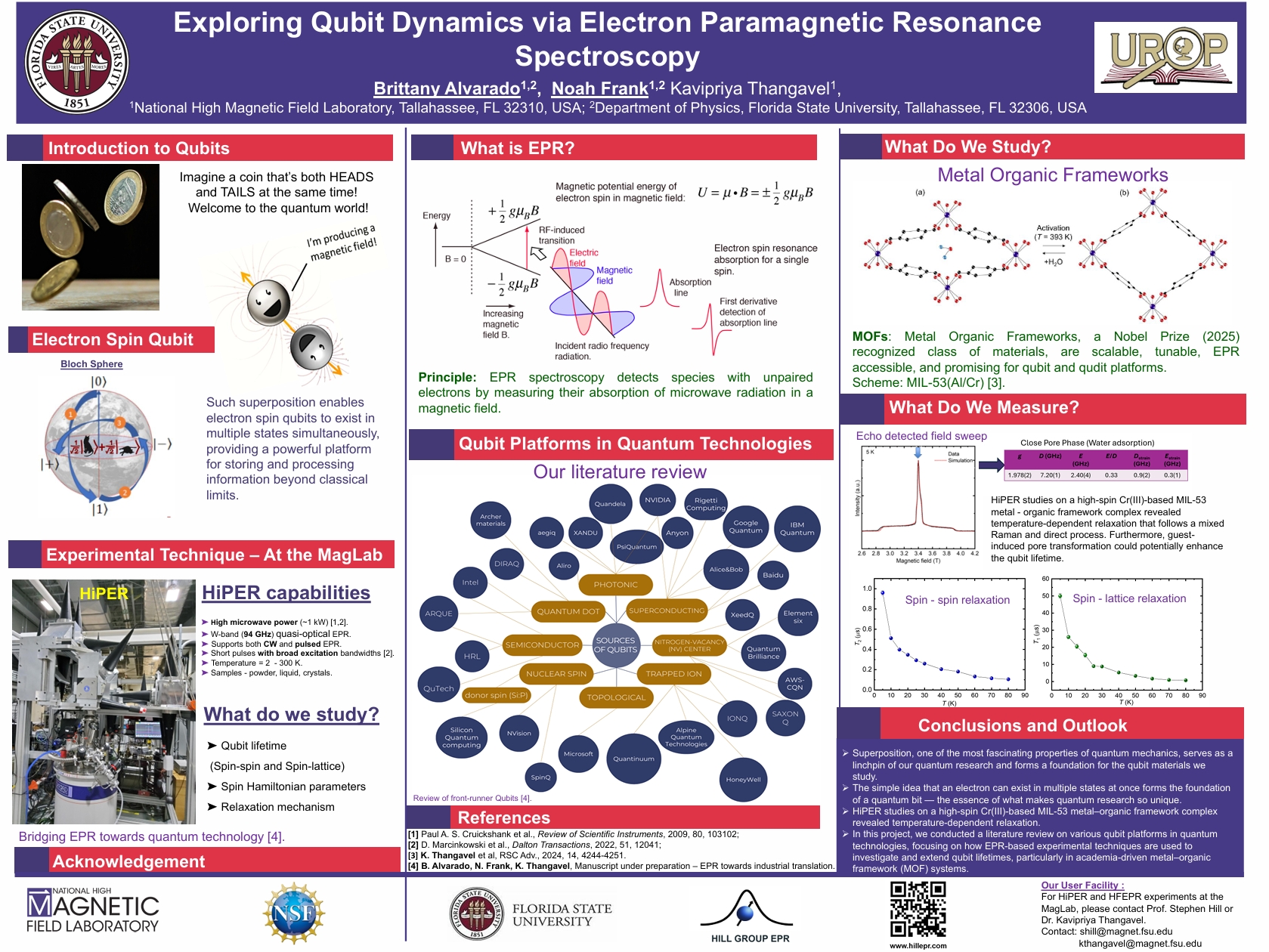
Exploring Qubit Dynamics via Electron Paramagnetic Resonance Spectroscopy
Authors: Brittany Alvarado, Dr. Kavipriya ThangavelStudent Major: Applied Mathematics
Mentor: Dr. Kavipriya Thangavel
Mentor's Department: Department of Condensed Matter Science Mentor's College: Natl High Magnetic Field Lab Co-Presenters: Noah Frank
Abstract
he intrinsic spin of an electron generates a magnetic dipole moment, in which it interacts with an external magnetic field. This is the fundamental property that allows spin-based qubits. We achieve a level of coherent control in single molecular magnets, with ligands tuning its magnetic environment for quantum memory. Electron Paramagnetic Resonance (EPR) spectroscopy provides a direct probe of unpaired electron spins, making it uniquely suited for identifying, characterizing, and understanding electron spin - based qubit platforms, as well as their relaxation mechanisms, pathways, and associated intricacies. EPR enables the direct extraction of key spin-Hamiltonian parameters and coherence metrics, such as spin–lattice relaxation times (T1) and coherence time (T2). Coherent spin control is demonstrated through Rabi pulse sequences analyzed from a "rotating frame" that moves with the spin so that we may extract results clearer. Echo sequences and field sweep measurements evaluate coherence and local geometric and electronic environments. This research is investigating the quantum effects and a means to store information at the molecular level. Metal-organic frameworks provide a tunable and scalable environment for molecular qubits. This research is used for guiding the optimization of molecular design strategies aimed at achieving extended quantum coherence lifetimes. There is a direct translation of the industrial relevance of EPR for qubit development and highlights MOF-based qubits as a promising future platform for quantum technologies. This can be used in logic gates, long range communications, other sensing applications.
Keywords: Physics, Condensed Matter, Quantum