
Research Symposium
26th annual Undergraduate Research Symposium, April 1, 2026
Leo Raden Poster Session 1: 9:30 am - 10:30 am / Poster #177

BIO
Leo Raden is a sophomore at Florida State University Honors College pursuing a Bachelor of Science in Biomathematics. As a student at Florida State University, he integrates quantitative analysis with biological science, developing skills that allow him to approach complex medical and scientific problems from an interdisciplinary perspective.
Leo is a recipient of the prestigious Vires Scholarship, awarded to high-achieving students who demonstrate strong academic potential and leadership within the university community. Through the Honors College, he engages in rigorous coursework and scholarly enrichment opportunities that emphasize research, intellectual curiosity, and academic excellence.
His academic interests lie at the intersection of mathematics, biology, and medicine. By studying biomathematics, Leo seeks to better understand how mathematical modeling and data analysis can be applied to biological systems and healthcare challenges. These experiences support his broader goal of pursuing a career in medicine.
Following the completion of his undergraduate studies, Leo plans to attend medical school, where he hopes to combine his quantitative background with clinical training to improve patient care and contribute to advances in medical science. Through continued academic achievement and engagement in research and service, he aims to build a strong foundation for a future career as a physician.
Text and Word Level Differences in Children's Books by Genre
Authors: Leo Raden, Rebeca VasileStudent Major: Biomathematics
Mentor: Rebeca Vasile
Mentor's Department: Health, and Human Sciences Mentor's College: Anne Spencer Daves College of Education Co-Presenters: Ana De Freitas
Abstract
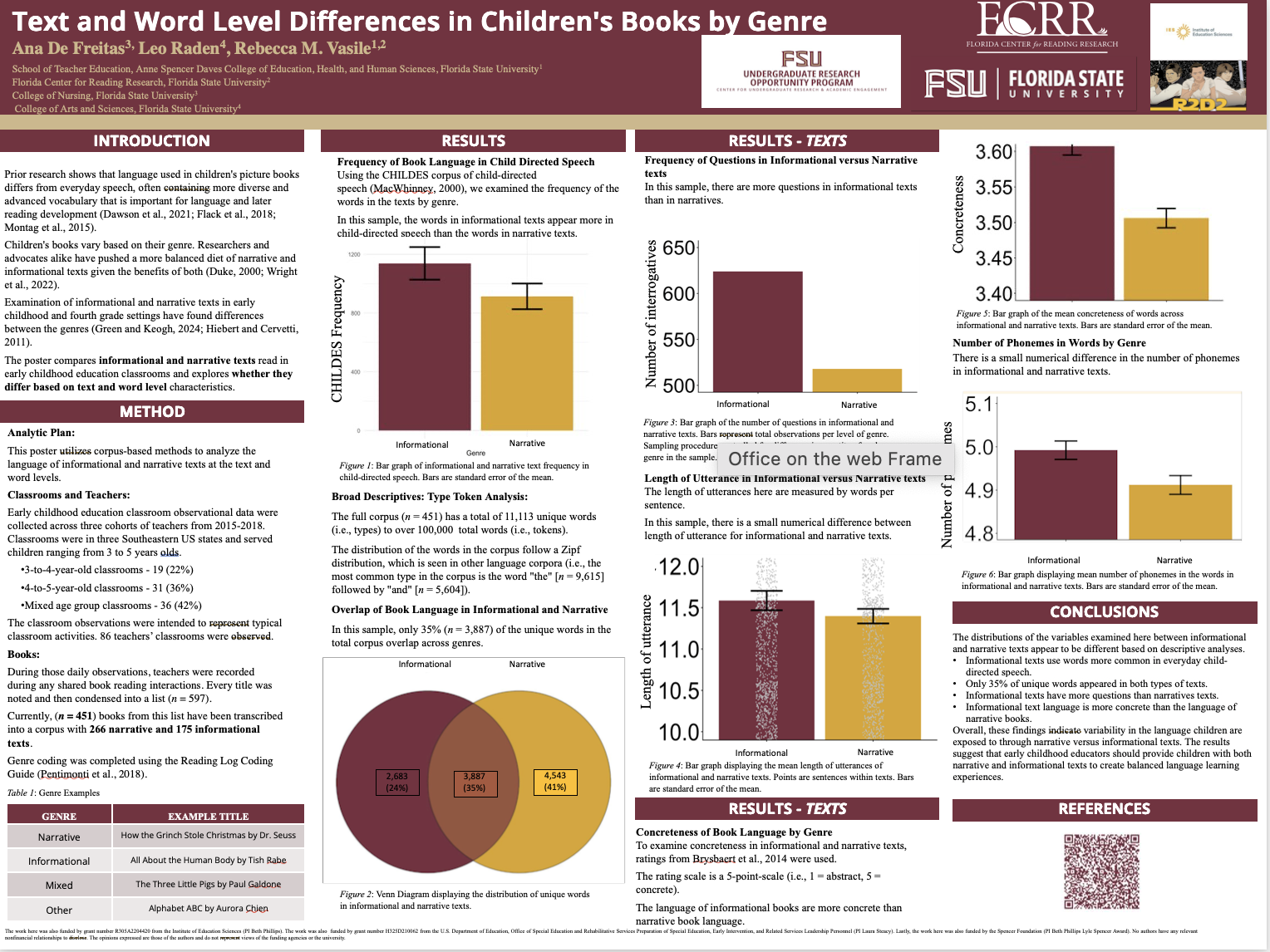
This study compares narrative and informational texts used in early childhood classrooms. Research by Green and Keogh (2024) shows that these genres expose children to different vocabulary and language patterns. However, limited research has examined how the genres differ in specific text- and word-level features, such as frequency in child-directed speech, age of acquisition, and concreteness. Our research question asks: How do narrative and informational texts differ in their text- and word-level features? Understanding these differences is important because children need balanced exposure to both genres to develop strong literacy skills.
We used corpus-based methods to analyze 447 books from 86 preschool classrooms in the southeastern United States, including 264 narrative texts and 171 informational texts. Genre coding was completed using an adapted scheme (Pentimonti et al., 2018) by two graduate students. Each book was transcribed to examine word frequency patterns and features such as frequency in child-directed speech, question use, utterance length, concreteness, and number of phonemes.
Preliminary results show clear genre differences. Narrative texts use words more common in everyday child speech, whereas informational texts include words typical of adult writing. Only 26% of unique words appeared in both genres. Narrative texts also contained more questions than informational texts. These findings highlight differences in language exposure and suggest that educators should provide both genres to support balanced literacy development.
Keywords: Reading, Genre, Book, Literacy