
Research Symposium
26th annual Undergraduate Research Symposium, April 1, 2026
Ramon Morales III Poster Session 4: 3:00 pm - 4:00 pm / Poster #200

BIO
Ramon Morales III, an undergraduate of physics at FSU. He has been interested in learning the mechanics of how the universe has worked, so he has perused studying STEM in Highschool, but he really fell in love with Physics in my senior year, where he decided to pursue a physics path. He joined the UROP program to pursue undergraduate research in his freshman year.
1-Dimesional Random Walk Simulations
Authors: Ramon Morales III, Sandeep JoyStudent Major: Physics
Mentor: Sandeep Joy
Mentor's Department: Physics (Maglab) Mentor's College: FSU Co-Presenters:
Abstract
Random walks are a situation where an object has a randomized probability of moving in a direction on a grid. Random walks can be used to model various phenomena in the field of physics and chemistry, such as the movement of quantum particles or the folding of polymers attempting to arrange themselves. Perlocution theory analyzes how objects move through a porous medium; random walks are crucial for such modeling, which can be represented as a random walk on a lattice of randomly broken parts. To build to this, we must first be able to effectively simulate random walks by current mathematical theory.
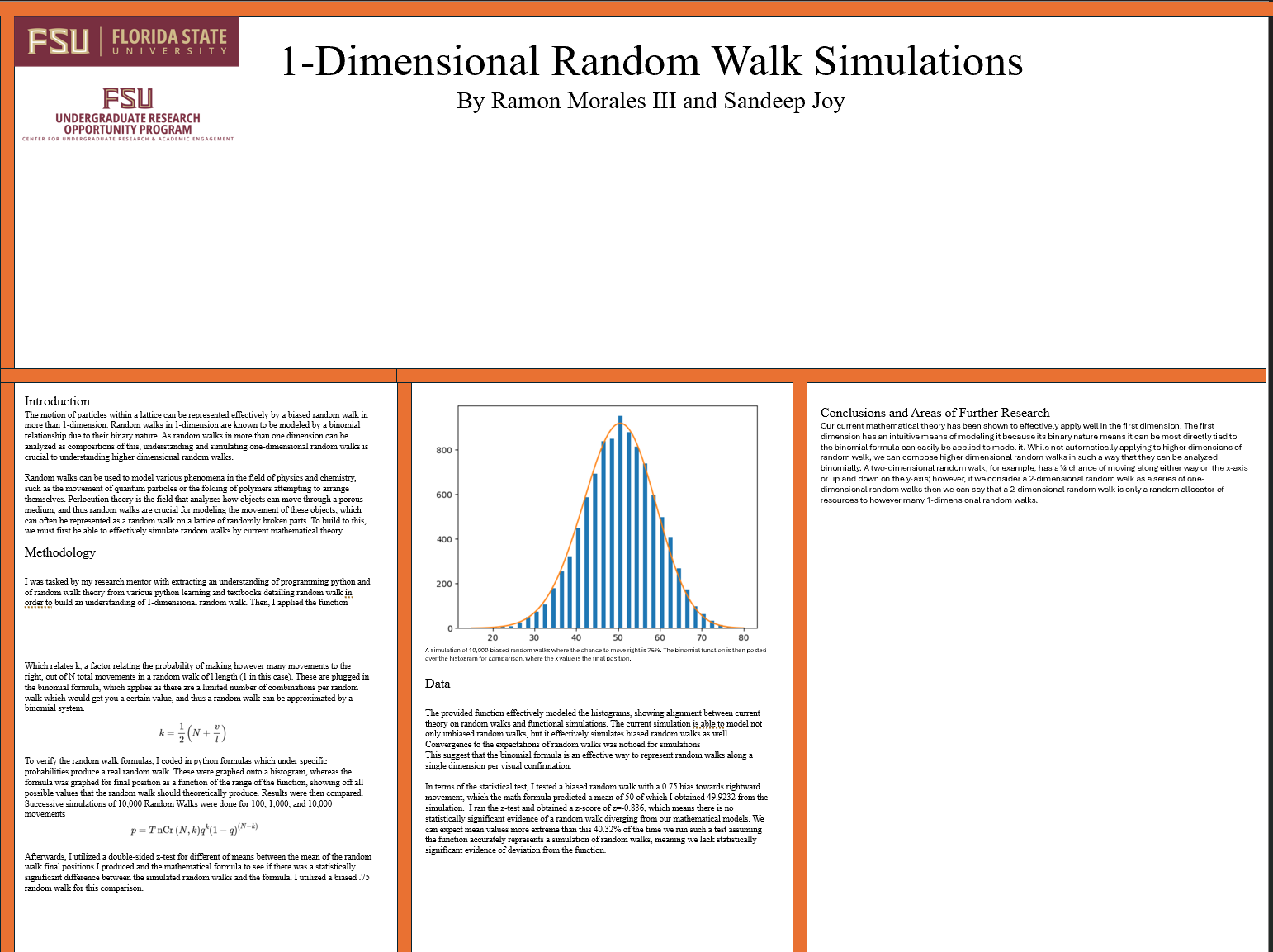
In the course of my research I simulated random walks by constructing a histogram-based python code which simulated a 1 dimensional random walk which either symmetrical, equal chance left or right movement, or bias towards a side. Afterwards, I ran a z-test to see how far my histogram deviated from the mathematical formula in its mean.
Visually, the divergence between the shape of the graph and the area under it represented by the histogram is minimal, suggesting accurate representation. I obtained a z-score of z=-0.836 for the deviation of the mean from the formula, which means there is no statistically significant evidence of a random walk diverging from our mathematical models.
Thus, our current understanding of 1-dimensional random walks are shown to be accurate at predicting random walks in 1-dimension. The simulation can be generalized to the second dimension by applying on 2 variables.
Keywords: Random Walk, Simulation, Coding