
Research Symposium
26th annual Undergraduate Research Symposium, April 1, 2026
Emma Schlotthauer Poster Session 3: 1:45 pm - 2:45 pm / Poster #161

BIO
Emma Schlotthauer is a freshman at Florida State University pursuing a Bachelor of Science degree in cell and molecular neuroscience with a minor in chemistry. Her academic interests include the gut biome interaction with health and pathology, as well as biological and neurological sciences.
At Florida State University, Emma has been actively involved in undergraduate research and scholarly initiatives. She currently conducts research under the mentorship of Cole Patoine, M.S, RDN, and Dr. Ravinder Nagpal, PhD in the Gut Biome Lab, where her work focuses on examining the effects of ultra-processed food intake on gut, oral, and metabolic health in young adults. Through this experience, Emma has developed skills in methodology formulation, data collection, and analytic techniques, while exploring broader questions related to microbiome diversity and gut interactions.
Emma has been recognized for her academic achievements through honors including selection as a Presidential Scholar, participation in the honors program, and recipient of the Seminole Scholar award. She has also directed and implemented a project evaluating resilience in child victims of maltreatment. She participated in a pediatric trauma surgery and nephrology internship, and shadows a gastroenterologist, which has further strengthened her commitment to studying dynamic interactions in the gut and investigating the complex associations between the gut microbiome and systemic health.
Following completion of her Bachelor of Science degree, Emma plans to attend medical school to become a physician. She hopes to continue contributing to translational research and innovation in academic medicine.
The Effect of Ultra-processed Food Intake on Metabolic Health in Young Adults
Authors: Emma Schlotthauer, Cole Patoine M.S, RDNStudent Major: Cell and Molecular Neuroscience
Mentor: Cole Patoine M.S, RDN
Mentor's Department: Department of Health, Nutrition, and Food Sciences Mentor's College: Anne Spencer Daves College of Education, Health, and Human Sciences Co-Presenters:
Abstract
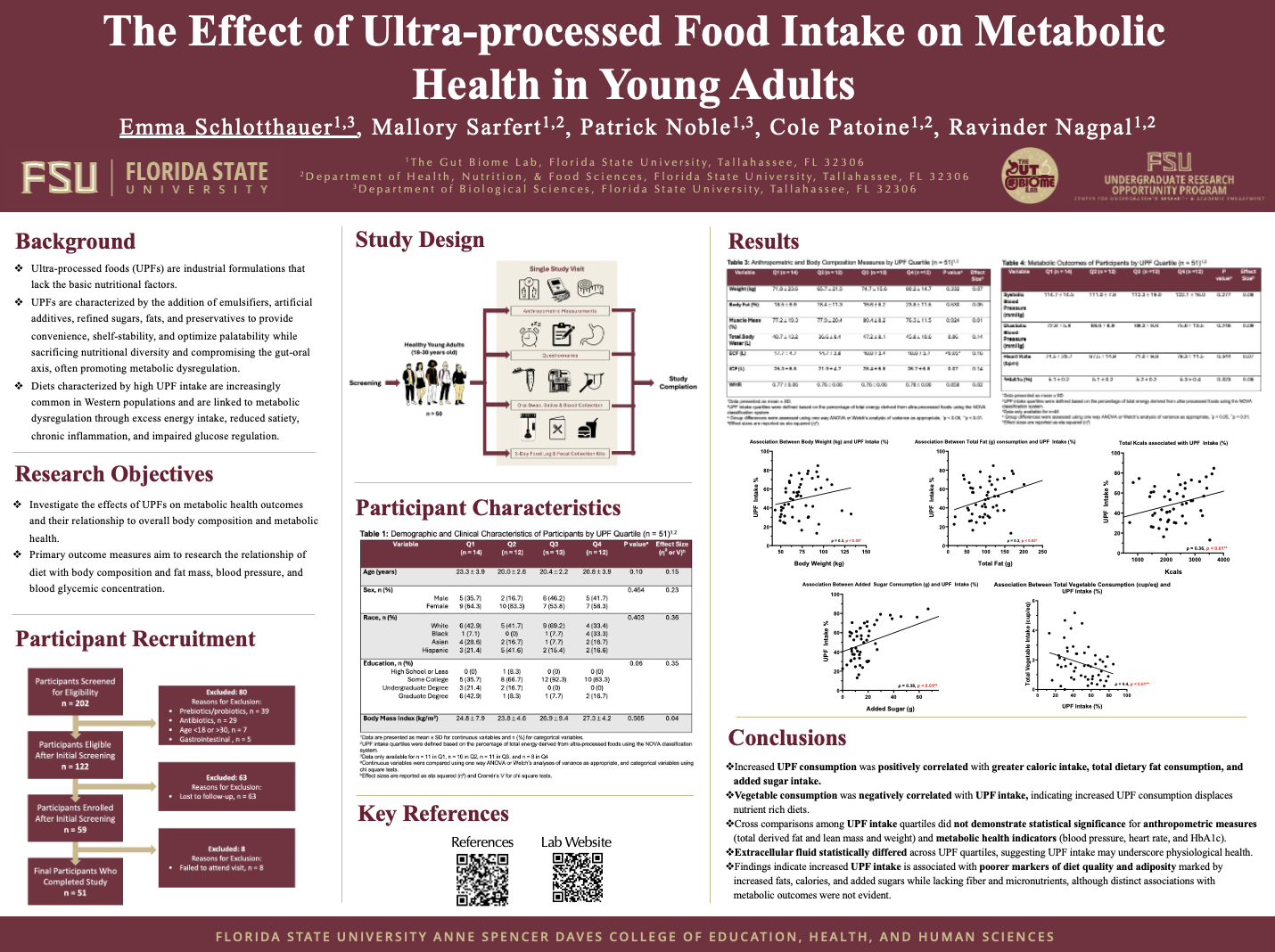
Objectives: Ultra-processed foods (UPFs) are industrial food products formulated for convenience and shelf stability and are typically high in refined sugars, fats and sodium, while low in fiber and micronutrients. Diets high in UPFs are increasingly common among young adults and have been associated with metabolic dysregulation through excess energy intake, reduced satiety, inflammation, and impaired glucose regulation. However, data examining metabolic effects of UPF intake in young adults remain limited. This study evaluated associations between UPF intake, body composition, and metabolic health in young adults.
Methods: This cross-sectional utilized a single study visit to assess metabolic health in 51 young adults. Dietary intake was evaluated using 3-day diet records, and UPF intake was classified according to the NOVA system. Long term glycemic control was measured using fingerstick blood analyzed with an Afinion HbA1c analyzer. Body composition was assessed using bioelectrical impedance analysis. Associations were evaluated using ANOVA across UPF intake quartiles and FDR-corrected Spearman correlations.
Results: Higher UPF intake was associated with poorer diet quality, including greater total energy, fat, and added sugar intake (all p<0.01) and lower vegetable intake (p<0.01). UPF intake was positively correlated with body weight and body mass index (p<0.05). Extracellular fluid volume differed significantly across UPF quartiles (p<0.05). No significant associations were observed between UPF intake and blood pressure, HbA1c, or waist to hip ratio.
Conclusions: Higher UPF intake was associated with poorer diet quality and greater body mass, though clear metabolic dysfunction was not evident in this young adult population.
Keywords: Ultra-processed Foods, Metabolic Health, Microbiome, Nutrition, Diet