
Research Symposium
26th annual Undergraduate Research Symposium, April 1, 2026
Olena Galushko Poster Session 3: 1:45 pm - 2:45 pm / Poster #255

BIO
Olena Galushko is a first-year student at Florida State University pursuing a Bachelor of Science in Computer Science. She is involved in undergraduate research through the Undergraduate Research Opportunity Program, where she works on a project inspired by the Leavitt communication network experiments using AI agents and NVIDIA Jetson Nano Developer Kit units. Her research explores how communication structure affects coordination and problem-solving in multi-agent systems with the goal to develop a game platform with human-AI participants. She is mentored by Dr. Marcos Vasconcelos at the FAMU-FSU College of Engineering. Olena’s academic and research interests include artificial intelligence, large language models, multi-agent systems, and communication networks. She hopes to continue building research experience in AI and computer science to apply these skills in the technology industry.
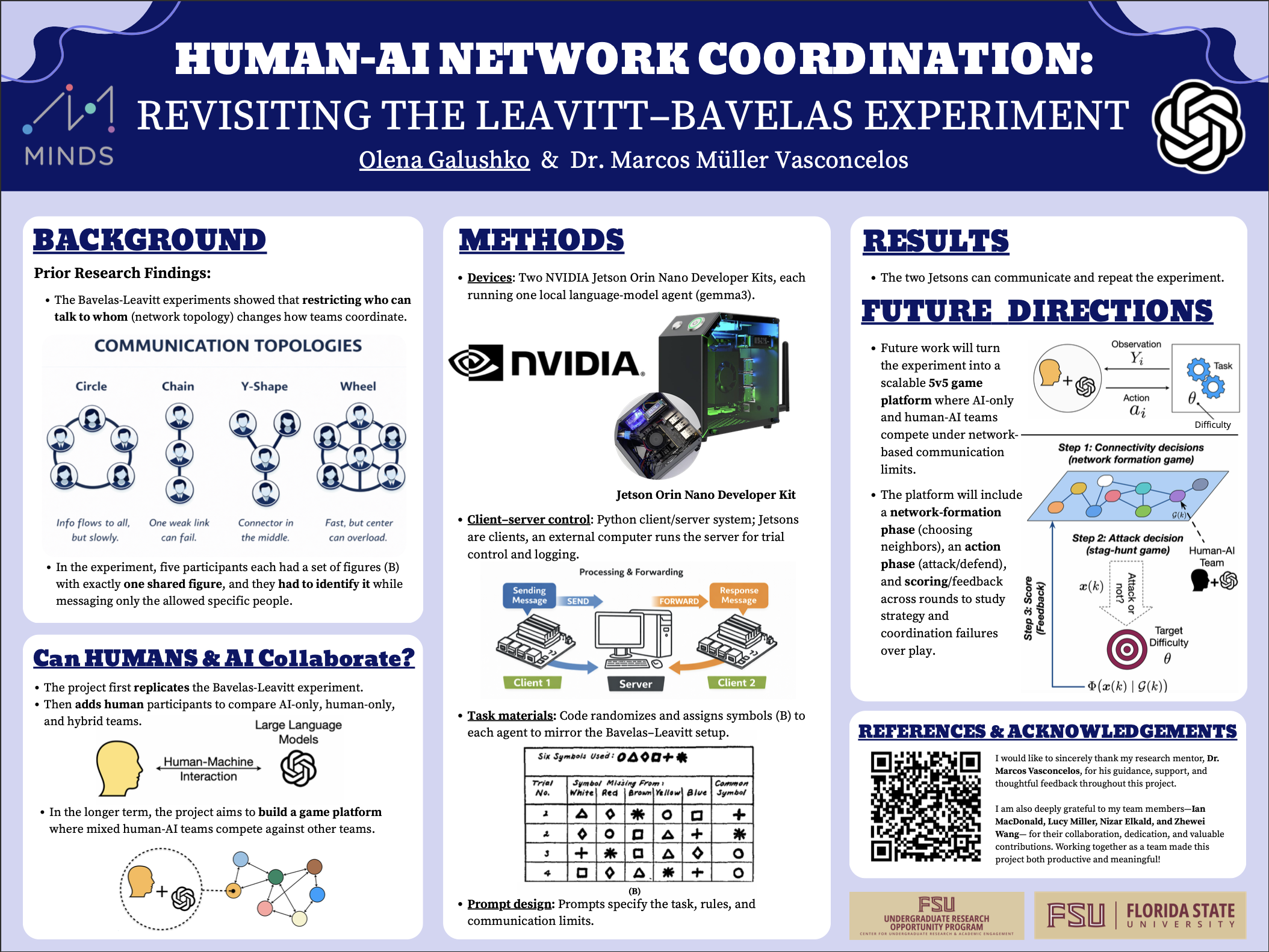
Human-AI Network Coordination: Revisiting the Leavitt–Bavelas Experiment
Authors: Olena Galushko, Dr. Marcos Müller VasconcelosStudent Major: Computer Science
Mentor: Dr. Marcos Müller Vasconcelos
Mentor's Department: Dept. of Electrical and Computer Engineering Florida State University Mentor's College: FAMU-FSU College of Engineering Co-Presenters:
Abstract
As AI becomes more common, it is increasingly used in settings where it must collaborate with people. This project builds a controlled testbed to study that teamwork. The current prototype runs small language model agents on compact computers with direct device-to-device messaging. In each trial, agents get the same task, exchange short messages, and update their decisions. The design adapts the Bavelas-Leavitt communication-network studies by placing agents into fixed network roles and limiting who can communicate with whom. Results are not yet available because the experiment is still being finalized. Long term, the platform will scale to larger networks, add human participants under the same rules, and support more game-like human-AI team scenarios.
Keywords: AI, Communication Networks, Human-AI Collaboration, Machine Learning, Small Language Models, Game