
Research Symposium
26th annual Undergraduate Research Symposium, April 1, 2026
Jolynn Rodriguez Poster Session 3: 1:45 pm - 2:45 pm / Poster #289

BIO
Hi! My name is Jolynn Rodriguez and I am a sophomore at Florida State University, pursuing a degree in Criminology with a minor in Business. I am a member of Phi Alpha Delta Pre-Law Fraternity and I am working towards a future in law. I plan to attend law school and I am eager to pursue my passion for helping and advocating for others. My research project aims to highlight the discrepancies amongst police use of fatal force datasets across multiple crowd sourced reporting systems, such as The Washington Post, Fatal Encounters , and Mapping Police Violence. By comparing and coding specified datasets, my team was able to create a comprehensive dataset that researchers can utilize for understanding and applying police use of fatal force for future research.
Comprehensive Overview on the Data Collections for Police Use of Fatal Force: Implications for Future Research
Authors: Jolynn Rodriguez, Keller SheppardStudent Major: Criminology
Mentor: Keller Sheppard
Mentor's Department: Criminology Mentor's College: Florida State University Co-Presenters: Leila Stemler
Abstract
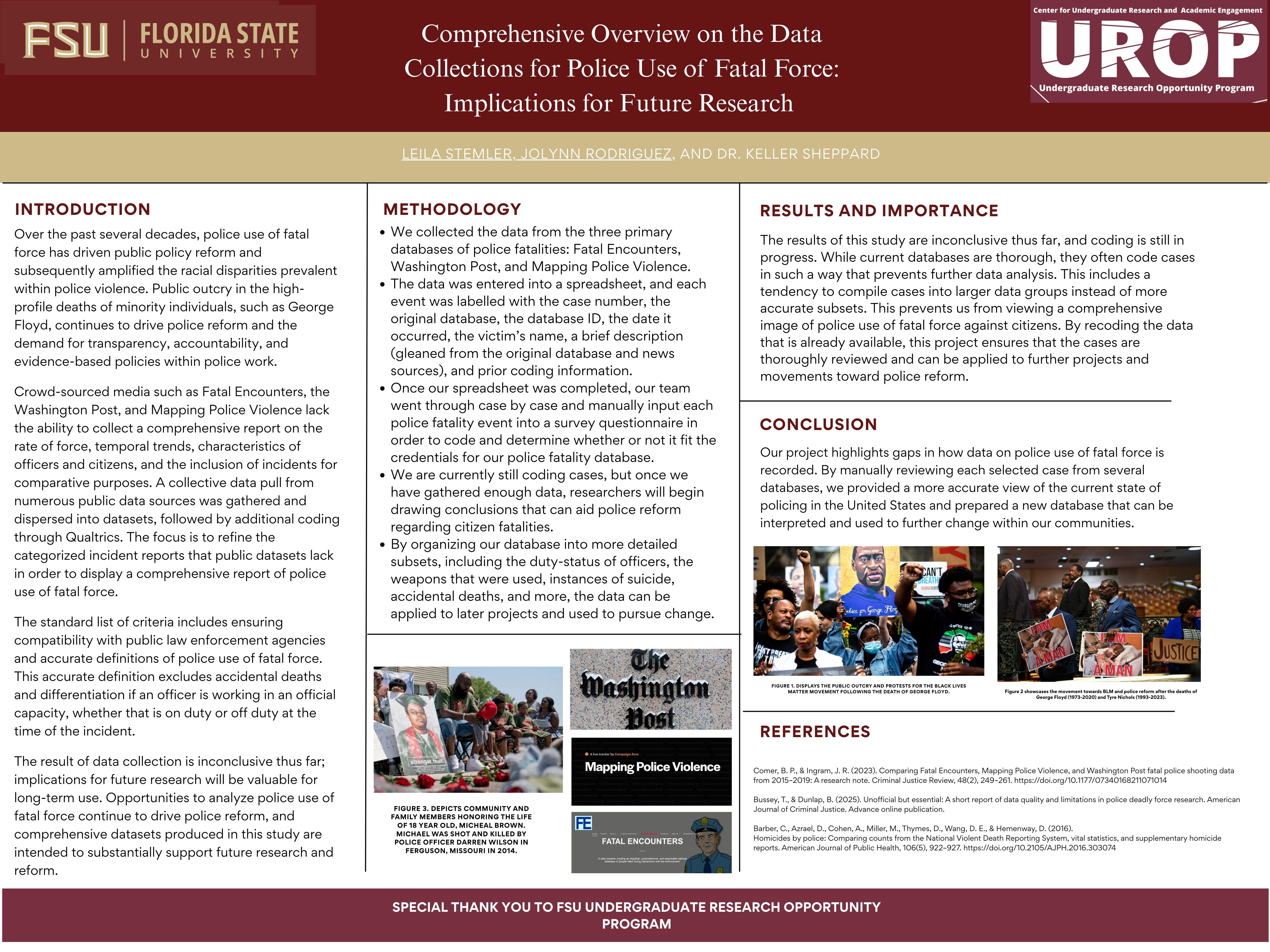
Over the past several decades, police use of fatal force has driven public policy reform and subsequently amplified the racial disparities prevalent within police violence. Public outcry in the high-profile deaths of minority individuals, such as George Floyd, continue to drive police reform and the demand for transparency, accountability, and evidence-based policies within police work. Crowd sourced media such as Fatal Encounters, Washington Post, and Mapping Police Violence lack the ability to collect a comprehensive report on the rate of force, temporal trends, characteristics of officers and citizens, and inclusion of incidents for comparative purposes. A collective data pull from numerous public data sources was gathered and dispersed into datasets, followed with additional coding through Qualtrics. The focus was to refine the categorized incident reports that public datasets lacked in order to display a comprehensive report of police use of fatal force. The standard list of criteria includes ensuring compatibility with public law enforcement agencies and accurate definitions of police use of fatal force. This accurate definition excludes accidental deaths and differentiation if an officer is working in an official capacity, whether that is on duty or off duty at the time of the incident. The result of data collection is inconclusive thus far, however implications for future research will be valuable for long term use. Opportunities to analyze police use of fatal force continue to drive police reform, and comprehensive datasets produced in this study are intended to substantially support future research and reform.
Keywords: police use of force, data collection, fatal force