
Research Symposium
26th annual Undergraduate Research Symposium, April 1, 2026
Finn Johnson Poster Session 1: 9:30 am - 10:30 am / Poster #55

BIO
Finn Johnson is a second-year undergraduate student majoring in Political Science and Interdisciplinary Social Science. He is passionate about urban planning, particularly affordable housing policy. Currently, he is conducting research on Low Income Housing Tax Credits and their relation to socio-demographics in the State of Florida. He is driven by his curiosity and desire to create meaningful change. He plans to continue similar research in graduate school.
Socio-Demographic Data of Opportunity and Non-Opportunity Tracts and Their Relation To LIHTC in Florida
Authors: Finn Johnson, Chao WangStudent Major: Political Science & Interdisciplinary Social Science
Mentor: Chao Wang
Mentor's Department: Urban and Regional Planning Mentor's College: College of Social Sciences and Public Policy Co-Presenters:
Abstract
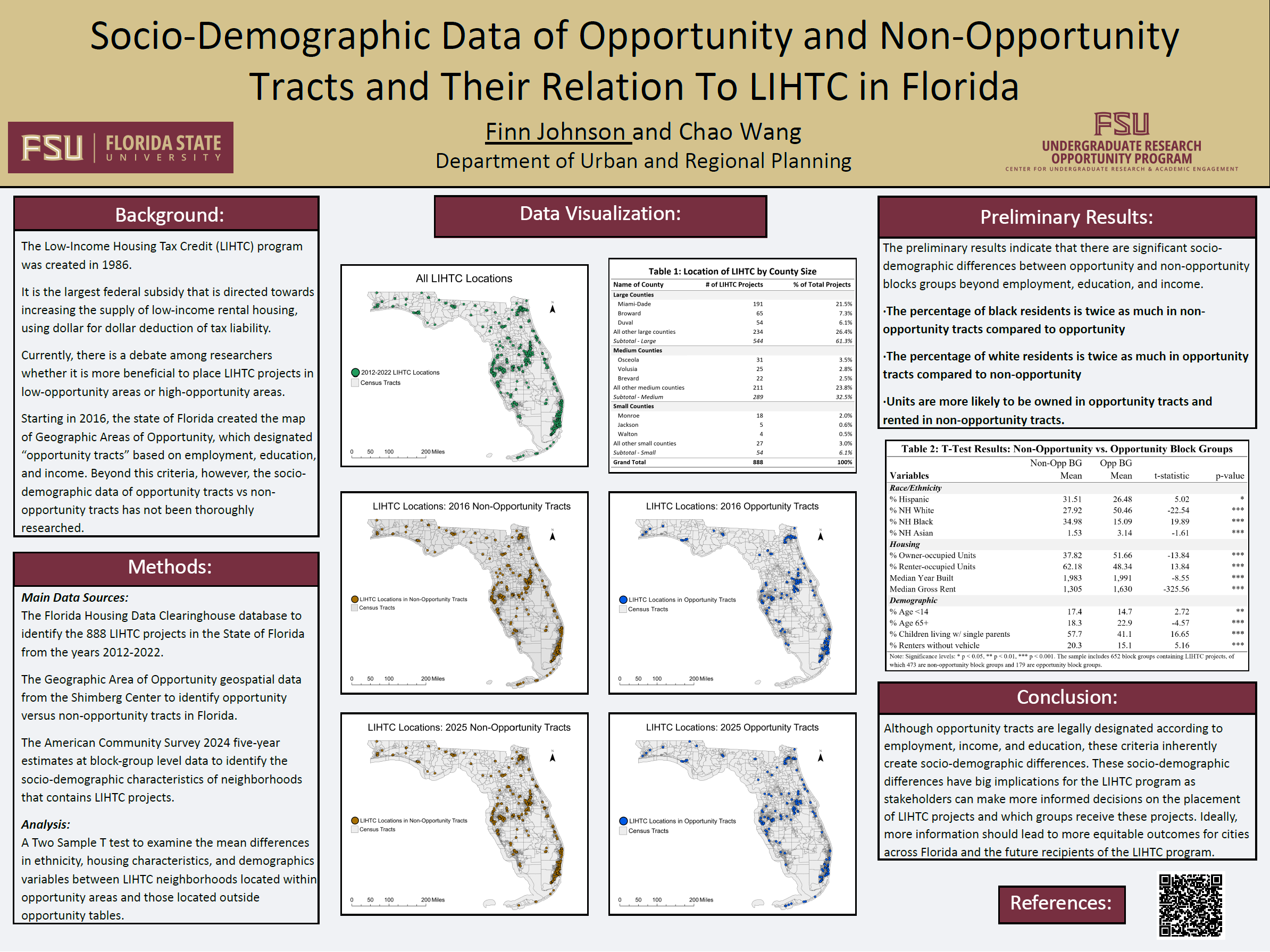
In 1986, the federal government created the Low-Income Housing Tax Credit (LIHTC) program, which is the largest federal subsidy that is directed towards increasing the supply of low-income rental housing, using dollar for dollar deduction of tax liability. Currently, there is a debate among researchers whether it is more beneficial to place LIHTC projects in low-opportunity areas or high-opportunity areas. Moreover, starting in 2016, the state of Florida created the map of Geographic Areas of Opportunity, which designated “opportunity tracts” based on employment, education, and income. This research asks how the socio-demographic and housing characteristics differ between designated opportunity and non-opportunity tracts. This study also aims to explore whether the location patterns of LIHTC projects have shifted after the creation of the 2016 opportunity map. To determine this, we used data from the Florida Housing Data Clearinghouse database and Geographic Area of Opportunity geospatial data from the Shimberg Center to identify the location of LIHTC projects being placed inside vs outside of designated area in the 2016 opportunity map. As the opportunity maps are updated each year by the state government, we ran a robustness test by using the 2025 opportunity map to explore the difference. The preliminary findings suggest that aside from employment, education, and income, opportunity tracts are whiter with higher share of renter occupied units. Further research can look into the differences between 4% and 9% tax credits and if those have been changed and in what ways since 2016.
Keywords: LIHTC, affordable housing, opportunity tracts