
Research Symposium
26th annual Undergraduate Research Symposium, April 1, 2026
David Rodriguez-Garrido Poster Session 4: 3:00 pm - 4:00 pm / Poster #182

BIO
David R.G. is a first-year undergraduate student at Florida State University pursuing a Bachelor of Science in Political Science and intends to double major in Economics. As a Quest Scholar and a first-generation college student, he is committed to academic excellence and using education as a pathway to create meaningful change in his community.
In addition to his coursework, he participates in the Undergraduate Research Opportunity Program (UROP) at Florida State University. Through this program, he contributes to a research project analyzing Bollywood films directed by women, focusing on how gender roles, cultural expectations, and social class are portrayed through clothing and visual representation. This research experience has allowed him to develop analytical, research, and collaborative skills, as well as to learn about Hindi culture while working alongside Dr. Rebecca Peters and colleagues.
David R.G. plans to attend law school after completing his undergraduate studies with the goal of becoming a family lawyer. He hopes to use his legal education to support and advocate for families, especially single mothers, who are navigating complex legal and emotional challenges. Through his studies in Political Science and Economics, he aims to build a strong foundation in law, policy, and social systems that will prepare him for a career dedicated to serving the community and strengthening familial relations.
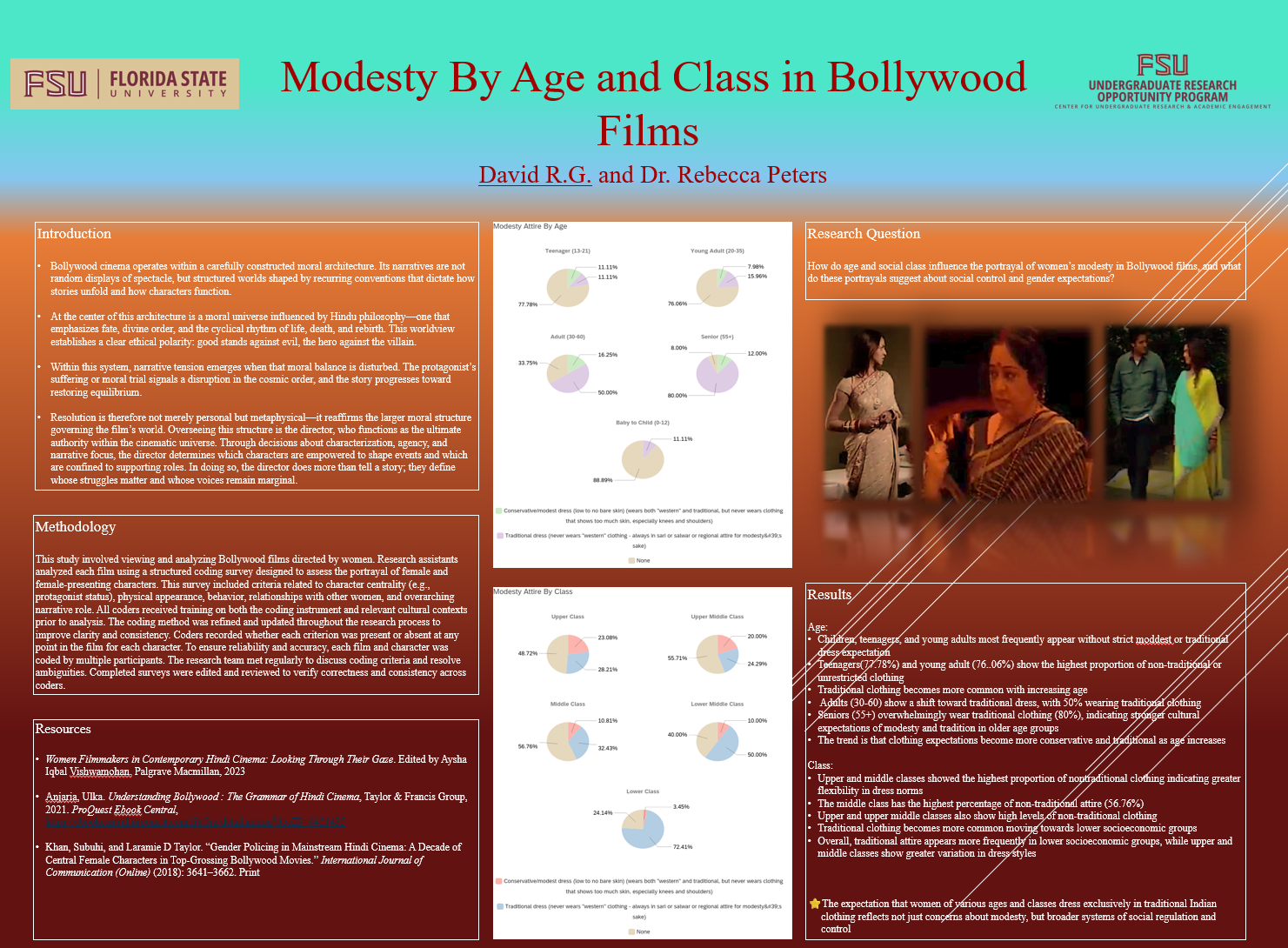
Modesty By Age and Class in Bollywood Films
Authors: David Rodriguez-Garrido, Rebecca PetersStudent Major: Political Science
Mentor: Rebecca Peters
Mentor's Department: Department of Religion Mentor's College: College of Arts and Sciences Co-Presenters:
Abstract
This study involves viewing and analyzing Bollywood films directed by women. Research assistants analyzed each film using a structured coding survey designed to assess the portrayal of female and female-presenting characters. This survey includes criteria related to character centrality (e.g. protagonist status), physical appearance, behavior, relationships with other women, and overarching narrative role. All coders received training on both the coding instrument and relevant cultural contexts prior to analysis. The coding method was refined and updated throughout the research process to improve clarity and consistency. Coders recorded whether each criterion was present or absent at any point in the film for each character. To ensure reliability and accuracy, each film and character was coded by multiple participants. The research team met regularly to discuss coding criteria and resolve ambiguities. Completed surveys were edited and reviewed to verify correctness and consistency across coders. Preliminary results based on the first seven films analyzed reveal notable patterns in the portrayal of women. Across social classes, wheatish skin tone was most represented, with darker skin tones appearing more frequently among lower-class characters. Unexpectedly, upper-class women exhibited an even distribution of white, fair, dusky, and wheatish skin tones, challenging traditional Bollywood associations between skin tone and class. Most female characters did not engage in taboo behaviors; however, when present, openly flirting and dating were the most common, particularly among young adult characters. The results suggest that women directors may contribute to more diverse and less traditional representations of women in Bollywood.
Keywords: Bollywood, Modesty, Films