
Research Symposium
26th annual Undergraduate Research Symposium, April 1, 2026
Aiden Vick Poster Session 3: 1:45 pm - 2:45 pm / Poster #3
BIO
Hello, my name is Aiden Vick, and I am a first year Cell and Molecular Neuroscience student planning on attaining a dual degree in Exercise Physiology. I am originally from Orlando, Florida. My research is on red tide and the impacts it creates on public health most notably respiratory health decline. Beyond research I like to golf, workout, and play with my two French bulldogs (Maple and Suki). In the future I hope to attend medical school and become a physician. I am currently very interested in the anesthesia specialty but have a very open mind looking forward.
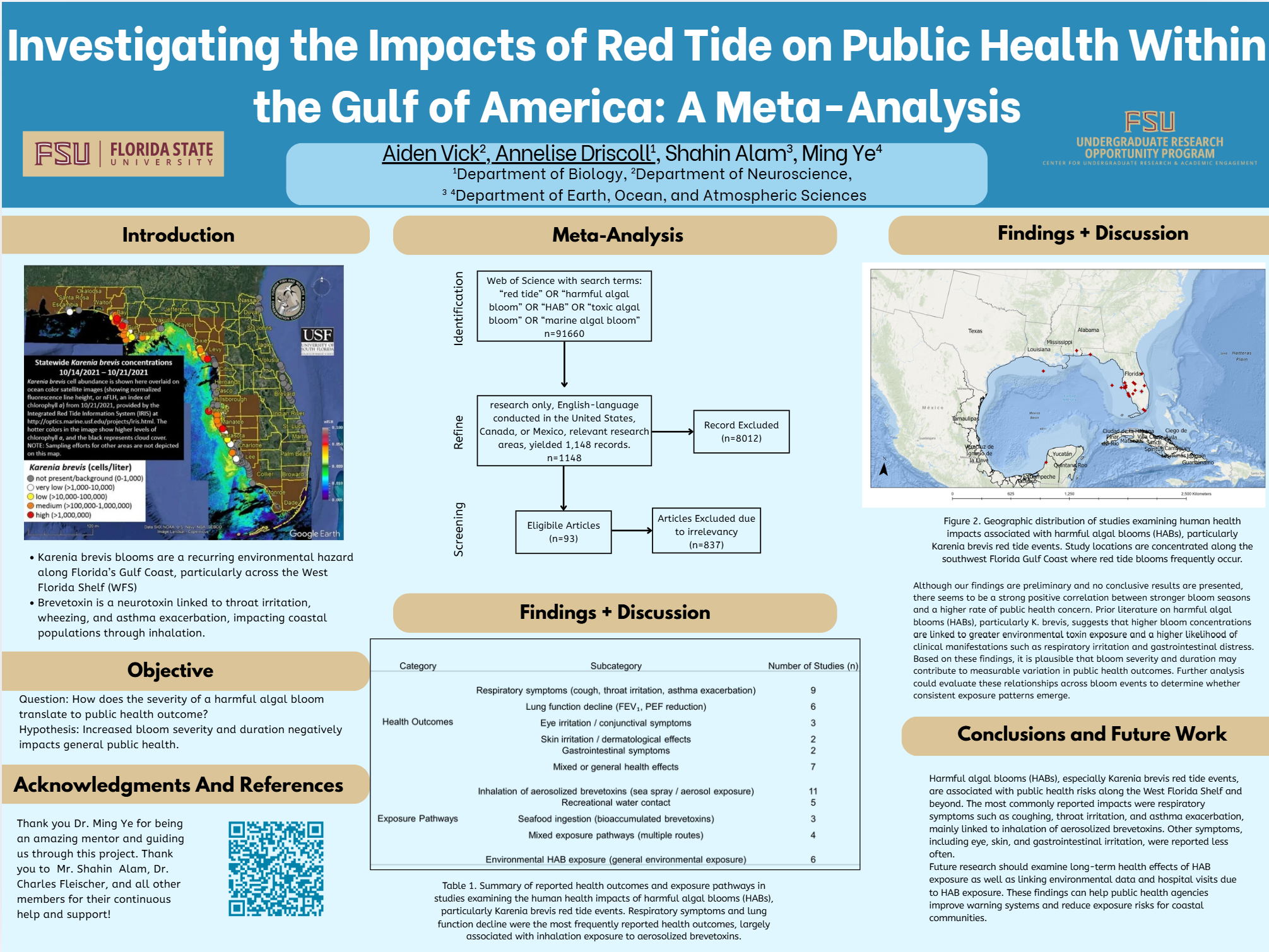
Investigating the Impacts of Red Tide on Public Health Within the Gulf of America: A Meta-Analysis
Authors: Aiden Vick, Ming YeStudent Major: Cell and Molecular Neuroscience
Mentor: Ming Ye
Mentor's Department: Department of Earth, Ocean, and Atmospheric Sciences Mentor's College: College of Arts and Science Co-Presenters: Annelise Driscoll
Abstract
Red tide, a form of harmful algal bloom (HAB) is a very prevalent natural phenomenon along Florida's gulf coast. While the cause of red tide is widely understood and backed by science, the clinical outcomes are much less studied giving a gray area. This study's purpose is to highlight how differing proximity and concentration of HABs impact human health outcomes such as respiratory health and gastrointestinal distress. By conducting a meta-analysis along the West Florida Shelf we analyzed 62 peer reviewed articles screened by specific keywords such as “HAB” and “red tide” within the timeframe from 2006-2025 we are able to gain a greater understanding of red tide and its public health impacts. Through using non-identifying patient data we hope to correlate real visits to the HAB blooms at different times of the year. By using multiple methods, from previously published studies to clinical data collection, we hope to clear this gray area or gap of knowledge between the scientific and medical hemispheres. While we are yet to obtain any findings the team expects there to be a positive correlation between red tide bloom events and public health. This would call attention to the significance of red tide as an environmental hazard and promote solutions such as area specific alerts when concentrations are above a certain threshold, warning of public health risks.
Keywords: Biology, Evironmental Hazard, Marine Biology, Earth Science, Environmental Science