
Research Symposium
26th annual Undergraduate Research Symposium, April 1, 2026
Guadalupe Figueroa Poster Session 1: 9:30 am - 10:30 am / Poster #1
BIO
My name is Guadalupe, but I go by Lupe for short. I am a sophomore at Florida State University, double-majoring in Public Health and Psychology. As a first-generation college student, I am determined to use my education to support others, particularly those who face language barriers in accessing care and resources. I am originally from Clewiston, Florida, a small town in South Florida located south of Lake Okeechobee. I stand for cultural awareness, and I aspire to become a psychiatric nurse, where I aim to expand my passion for mental health and advocacy to provide accessible care to diverse populations.
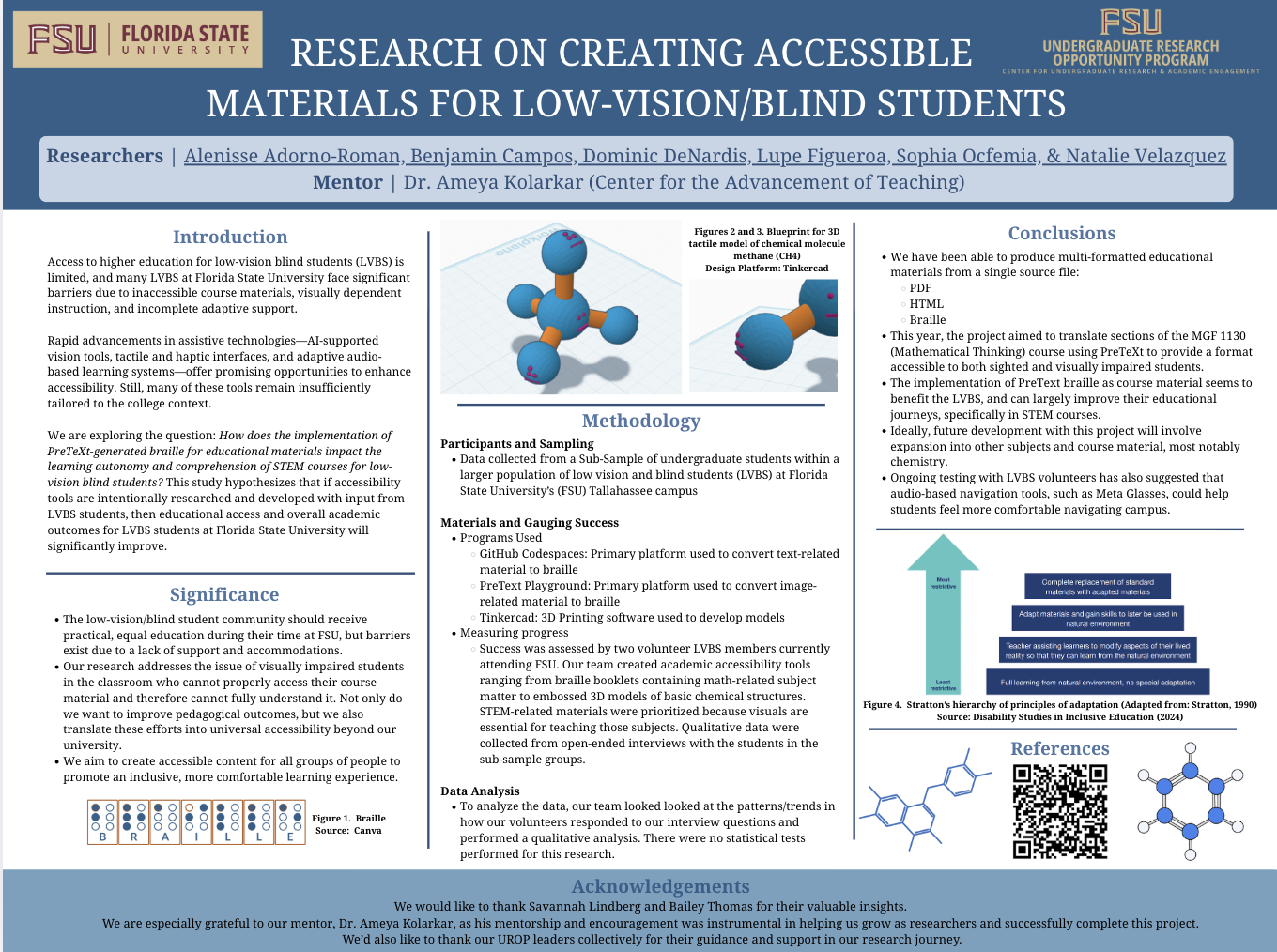
Research on Creating Accessible materials for low-vision/blind students
Authors: Guadalupe Figueroa, Ameya KolarkarStudent Major: Public Health and Psychology
Mentor: Ameya Kolarkar
Mentor's Department: FSU Department of Mathematics Mentor's College: FSU Department of Mathematics Co-Presenters: Natalie Velazquez, Dominic Denardis, Benjamin Campos, Alenisse Adorno-Roman
Abstract
As we make progress in improving accessibility and equitable education for students with disabilities, we can do much more to develop an education system that accommodates all. We were investigating what accessibility tools can be researched or developed to assist low-vision and blind students (LVBS) at FSU.
About a decade ago, researchers and teachers began implementing the use of 3-D printing to create tactile models for visually impaired students. Our team has added to these efforts by using coding and the PreTeXt format to translate core math units into multiple formats including braille. We are also exploring the use of Meta AI glasses, giving the LVBS audio instructions to map commonly walked routes. Our data results from the feedback of FSU LVBS, who volunteer their time to test out the accessibility tools we work on.
While splitting up coding efforts, there was trial and error when configuring the programming. Once we code each of our sections individually, they are compiled into a single book that is then converted into braille. Another part of our team was working with the Innovation Hub to develop tactile molecular models with tangible braille embossing on its surfaces.
This research is ongoing, so the results so far are preliminary. Early feedback from LVBS volunteers shows that translating course materials into braille using PreTeXt helps make visual STEM content more accessible. The results of this study suggest that accessibility tools created with direct input from LVBS can improve their learning experience and campus navigation.
Keywords: Low Vision Blind Students