
Research Symposium
26th annual Undergraduate Research Symposium, April 1, 2026
Nikki Zahedi Poster Session 1: 9:30 am - 10:30 am / Poster #259

BIO
Hi guys, my name is Nikki and I am a junior studying Computer Science with interests in machine learning and cloud computing. My work focuses on applying modern computing techniques to solve complex, real-world engineering problems.
My research explores the use of Physics-Informed Neural Networks (PINNs) deployed on Amazon Web Services (AWS) to model heat transfer in advanced manufacturing processes. Traditional simulation methods can be slow and computationally expensive, especially for systems with rapidly changing conditions. By embedding physical laws directly into neural networks, PINNs offer a way to generate accurate predictions without requiring large labeled datasets.
I am particularly interested in this work because it sits at the intersection of machine learning, physics, and scalable cloud infrastructure. Leveraging AWS services such as SageMaker and EC2, I investigate how cloud-based workflows can make high-performance scientific computing more efficient and accessible. This research reflects my broader goal of building systems that are both technically robust and practically impactful in real-world applications.
Training Physics-Informed Neural Networks for Additive Manufacturing PDEs Using AWS Cloud Computing
Authors: Nikki Zahedi, Raghav GnanasambandamStudent Major: Computer Science
Mentor: Raghav Gnanasambandam
Mentor's Department: Mechanical Engineering Mentor's College: College of Engineering Co-Presenters:
Abstract
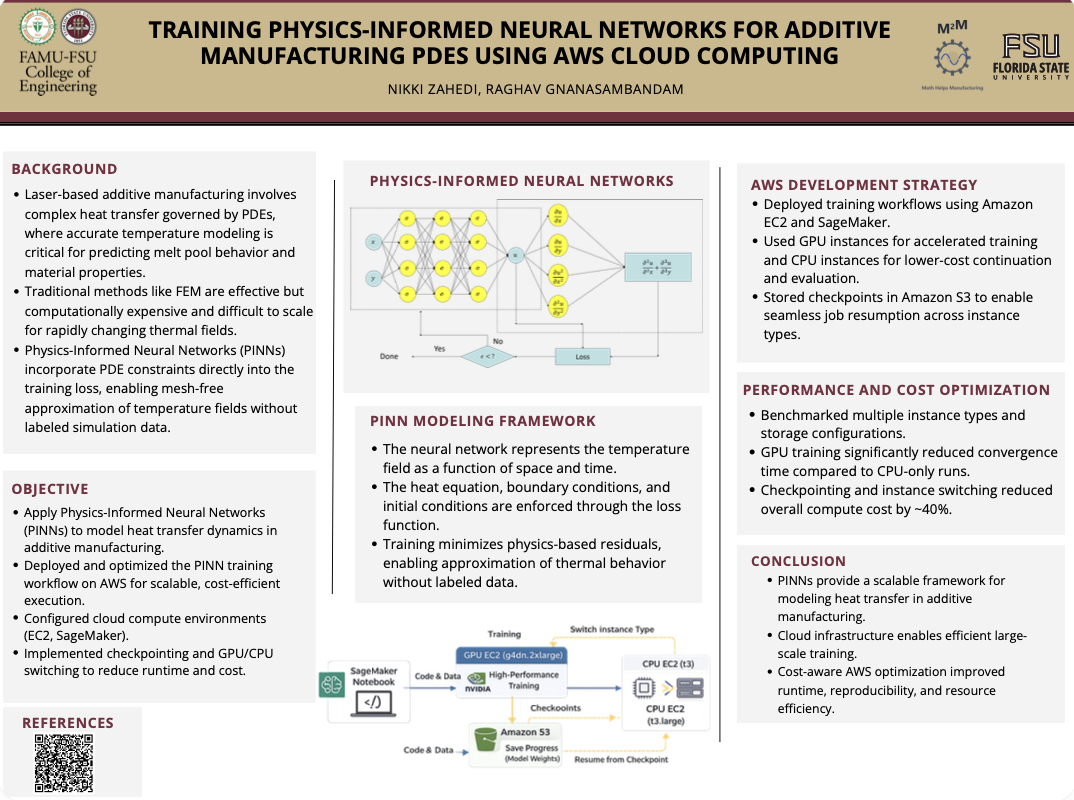
This project explores the use of Physics-Informed Neural Networks (PINNs) to model the heat transfer processes that occur during laser-based additive manufacturing. Traditional numerical methods for solving the heat equation can be computationally expensive and difficult to scale, especially when dealing with rapidly changing temperature fields. PINNs offer an alternative by embedding the governing partial differential equation directly into the loss function of a neural network. The network begins as a random function, and training consists of minimizing how much the function violates the physics of the system. This allows the model to approximate temperature distributions without the need for labeled simulation data.
To evaluate computational performance, training experiments were conducted using cloud resources from Amazon Web Services on both CPU and GPU instances. Early results indicate that GPU-based training significantly reduces computation time and that the PINN is able to reproduce key thermal patterns expected in additive manufacturing.
These findings suggest that PINNs may provide a flexible and scalable framework for modeling complex physical processes. The project demonstrates how machine learning and cloud computing can be combined to support advanced manufacturing research, and future work will extend the model to more complex geometries and multi-physics behavior.
Keywords: PINNS, Neural Networks, AWS, Cloud