
Research Symposium
26th annual Undergraduate Research Symposium, April 1, 2026
Ava Simon Poster Session 4: 3:00 pm - 4:00 pm / Poster #92

BIO
Ava Simon is a third-year undergraduate student at Florida State University pursuing a Bachelor of Science in Behavioral Neuroscience with a minor in Chemistry, with an expected graduation date of Spring 2027. She is a member of the Florida State University Honors Program and has been recognized on the President’s List and Dean’s List for her academic performance. Ava conducts undergraduate research in the laboratory of Dr. Linda Rinaman, where she studies GLP-1 receptor signaling and neural activation in Gcg knockdown rats and has contributed to data collection and the preparation of the research poster presented here. Outside of the laboratory, Ava is actively involved in service and leadership roles on campus. She serves as External Service Director for Alpha Epsilon Delta, where she organizes volunteer opportunities such as Habitat for Humanity, Ability 1st and the Monarch/WHO festival with St. Marks Wildlife refuge center. She is also a member of the Medical Response Unit, where she responds to on-campus medical calls, staffs campus events, and teaches safety trainings such as Stop the Bleed. Following graduation, Ava plans to attend medical school and pursue a career as a physician dedicated to integrating scientific research with compassionate patient care. In her spare time, she enjoys hiking, scuba diving, and reading.
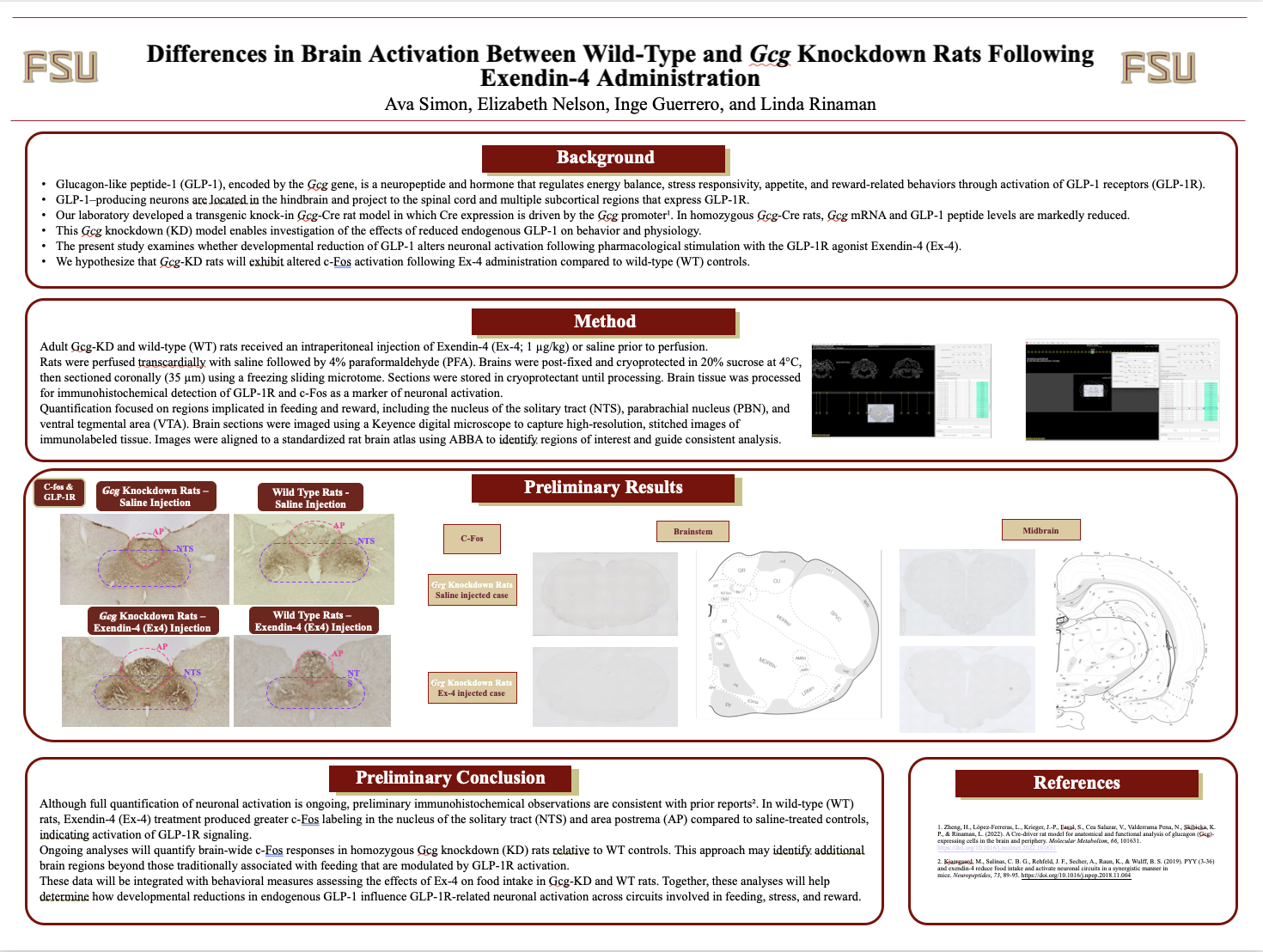
Differences in Brain Activation Between Wild-Type and Gcg Knockdown Rats Following Exendin-4 Administration
Authors: Ava Simon, Dr. Linda RinamanStudent Major: Behavioral Neuroscience
Mentor: Dr. Linda Rinaman
Mentor's Department: Department of Psychology Mentor's College: College of Arts and Sciences Co-Presenters: Elizabeth Nelson
Abstract
GLP-1 (Glucagon-like peptide-1) is a peptide hormone and neurotransmitter that regulates energy, appetite, stress, and reward-related behaviors through the activation of GLP-1R (GLP-1 receptor). GLP-1 is taken from the GCG gene (preproglucagon). However, the neural consequences of lifelong reductions in GLP-1 availability need further research and understanding. This study investigates how chronic GLP-1 deficiency influences GLP-1R expression and neural activation in the rat brain. Using a GCG knockdown rat model, resulting in reduced endogenous GLP-1 throughout development, we compare knockdown and wildtype rats under normal conditions and also stimulated GLP-1R conditions. Rats receive either the GLP-1R agonist, Exendin-4 (1 µg/kg) or saline prior to perfusion. Brain tissue is then processed using immunohistochemistry to quantify GLP-1R expression and neural activation via c-fos labeling. The c-fos labeling will be in key regions involving feeding, energy balance and reward. These areas could include the nucleus of the solitary tract, ventral tegmental area, nucleus accumbens, and the parabrachial nucleus. We hypothesize that GCG knockdown rats will exhibit GLP-1R upregulation and heightened c-fos activation following Exendin-4 administration. We predict that this will reflect increased neural sensitivity to GLP-1R stimulation. These findings will advance understanding of GLP-1 receptor plasticity and neural adaptation to chronic hormonal deficiency with implications for individual variability in response to GLP-1 based therapeutics.
Keywords: GLP-1 signaling, Neural activation, c-Fos, Gcg knockdown