
Research Symposium
26th annual Undergraduate Research Symposium, April 1, 2026
Nora Wetherton Poster Session 1: 9:30 am - 10:30 am / Poster #249

BIO
Nora Wetherton is a Junior at Florida State University pursuing a Bachelor of Science in Interdisciplinary Medical Sciences. She plans to attend pharmacy school following graduation. Originally from Louisville, Kentucky, Nora has gained research experience in developing Microscopic BioArt and contributing to the development of a medical device in collaboration with Mayo Clinic.
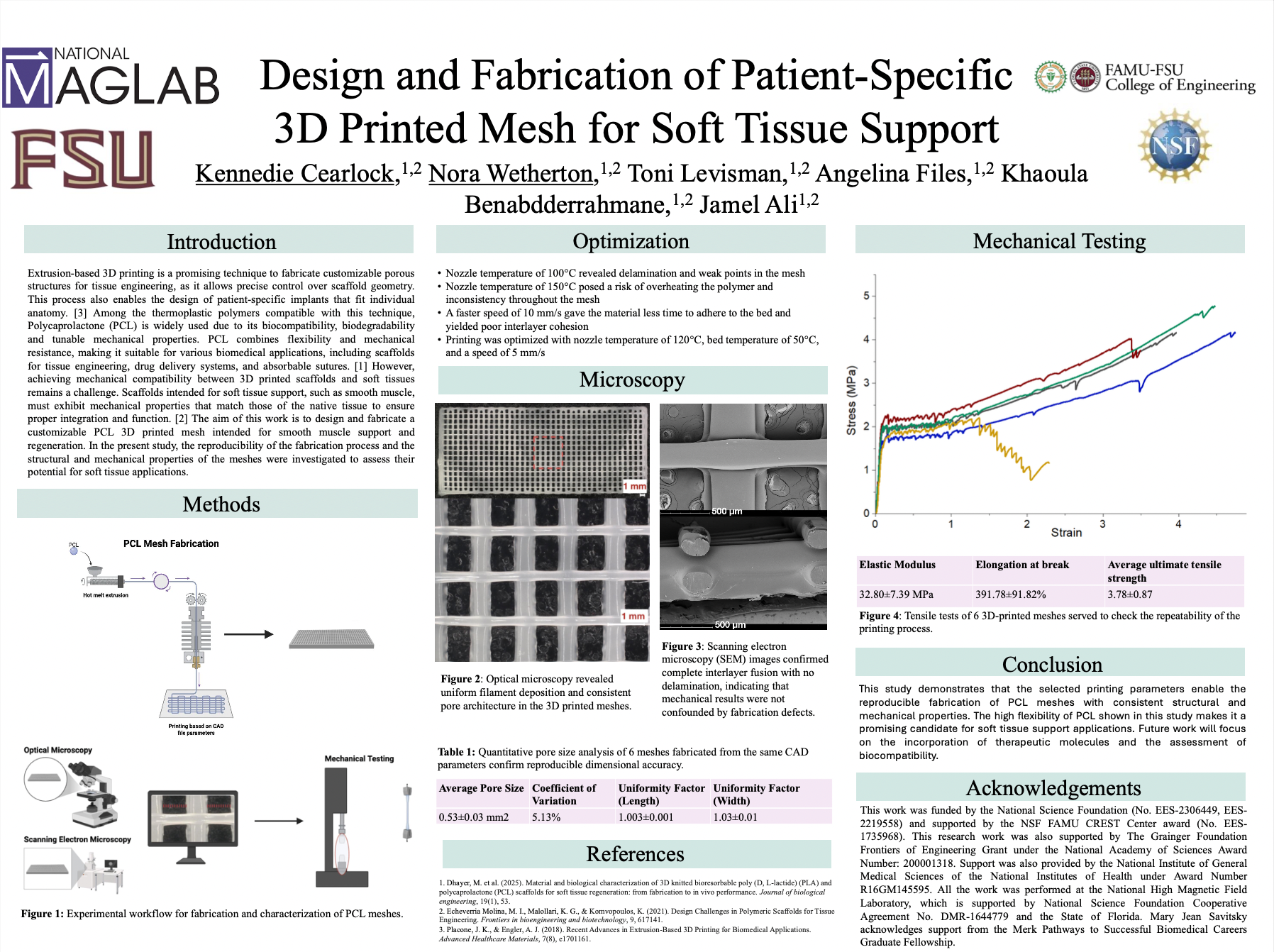
Design and Fabrication of Patient-Specific 3D Printed Mesh for Soft Tissue Support
Authors: Nora Wetherton , Dr. Jamel AliStudent Major: clinical professions
Mentor: Dr. Jamel Ali
Mentor's Department: Chemical and Biomedical Engineering Mentor's College: FAMU-FSU College of Engineering Co-Presenters: Kennedie Cearlock
Abstract
Extrusion-based 3D printing offers a versatile platform to fabricate customizable scaffolds intended for use in tissue engineering applications. Among the materials suitable for this technology, polycaprolactone (PCL) offers both biocompatibility and tunable mechanical properties, suitable for a wide range of tissues . This tunability enables the design of scaffolds appropriate not only for hard tissues, like bone, but also for soft tissue support, including smooth muscle supports (e.g., vascular stents ). Moreover, additive manufacturing also enables the creation of patient-specific implants to fit precisely the individual anatomy. Despite these advantages, there is still a gap in the development of thermoplastic 3D printed scaffolds adapted to the mechanical demands of soft tissues. Additionally, these scaffolds do not allow the incorporation of therapeutic molecules, limiting their multifunctional potential. The aim of this work is to develop a customizable PCL 3D printed mesh designed to match the mechanical requirements of smooth muscle support and regeneration. The customizable mesh was designed using CAD software with variations in patterns, followed by fabrication through extrusion-based printing of PCL. Mechanical characterization was performed to evaluate the mesh’s suitability for smooth muscle support. Additionally, the incorporation of therapeutic molecules into the structure or as a surface coating will be investigated, along with an assessment of their biocompatibility.
Keywords: 3D Printing, Polycaprolactone (PCL), Tissue Engineering