
Research Symposium
26th annual Undergraduate Research Symposium, April 1, 2026
Elizabeth Nelson Poster Session 4: 3:00 pm - 4:00 pm / Poster #92

BIO
Elizabeth Nelson is a junior at Florida State University pursuing a Bachelor of Science in Cell and Molecular Neuroscience on the pre-med track. She is deeply interested in the intersection of neuroscience, physiology, and human health. Elizabeth is currently conducting her honors thesis research examining how GLP-1 receptor agonists modulate dopamine signaling through GABAergic neurons. Through this work, she has gained extensive experience in experimental design, data analysis, and scientific communication under the mentorship of faculty in her department. Her research has strengthened her interest in understanding the neural mechanisms underlying behavior and disease, as well as the translational potential of biomedical research. Following graduation, she plans to attend medical school and continue integrating research with patient care throughout her career.
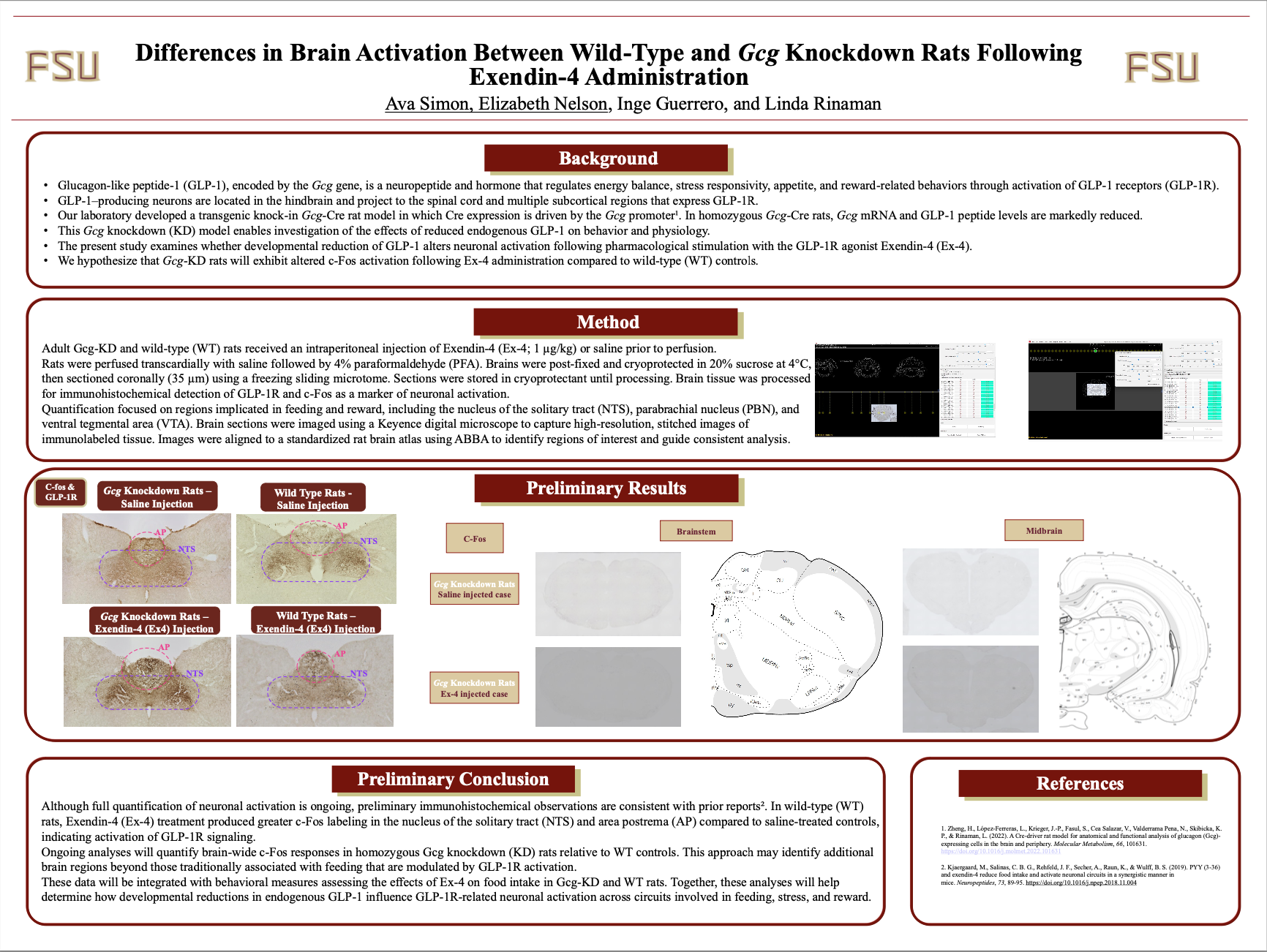
Differences in Brain Activation Between Wild-Type and Gcg Knockdown Rats Following Exendin-4 Administration
Authors: Elizabeth Nelson, Linda RinamanStudent Major: Cell and Molecular Neuroscience
Mentor: Linda Rinaman
Mentor's Department: Program in Neuroscience Mentor's College: College of Arts and Sciences Co-Presenters: Ava Simon
Abstract
Glucagon-like peptide-1 (GLP-1) is a peptide hormone and neurotransmitter that regulates energy balance, stress responsivity, appetite, and reward-related behaviors through activation of GLP-1 receptors (GLP-1R). To investigate the neural consequences of chronic endogenous GLP-1 deficiency, the present study examined whether developmental reduction of GLP-1 alters GLP-1R immunolabeling and neuronal activation following pharmacological stimulation of GLP-1R. We used a CRISPR-Cas9–generated glucagon gene (Gcg) knockdown (KD) rat model characterized by reduced endogenous GLP-1 production across development. Adult KD and wild-type (WT) rats received an intraperitoneal injection of the GLP-1R agonist exendin-4 (Ex-4; 1 µg/kg) or saline prior to perfusion. Brain tissue was processed for immunohistochemical detection of GLP-1R expression and c-Fos as a marker of neuronal activation. Quantification focused on key regions implicated in feeding and reward, including the nucleus of the solitary tract, parabrachial nucleus, ventral tegmental area, and nucleus accumbens. We hypothesize that chronic GLP-1 deficiency will alter receptor regulation and neural responsivity, such that KD rats will exhibit altered GLP-1R expression and differential c-Fos activation following Ex-4 administration compared to WT controls. These findings will provide insight into how reductions in endogenous GLP-1 during development can lead to changes in GLP-1R expression and evoke neuronal activation across key brain regions involved in feeding, stress, and reward.
Keywords: Neuroscience, GLP-1, Knockdown