
Research Symposium
26th annual Undergraduate Research Symposium, April 1, 2026
Reza Noori Poster Session 1: 9:30 am - 10:30 am / Poster #289

BIO
Reza Noori is a third-year clinical professions major, pursuing a Bachelor of Biomedical Sciences degree on the pre-medical track at Florida State University. His current research explores the correlation between plasma and fecal metabolites in relation to cognition in older adults at risk for dementia. He is applying to medical school this year.
Circulating and gut-derived metabolites linked to cognitive function
Authors: Reza Noori, Julia ShefflerStudent Major: Clinical Professions
Mentor: Julia Sheffler
Mentor's Department: Center for Translational and Behavioral Sciences Mentor's College: College of Medicine Co-Presenters:
Abstract
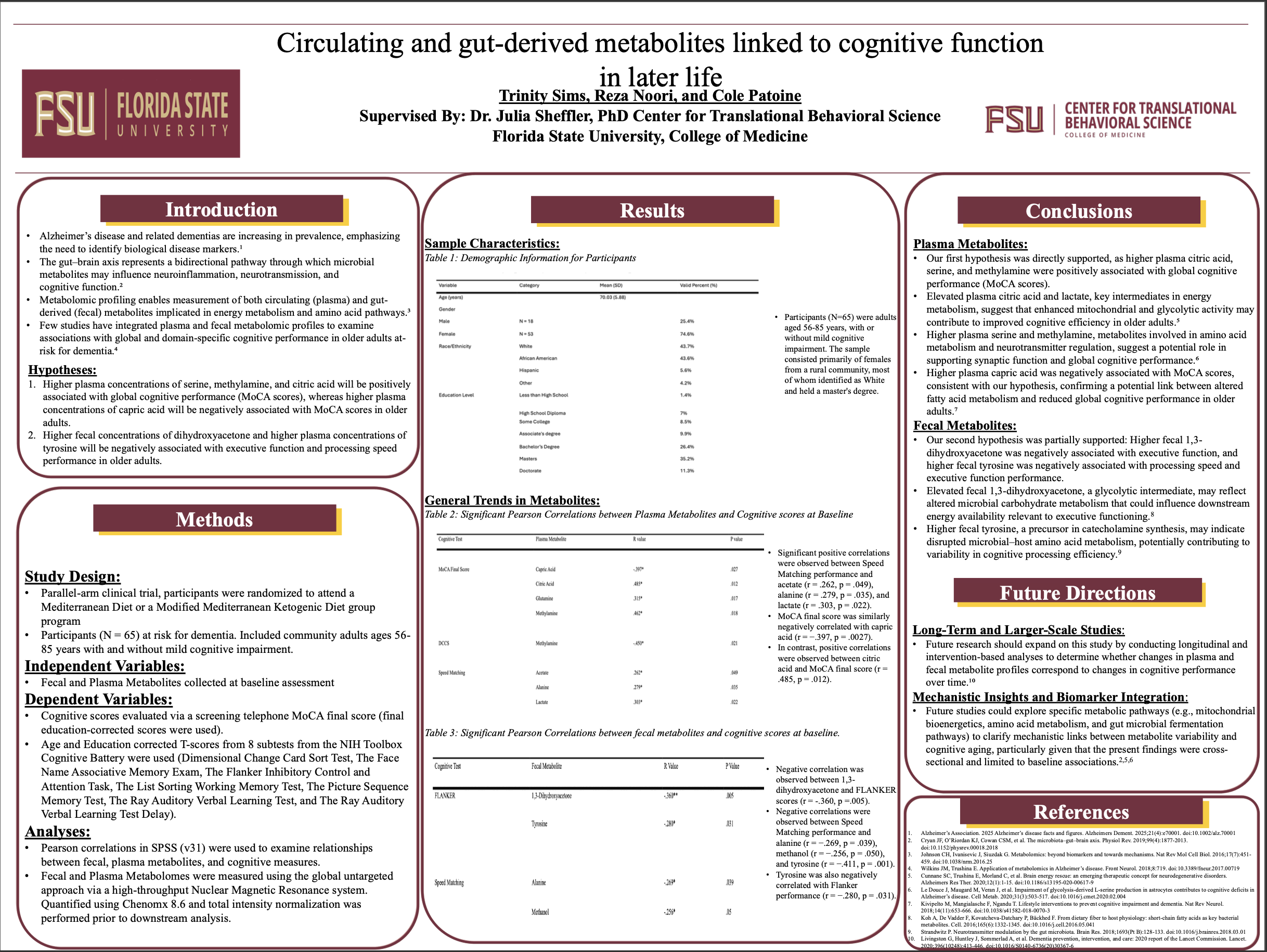
Background: Alzheimer’s disease and related dementias are increasing in prevalence as the population ages, creating a substantial public health crisis worldwide. There remains a need to clarify modifiable mechanisms underlying neurocognitive aging. Emerging evidence highlights the gut–brain axis as a critical pathway linking microbial metabolism to cognitive processes. Metabolomic profiling of plasma and fecal samples offers a method to capture these systemic and gut-derived signals.
Methods: Participants (N = 71; M: age = 70.03 years) were community-dwelling adults with and without mild cognitive impairment, enrolled in a parallel-arm clinical trial comparing two dietary interventions. Fasting plasma and fecal samples were analyzed using global untargeted nuclear magnetic resonance metabolomics. Cognitive performance was assessed using the Montreal Cognitive Assessment (MoCA) and NIH Toolbox measures of executive function, memory, and processing speed. Pearson and Spearman correlations examined associations between baseline metabolites and cognition.
Results: Higher plasma citric acid (r=.485, p=.012), serine (r= .432, p<.001), glutamine (r=.315, p=.017), and methylamine (r=.462, p=.018) were associated with higher MoCA scores, whereas capric acid was negatively associated (r=−.409, p=.022). Processing speed was positively associated with plasma lactate (r=.303, p=.022) and acetate (r=.262, p=.049). Fecal metabolites demonstrated negative associations between tyrosine and processing speed (r=−.411, p=.001) and between 1,3-dihydroxyacetone and executive function (r=−.360, p=.005).
Conclusions: Both plasma and fecal metabolite signatures were significantly associated with global and domain-specific cognitive performance in older adults. Assessing metabolites in both blood and stool may offer a more complete view of how gut and systemic metabolic signals relate to cognitive outcomes.
Keywords: Dementia, Diet, Metabolites, Plasma Metabolites, Fecal Metabolites, Cognition