
Research Symposium
26th annual Undergraduate Research Symposium, April 1, 2026
Vijay Baksh Poster Session 3: 1:45 pm - 2:45 pm / Poster #305

BIO
Vijay Baksh is a Junior majoring in Biological Sciences. He will be graduating with Honors in the Major in Summer 2026. Since his freshman semester, he has investigated various conditions intertwined with the Gut Microbiome such as Celiac Disease, Type 1 Diabetes, and Obesity under the direction of Dr. Ravinder Nagpal. Outside of research and academic pursuits, he is involved with Lambda Alpha Epsilon alongside strengthening expertise of the electric guitar and photography. His future plans are to become a Forensic Biologist or investigate the immunological mechanisms underlying cancerous development, followed by obtaining a PhD.
Antagonizing Klebsiella pneumoniae using prebiotics and postbiotics in simulated gut conditions
Authors: Vijay Baksh, Ravinder NagpalStudent Major: Biological Sciences
Mentor: Ravinder Nagpal
Mentor's Department: Department of Health, Nutrition, and Food Sciences Mentor's College: Anne Spencer Daves College of Education, Health, and Human Scienes Co-Presenters:
Abstract
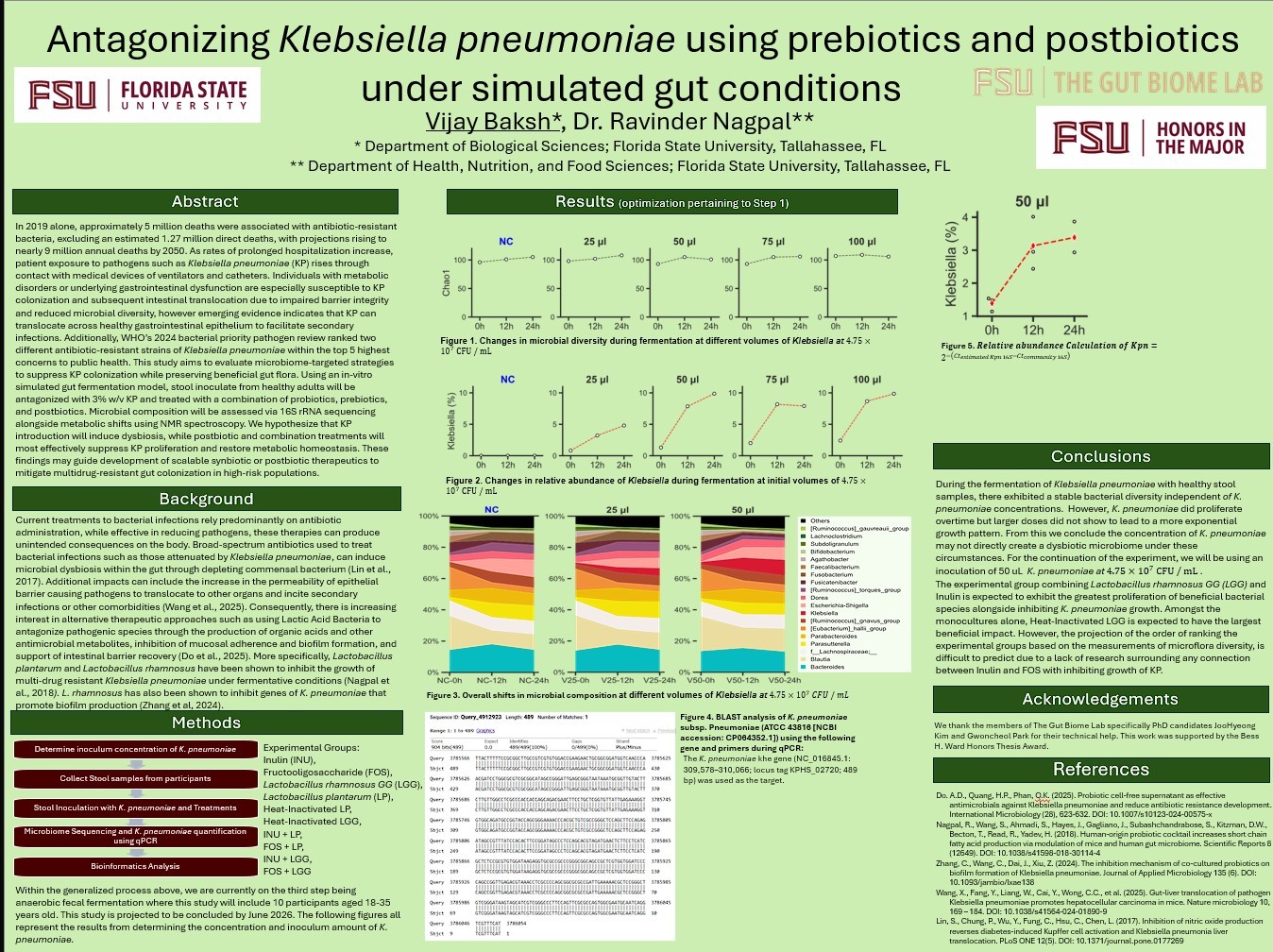
Throughout the 21st century, antimicrobial resistance has emerged as a public health crisis due to its escalating impact on infection severity and mortality among hospitalized patients. In 2019 alone, approximately 5 million deaths were associated with antibiotic-resistant bacteria, excluding an estimated 1.27 million direct deaths, with projections rising to nearly 9 million annual deaths by 2050. As rates of prolonged hospitalization increase, patient exposure to pathogens such as Klebsiella pneumoniae (KP) rises through contact with medical devices of ventilators and catheters. Individuals with metabolic disorders or underlying gastrointestinal dysfunction are especially susceptible to KP colonization and subsequent intestinal translocation due to impaired barrier integrity and reduced microbial diversity, however emerging evidence indicates that KP can translocate across healthy gastrointestinal epithelium to facilitate secondary infections. Additionally, WHO’s 2024 bacterial priority pathogen review ranked two different antibiotic-resistant strains of Klebsiella pneumoniae within the top 5 highest concerns to public health. This study aims to evaluate microbiome-targeted strategies to suppress KP colonization while preserving beneficial gut flora. Using an in-vitro simulated gut fermentation model, stool inoculate from healthy adults will be antagonized with 3% w/v KP and treated with a combination of probiotics, prebiotics, and postbiotics. Microbial composition will be assessed via 16S rRNA sequencing alongside metabolic shifts using NMR spectroscopy. We hypothesize that KP introduction will induce dysbiosis, while postbiotic and combination treatments will most effectively suppress KP proliferation and restore metabolic homeostasis. These findings may guide development of scalable synbiotic or postbiotic therapeutics to mitigate multidrug-resistant gut colonization in high-risk populations.
Keywords: Klebsiella pneumoniae, Gut Microbiome, Prebiotics, Postbiotics, Probiotics, qPCR