
Research Symposium
26th annual Undergraduate Research Symposium, April 1, 2026
Grace Wisdom Poster Session 1: 9:30 am - 10:30 am / Poster #123

BIO
Grace Wisdom is a senior Biological Sciences student at Florida State University. She has been a lab member in Dr. Kathryn Jones's lab since the fall semester of 2023. While initially working on bacterial plating, nodule crushes, and colony quantification, she has transitioned to molecular biology techniques under the leadership of Dr. Jones through directed independent study. Grace will graduate this semester with a BS in Biological Sciences with a minor in chemistry. She hopes to conduct full-time research through a post-baccalaureate program before applying to MD/PhD programs.
The Interplay of Terminal Differentiation of Symbiotic Sinorhizobium meliloti and Nitrogen Fixation in Legume Plants
Authors: Grace Wisdom, Dr. Kathryn JonesStudent Major: Biological Sciences
Mentor: Dr. Kathryn Jones
Mentor's Department: Biological Sciences Mentor's College: University of Chicago Co-Presenters:
Abstract
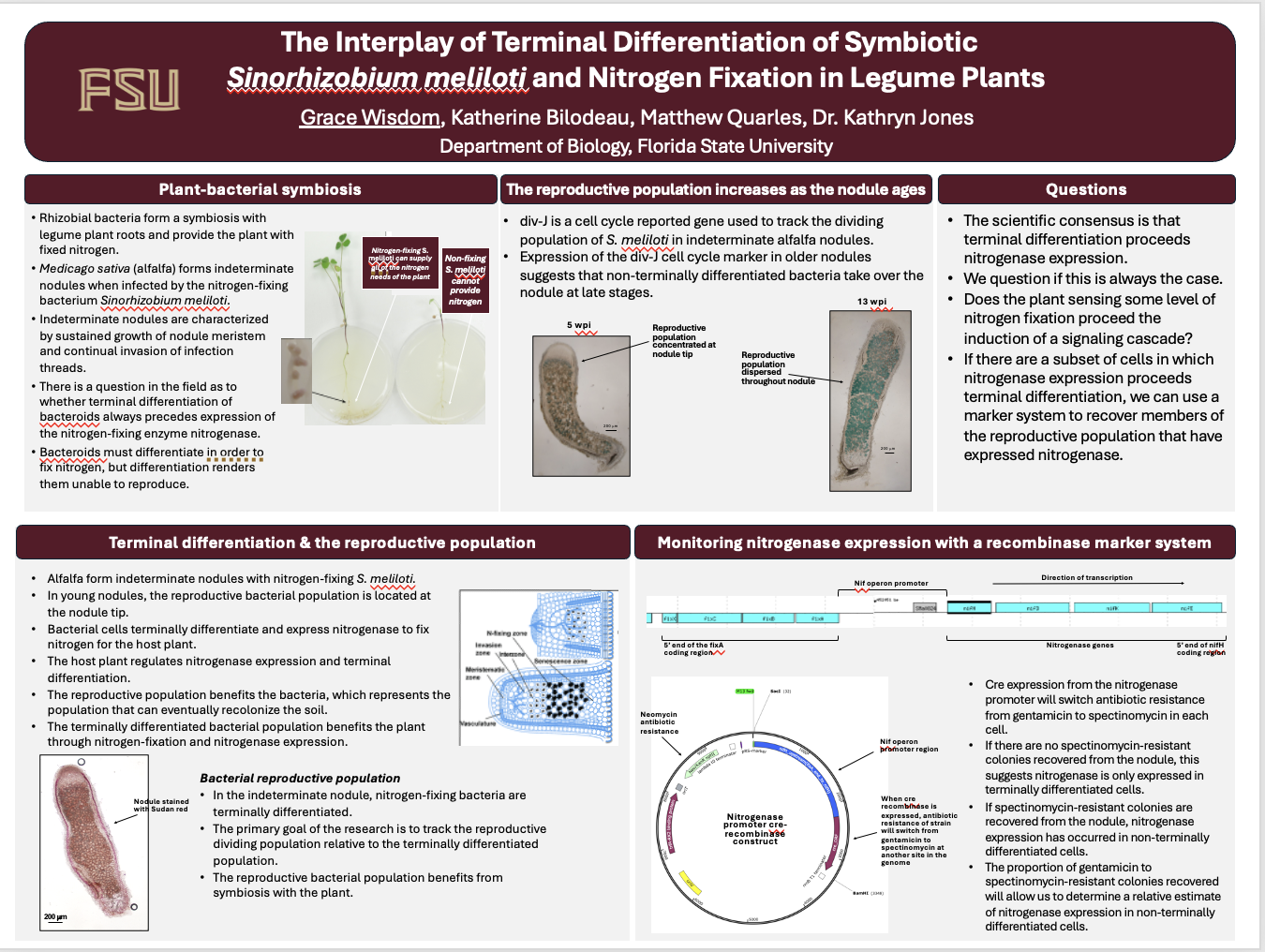
The soil bacterium Sinorhizobium meliloti establishes a nitrogen-fixing symbiosis with indeterminate-nodule-forming legumes such as Medicago sativa (alfalfa). In indeterminate nodules, bacterial cells differentiate into nitrogen-fixing bacteroids that express the N2-fixing enzyme nitrogenase but lose the ability to divide and form new cells. This differentiation splits the bacterial population within the nodule into two distinct groups: terminally differentiated, nitrogen-fixing cells that are sacrificed and undifferentiated, reproductive cells capable of benefiting from their interaction with the plant and re-entering the soil. It is also whether all nitrogenase expression is limited to bacterial cells that have committed to this ‘terminal differentiation’ or if some nitrogenase-expressing bacteria retain reproductive capacity. Bacterial nitrogenase expression within plant cells that are not ready to regulate the oxygen level to which the bacteria are exposed can be extremely detrimental to both the bacteria and the host cell and result in failure of the symbiosis. Therefore, the host plant tightly regulates both bacterial nitrogenase expression and terminal differentiation. To determine if bacterial cell lineages in which nitrogenase expression has occurred can be found in the reproductive population, we constructed a self-replicating DNA plasmid that will mark these lineages permanently once nitrogenase has been expressed. This is known as recombinase-based, in vivo expression technology (RIVET). This plasmid construct will provide a genetic tool for monitoring nitrogenase expression during symbiosis. This work contributes to the development of experimental agents for investigating the regulatory mechanisms underlying the timing of both bacterial differentiation and nitrogenase expression during symbiotic development.
Keywords: plant-bacterial symbiosis, recombinase marker system, nitrogen fixation