
Research Symposium
26th annual Undergraduate Research Symposium, April 1, 2026
Michael Dadlani Poster Session 1: 9:30 am - 10:30 am / Poster #153

BIO
Michael Dadlani is a senior Exercise Physiology major from Orlando, Florida, graduating in Spring 2026. He will be attending medical school in the fall, where he plans to further pursue his research interests in preventative medicine and the role that lifestyle interventions can play in the progression of chonic disease.
The Increased Susceptibility of the Sarcospan-deficient Myocardium to beta-adrenergic Agonists Occurs Through Distinct Immune-mediated Mechanisms
Authors: Michael Dadlani, Michelle ParvatiyarStudent Major: Exercise Physiology
Mentor: Michelle Parvatiyar
Mentor's Department: Department of Health, Nutrition and Food Sciences Mentor's College: College of Education, Health, and Human Sciences Co-Presenters:
Abstract
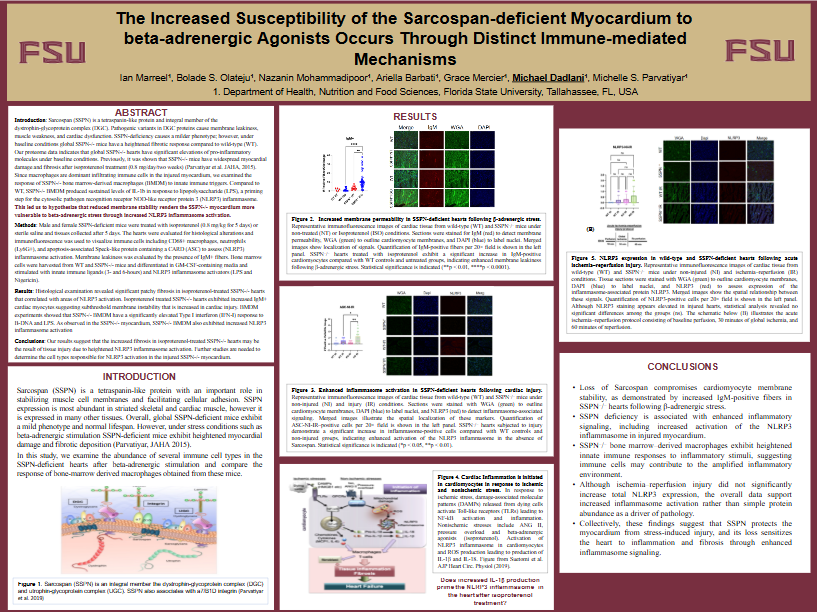
Introduction: Sarcospan (SSPN) is a tetraspanin-like component of the dystrophin–glycoprotein complex that stabilizes the muscle membrane. Pathogenic variants in this complex cause membrane leakiness, weakness, and cardiac dysfunction. Although SSPN deficiency produces a milder phenotype, SSPN⁻/⁻ mice exhibit heightened fibrosis and increased cardiac inflammation. Proteomic analysis revealed elevated pro-inflammatory signaling, and prior work showed extensive myocardial damage and fibrosis after isoproterenol. Because macrophages dominate immune infiltration after injury, we examined whether SSPN loss enhances innate immune and inflammasome responses.
Methods: Male and female SSPN⁻/⁻ and wild-type (WT) mice received isoproterenol (0.8 mg/kg/day, 5 days) or saline. Hearts were analyzed by histology and immunofluorescence for macrophages (CD68), neutrophils (Ly6G), and ASC specks to assess NLRP3 inflammasome activation. Membrane integrity was evaluated by IgM uptake. Bone marrow–derived macrophages (BMDMs) were differentiated with GM-CSF and stimulated with innate immune ligands and NLRP3 activators (LPS, nigericin).
Results: Isoproterenol-treated SSPN⁻/⁻ hearts showed patchy fibrosis colocalizing with NLRP3 activation and exhibited increased IgM+ cardiac myocytes suggesting subthreshold membrane instability that is increased in cardiac injury. BMDM experiments showed that SSPN-/- BMDM has a significantly elevated Type I interferon (IFN-I) response to B-DNA and LPS. As observed in SSPN-/- myocardium, SSPN-/- BMDM also exhibited increased NLRP3 inflammasome activation
Conclusions: Our results suggest that the increased fibrosis in isoproterenol-treated SSPN-/- hearts may be the result of tissue injury due to heightened NLRP3 inflammasome activation. Further studies are needed to determine the cell types responsible for NLRP3 activation in the injured SSPN-/- myocardium.
Keywords: sarcospan cardiac stress