
Research Symposium
26th annual Undergraduate Research Symposium, April 1, 2026
Ella Vizzini Poster Session 2: 10:45 am - 11:45 am / Poster #100

BIO
Ella Vizzini is a senior at Florida State University majoring in Exercise Physiology with a minor in Business. She began as a student researcher through the Undergraduate Research Opportunity Program (UROP) during her sophomore year, joining the Integrative Vascular & Metabolic Physiology Laboratory. There, she contributed to studies investigating the effects of creatine monohydrate on cardiovascular health, sparking her passion for cardiometabolic research. Ella continues to pursue projects at the intersection of exercise and health. As a premedical student, Ella is actively engaged in a number of pre-professional and service organizations, including Phi Delta Epsilon International Medical Fraternity, the FSU Medical Response Unit, Order of Omega Honor Society, Who We Play For, and Alpha Phi Sorority. Beyond her academic and extracurricular commitments, she enjoys running and exploring new recipes in the kitchen. Following graduation, Ella plans to take a gap year to gain additional clinical experience while applying to medical school.
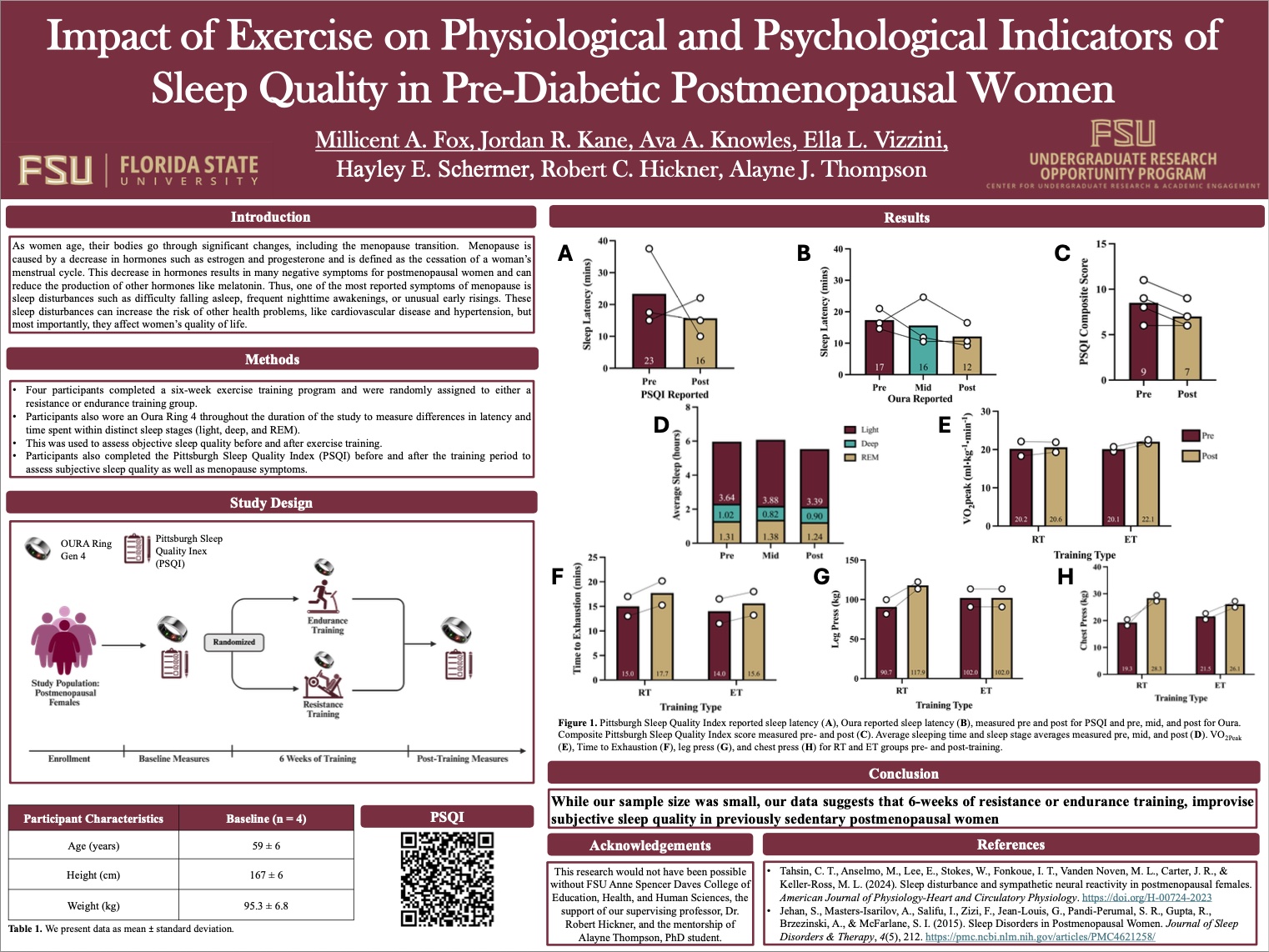
Impact of Exercise on Physiological and Psychological Indicators of Sleep Quality in Pre-Diabetic Postmenopausal Women
Authors: Ella Vizzini, Alayne ThompsonStudent Major: Exercise Physiology
Mentor: Alayne Thompson
Mentor's Department: Health, Nutrition, and Food Sciences Mentor's College: Education, Health, and Human Sciences Co-Presenters: Millicent Fox, Jordan Kane, Ava Knowles
Abstract
Menopause is an inevitable life stage impacting over half of the population, leading to significant mental and physiological changes. This study is ongoing and investigates the feasibility of exercise as a non-pharmacological intervention for the treatment of symptoms in post-menopausal women with obesity and prediabetes. In our research, four participants were randomly assigned to resistance or endurance training groups. To measure objective sleep parameters, such as heart rate and distinct sleep stages, participants also wore an Oura Ring 4 throughout the six weeks. Furthermore, participants’ subjective sleep quality and menopausal symptoms were evaluated via the Pittsburgh Sleep Quality Index (PSQI) and Menopause Rating Scale (MRS). We hypothesized that exercise would cause an increase in time spent in deep sleep and would improve perception of sleep quality. With a small sample size and the study still ongoing, we can only posit that our preliminary results indicate a trend towards improved strength, enhanced subjective sleep quality, and potential reductions in menopausal symptoms following the six-week exercise program. Further participant recruitment is necessary to enhance the statistical power to confirm these effects, yet our findings are promising in the potential application of exercise as a non-pharmacological strategy to improve sleep and menopausal health in this population.
Keywords: Exercise, Menopause, Women, Melatonin, Cortisol