
Research Symposium
26th annual Undergraduate Research Symposium, April 1, 2026
Isabela de Andrade Azambuja Poster Session 2: 10:45 am - 11:45 am / Poster #104
BIO
Isabela de Andrade is a Behavioral Neuroscience student at Florida State University. Isabela's research focuses on a divergent naming task comparing humans and artificial intelligence to measure creativity and differences in decision-making. Isabela is interested in cognition and neuroscience and plans to attend medical school and pursue a career in medicine.
Divergent naming task and creativity in humans vs. artificial intelligence
Authors: Isabela de Andrade Azambuja, Nelufar D. RadpourStudent Major: Behavioral Neuroscience
Mentor: Nelufar D. Radpour
Mentor's Department: Psychology Mentor's College: Arts and Sciences Co-Presenters: Rafael Meridinger
Abstract
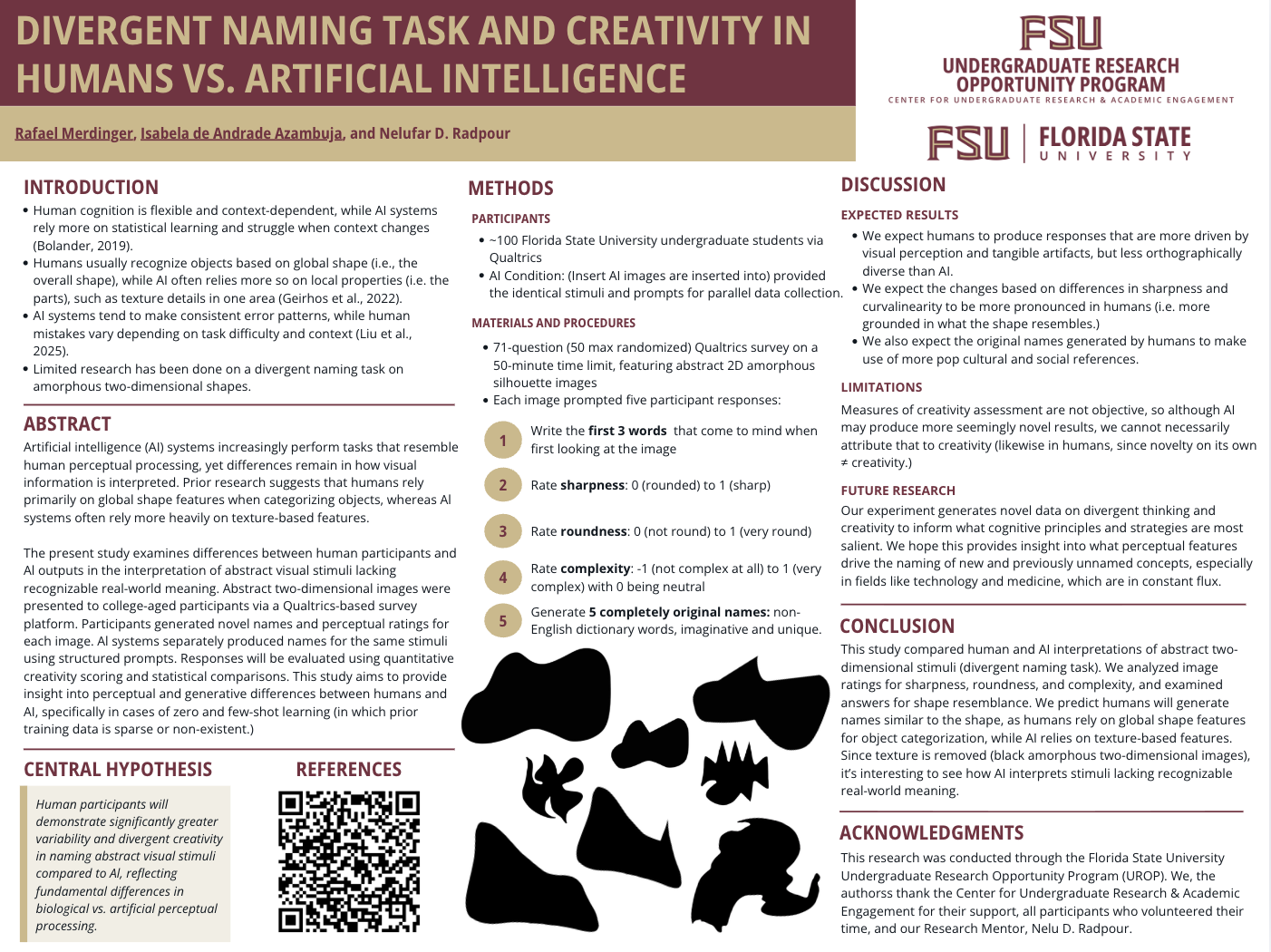
Artificial intelligence (AI) systems increasingly perform tasks that resemble human perceptual processing, yet differences remain in how visual information is interpreted. Prior research suggests that humans rely primarily on global shape features when categorizing objects, whereas Al systems often rely more heavily on texture-based features.
The present study examines differences between human participants and Al outputs in the interpretation of abstract visual stimuli lacking recognizable real-world meaning. Abstract two-dimensional images were presented to college-aged participants via a Qualtrics-based survey platform. Participants generated novel names and perceptual ratings for each image. Al systems separately produced names for the same stimuli using structured prompts. Responses will be evaluated using quantitative creativity scoring and statistical comparisons. This study aims to provide insight into perceptual and generative differences between humans and AI, specifically in cases of zero and few-shot learning (in which prior training data is sparse or non-existent.)
Keywords: Artificial intelligence, cognitive psychology, creativity