
Research Symposium
26th annual Undergraduate Research Symposium, April 1, 2026
Sydney Carlson Poster Session 3: 1:45 pm - 2:45 pm / Poster #61

BIO
Sydney Carlson is a senior pursuing a degree in Biological Science. She is actively involved in research in Dr. Vincis lab under the supervision of Dr. Odegaard. She is planning to apply to medical school and continue pursuing a career in healthcare.
Investigating neural connections between the mouse gustatory cortex and mediodorsal thalamus
Authors: Sydney Carlson, Katherine OdegaardStudent Major: Biological Science
Mentor: Katherine Odegaard
Mentor's Department: Biological Science Mentor's College: College of Arts and Sciences Co-Presenters:
Abstract
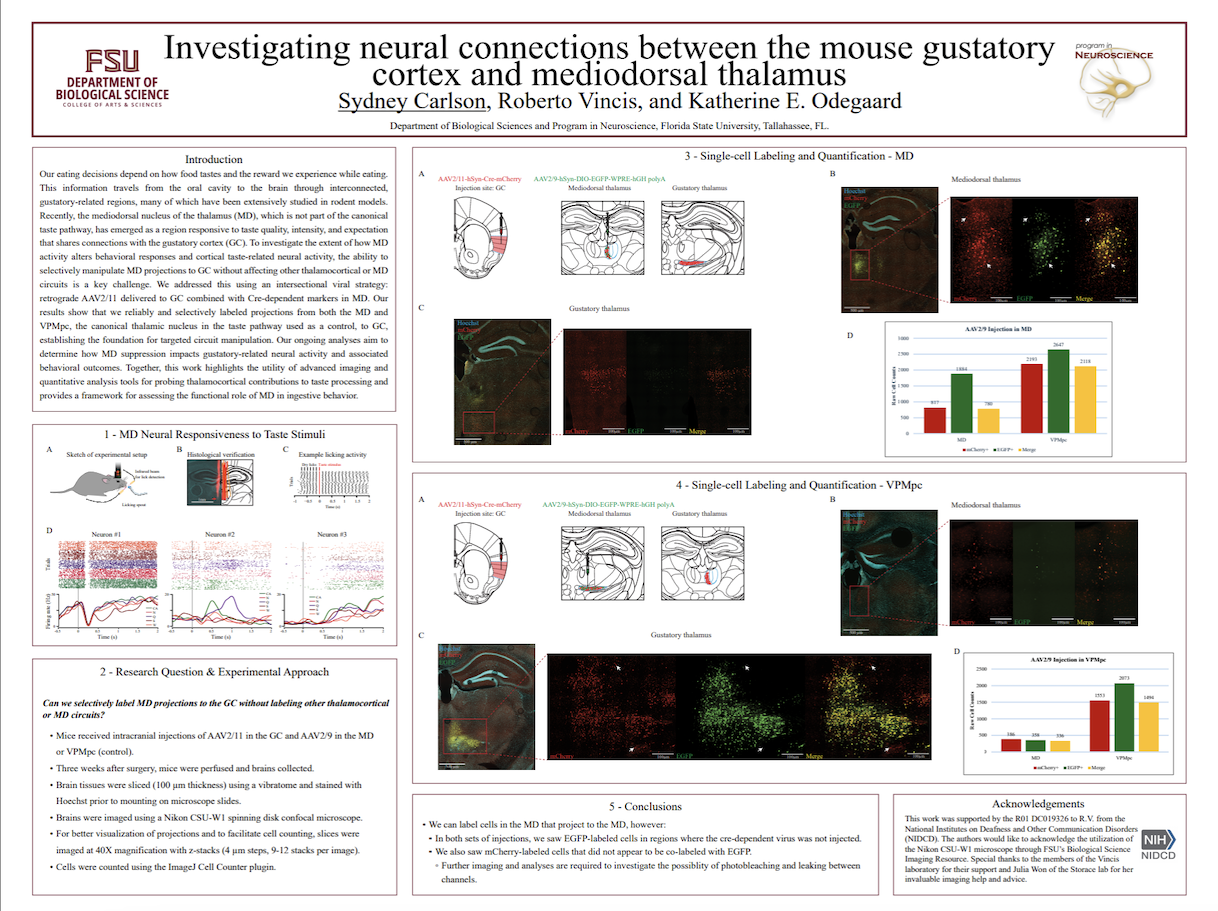
Our eating decisions depend on how food tastes and the reward we experience while eating. This information travels from the oral cavity to the brain through interconnected, gustatory-related regions, many of which have been extensively studied in rodent models. Recently, the mediodorsal nucleus of the thalamus (MD), which is not part of the canonical taste pathway, has emerged as a region responsive to taste quality, intensity, and expectation that shares connections with the gustatory cortex (GC). To investigate the extent of how MD activity alters behavioral responses and cortical taste-related neural activity, the ability to selectively manipulate MD projections to GC without affecting other thalamocortical or MD circuits is a key challenge. We addressed this using an intersectional viral strategy: retrograde AAV2/11 delivered to GC combined with Cre-dependent markers in MD. Our current results showed that we reliably and selectively labeled projections from both the MD and VPMpc, the canonical thalamic nucleus in the taste pathway used as a control, to GC, establishing the foundation for targeted circuit manipulation. Our ongoing analyses aim to determine how MD suppression impacts gustatory-related neural activity and associated behavioral outcomes. Together, this work highlights the utility of advanced imaging and quantitative analysis tools for probing thalamocortical contributions to taste processing and provides a framework for assessing the functional role of MD in ingestive behavior.
Keywords: neuroscience, taste processing, mediodorsal thalamus