
Research Symposium
26th annual Undergraduate Research Symposium, April 1, 2026
Tyler Moreno Poster Session 4: 3:00 pm - 4:00 pm / Poster #44

BIO
Tyler is a pre-medical neuroscience major in his third year. He has worked in multiple social psychology labs and hopes to pursue a career in drug treatment and research.
The Relation Between Socioeconomic Status, Anxiety, and Math Achievement in Early Elementary Students
Authors: Tyler Moreno, Colleen GanleyStudent Major: Cell and Molecular Neuroscience
Mentor: Colleen Ganley
Mentor's Department: Department of Psychology Mentor's College: Florida State University Co-Presenters:
Abstract
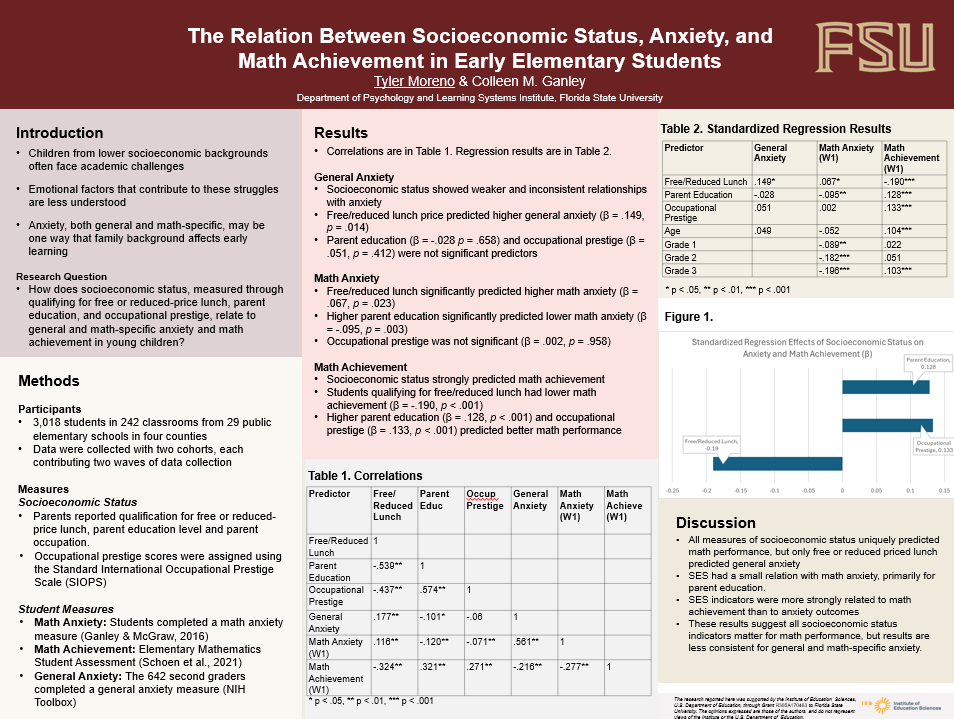
This study examines how socioeconomic status correlates with general and math-specific anxiety and math achievement in children. Children from lower socioeconomic backgrounds often face academic challenges, but the emotional factors that contribute to these struggles are less understood. Anxiety, both general and math-specific, may be one way that family background affects early learning. This study examines whether free or reduced-price lunch eligibility, parent education, and parent occupational prestige relate to child general anxiety, math anxiety, and math achievement.
Participants included 3.018 students from public elementary schools in Florida. Data were collected with two cohorts, each contributing to two waves of data collection. Parent surveys gathered demographic information, including free or reduced-price lunch status, education level and occupation. Occupational prestige scores were assigned using the Standard International Occupational Prestige Scale (SIOPS). Students completed a math anxiety measure in the classroom along with a standardized math test, the Elementary Mathematics Student Assessment. A smaller subset of approximately 600 second-grade students also completed a general anxiety measure.
Multiple regression models assessed the contributions of lunch status, parent education, and occupational prestige to general anxiety, math-specific anxiety, and child math performance. We ran separate models for each outcome. We found that all measures of socioeconomic status uniquely predicted math performance, but only free or reduced priced lunch predicted general anxiety, and SES had a small relation with math anxiety, primarily for parent education. These results suggest all socioeconomic status indicators matter for math performance, but results are less consistent for general and math-specific anxiety.
Keywords: anxiety, math learning, children