
Research Symposium
26th annual Undergraduate Research Symposium, April 1, 2026
Alexis Staveski Poster Session 4: 3:00 pm - 4:00 pm / Poster #111
BIO
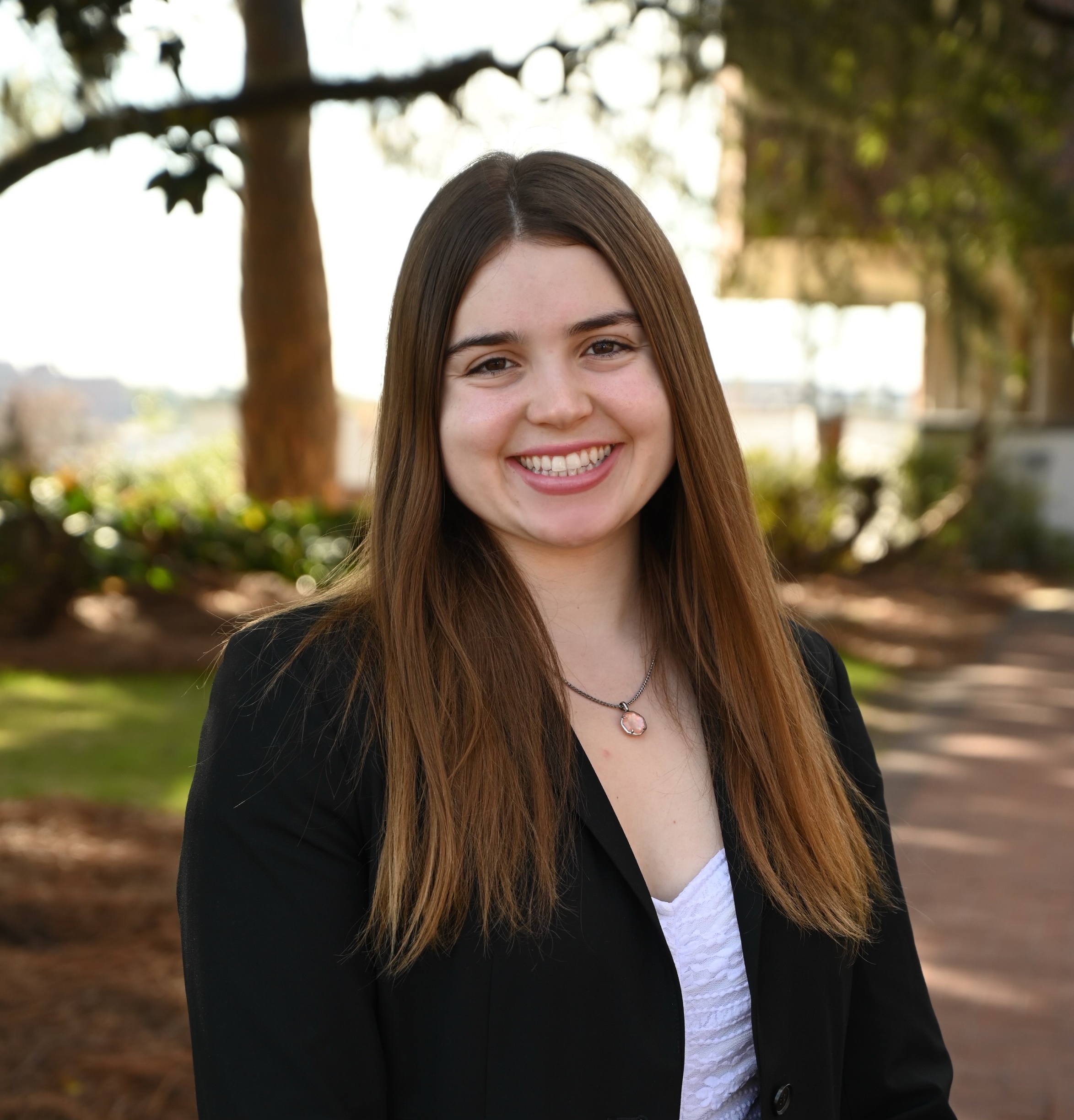
Alexis is a graduating senior studying computational science and economics with a minor in mathematics and an interest in computational social science. During her time at Florida State University, her significant involvements have included serving as Chair of the Presidential Scholars Program, Secretary of Student Services on the Student Body President's Cabinet, and currently the Manager of the Devoe L. Moore Institute's Data Analytics Group. She is preparing to defend her Honors Thesis, a decision support tool modeling the Tallahassee Clean Energy Plan. This work leverages many data sources and agent-based modeling to provide a framework for residential policy and product diffusion simulations. Off campus, she has spent her time interning at Oak Ridge National Laboratory, where her work was focused on designing automated data pipelines and geospatial analytics workflows to extract, integrate, and visualize information. Next Fall, Alexis is attending Cornell University in the Master's of Systems Engineering Program.
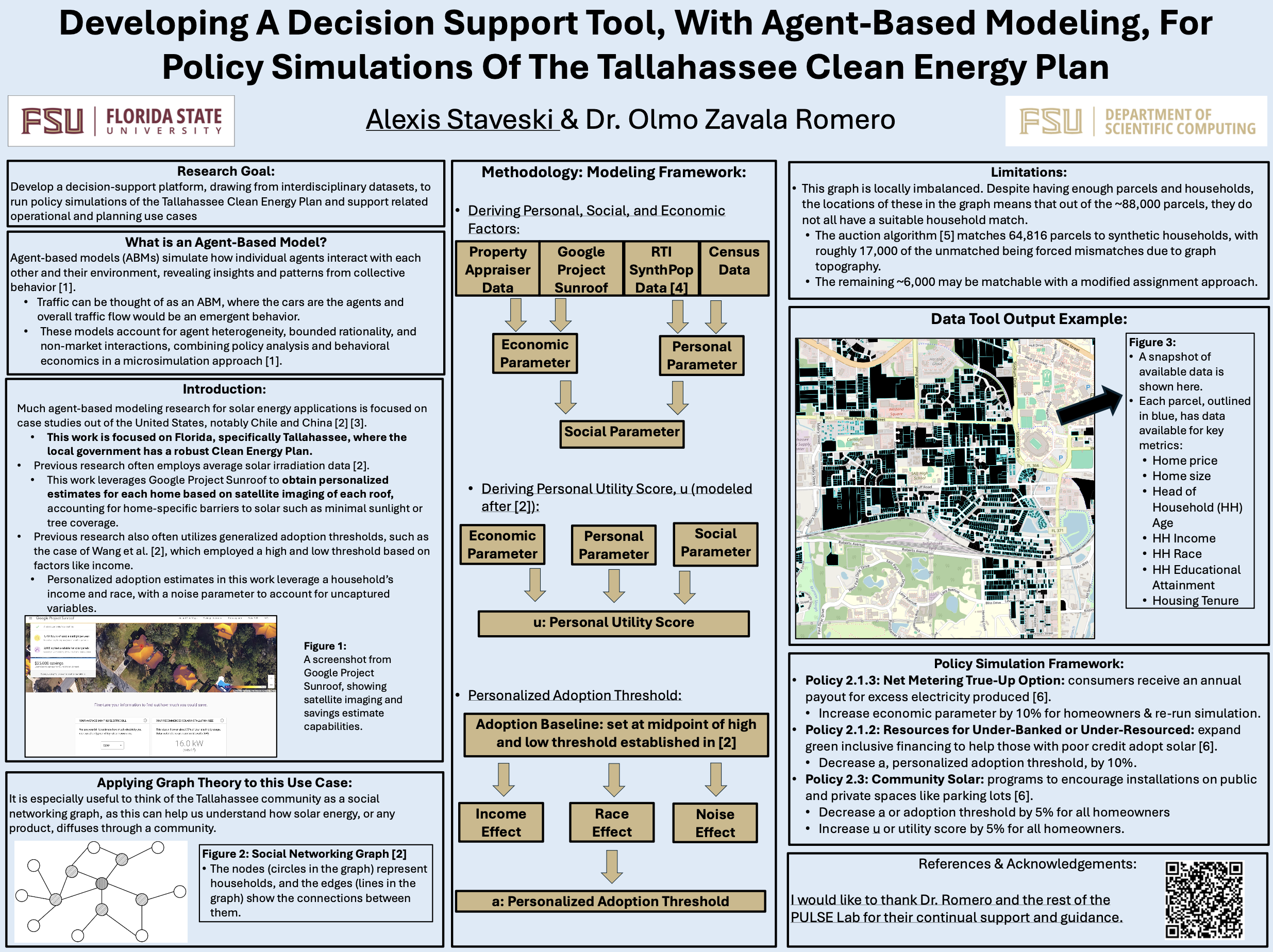
Developing A Decision Support Tool, With Agent-Based Modeling, For Policy Simulations Of The Tallahassee Clean Energy Plan
Authors: Alexis Staveski, Dr. Olmo Zavala RomeroStudent Major: Computational Science and Economics
Mentor: Dr. Olmo Zavala Romero
Mentor's Department: Department of Scientific Computing Mentor's College: College of Arts and Sciences Co-Presenters:
Abstract
Agent-based models (ABMs) simulate how individual agents interact with each other and their environment, revealing insights and patterns from collective behavior. According to a review paper in Wiley Interdisciplinary Reviews, agent-based modeling (ABM) became more prevalent in the field of climate mitigation in 2020, as ABMs account for agent heterogeneity, bounded rationality, and non-market interactions, combining policy analysis and behavioral economics in a microsimulation approach. Tallahassee, Florida has a robust Clean Energy Plan (CEP), with Goal Two of this plan focused on generating an additional 30 to 50 MW of distributed solar capacity in the community by 2030. The CEP names several potential policies to reach this benchmark: rooftop leasing, community solar, incentive programs, information campaigns, etc. This research combines parcel and tax roll data from the Leon County Property Appraiser, sunlight data from Google Project Sunroof, and Census Data, such as geographic mobility information to create synthetic households that are grounded in real data to run agent-based policy simulations. These simulations are ongoing; however, results are expected to reveal insights into the most effective and equitable residential solar policies that can be implemented in the Tallahassee community, with a focus on renters, as Tallahassee has a large renter population. Furthermore, the framework of this research has potential far-reaching implications in other public policy and product diffusion studies by applying these data and methods to other use cases and geographical areas.
Keywords: Agent-Based Modeling, Policy Simulations, Energy Policy