
Research Symposium
26th annual Undergraduate Research Symposium, April 1, 2026
Courtney Thompson Poster Session 1: 9:30 am - 10:30 am / Poster #83

BIO
Courtney Thompson is a senior at Florida State University pursuing a Bachelor of Science in Psychology with a minor in Chemistry. She is currently involved in the NatPAT Twin Project, where she contributes to research examining psychological and behavioral outcomes in twin populations. Courtney has gained clinical experience as a medical assistant in a neuro-ophthalmology clinic and through volunteering at the Mayo Clinic and the Alzheimer's Project. She also served as President of the Epilepsy Foundation at FSU and held leadership roles within Kappa Delta throughout her time at FSU. Her research interests include stress, mindfulness, and neurological health. Following graduation, Courtney plans to attend medical school and pursue a career in medicine.
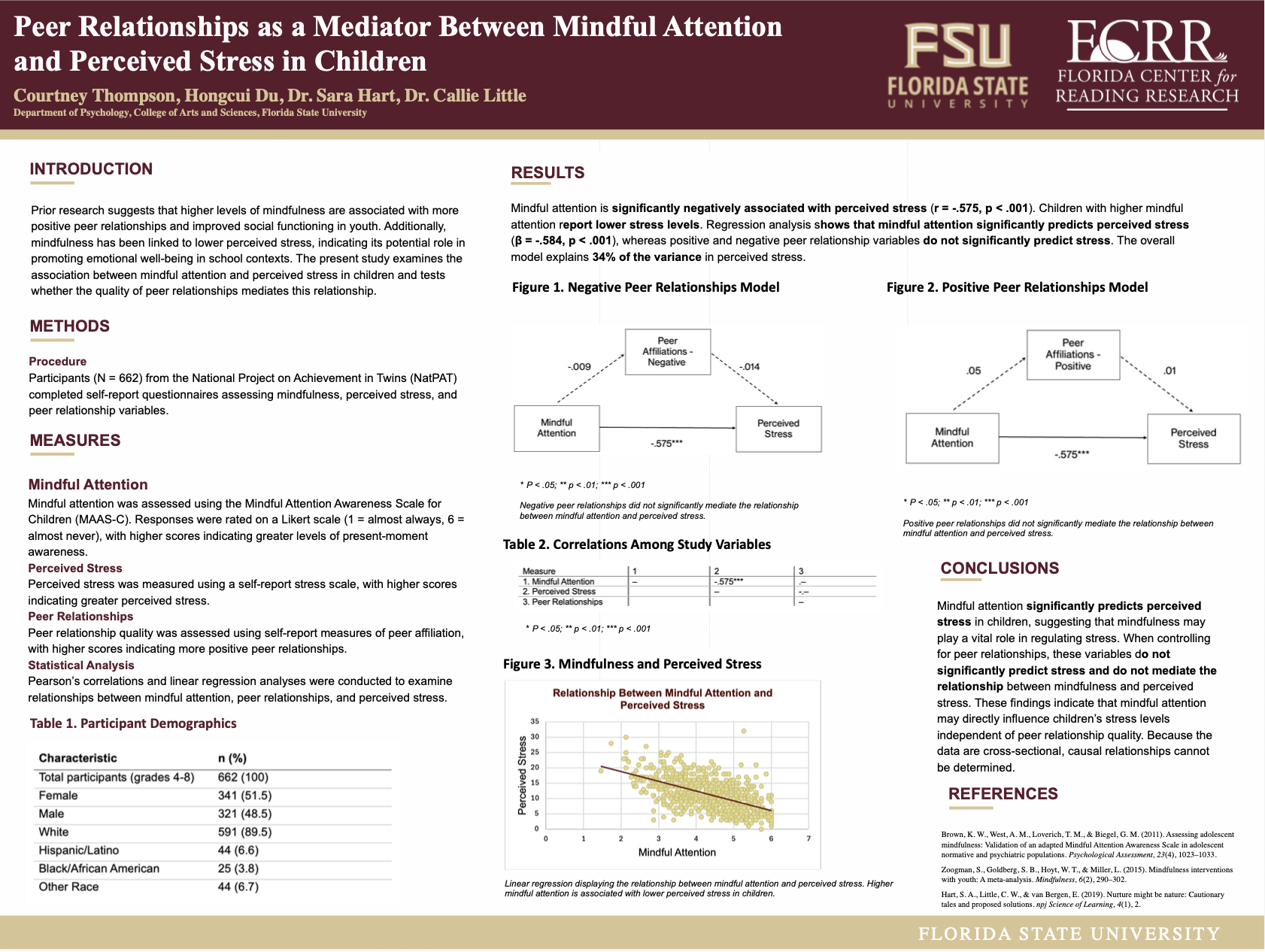
Peer Relationships as a Mediator Between Mindful Attention and Perceived Stress in Children
Authors: Courtney Thompson, Hongcui DuStudent Major: Psychology
Mentor: Hongcui Du
Mentor's Department: Department of Psychology Mentor's College: College of Arts and Sciences Co-Presenters:
Abstract
Perceived stress in children is associated with an increased risk for internalizing anxiety and depression. Research suggests that mindful attention (the ability to maintain awareness of present moment experiences) is associated with improved stress regulation and social functioning in children, though the exact process is unclear. The present study examines the association between mindful attention and perceived stress in children, and whether the quality of peer relationships mediates this relationship. Data were collected from twin pairs in grades 4-8 as part of the National Project on Achievement in Twins. Mindful attention was assessed with the Mindful Attention Awareness Scale-Children (MAAS-C), perceived stress was measured using the Perceived Stress Scale-Children (PSS-C), and quality of peer relationships was evaluated using measures of peer affiliation. It was hypothesized that higher mindful attention would be associated with lower perceived stress, mediated by quality of peer relationships. Results are expected to reveal a significant negative association between mindful attention and perceived stress, as well as a significant indirect effect through children's peer relationships. These findings would suggest that mindfulness may reduce stress in children in part through higher-quality peer relationships that provide social support.
Keywords: Mindfulness, children, perceived stress