
Research Symposium
26th annual Undergraduate Research Symposium, April 1, 2026
Lauren Afong Poster Session 2: 10:45 am - 11:45 am / Poster #292
BIO
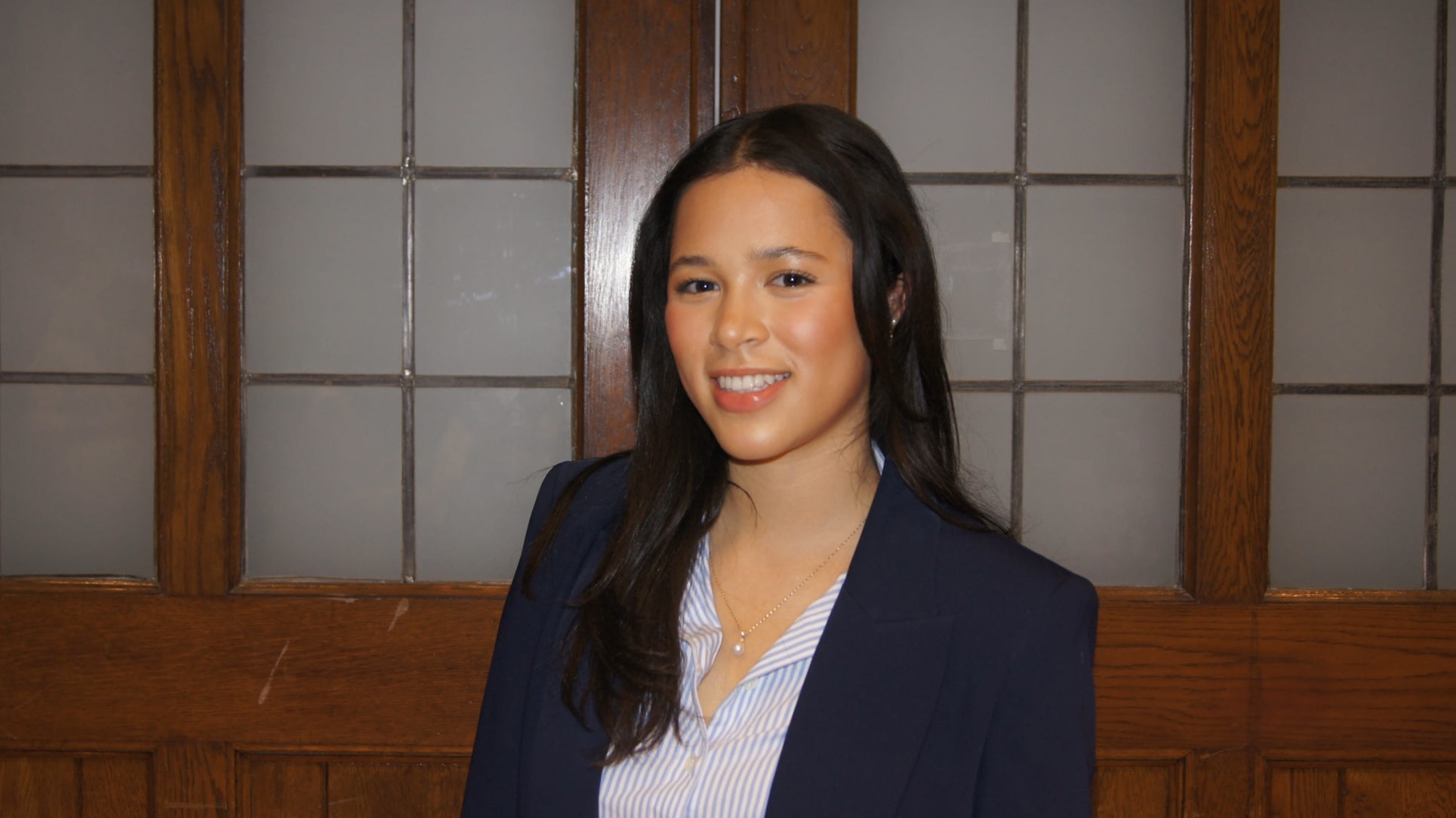
Lauren Afong is a sophomore from Miami, Florida. Majoring in Biological Sciences and Public Health, she is passionate about research that furthers medicine and healthcare, with interests in oncology and epidemiology. Her current research projects have provided her with knowledge in molecular biology, population health, public policy, and engineering. With past research experiences at the University of Miami Miller School of Medicine and Children's National Hospital and Research Institute, she looks to continue building upon her foundation across clinical and public health research.
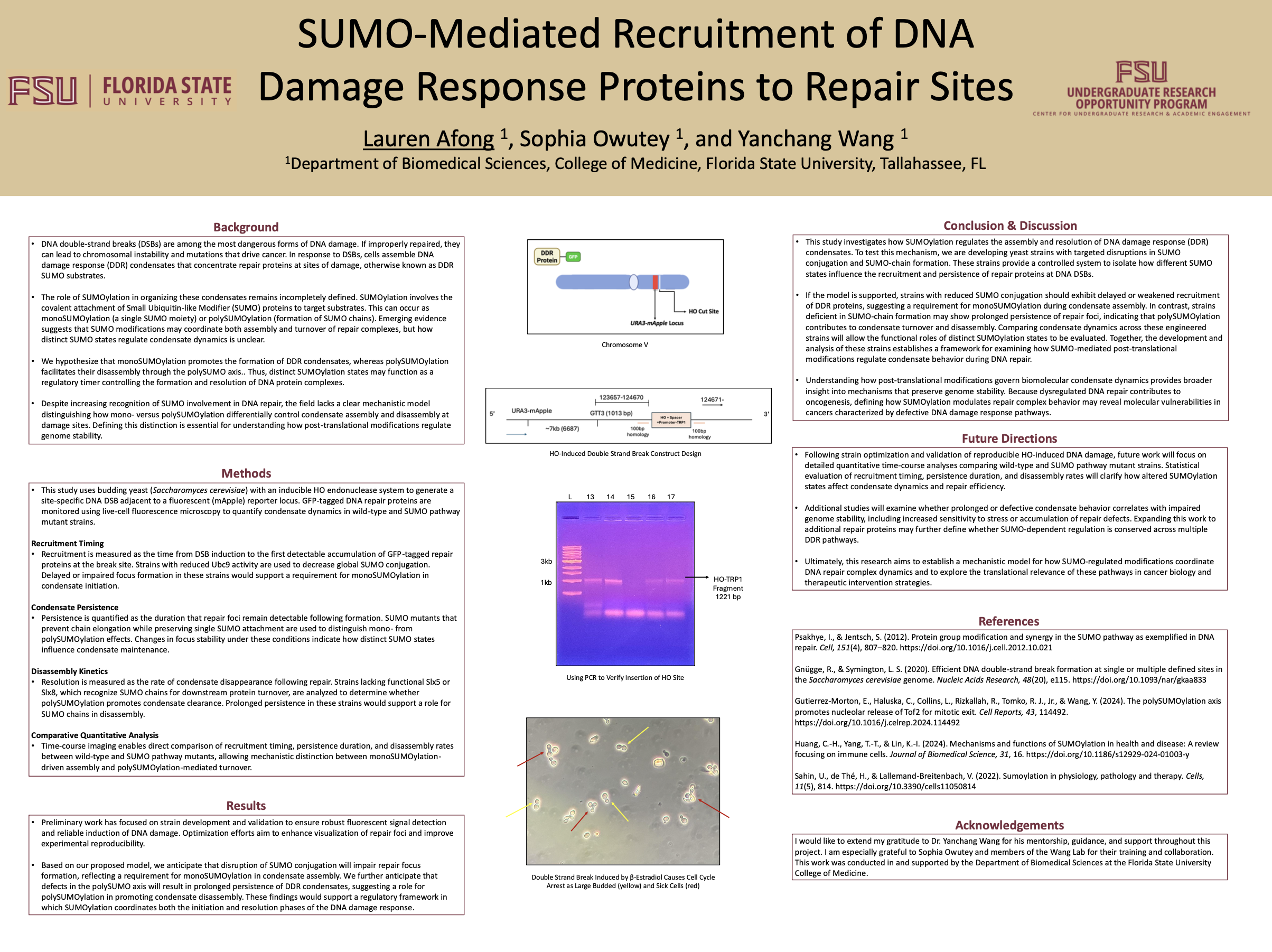
SUMO-Mediated Recruitment of DNA Damage Response Proteins to Repair Sites
Authors: Lauren Afong, Yanchang WangStudent Major: Biological Science and Public Health
Mentor: Yanchang Wang
Mentor's Department: Biomedical Sciences Mentor's College: College of Medicine Co-Presenters:
Abstract
DNA double-strand breaks (DSBs) are among the most harmful forms of DNA damage and, if improperly repaired, can lead to mutations that drive cancer. Cells respond to DSBs by assembling DNA damage response (DDR) condensates—dynamic, membrane-less structures that concentrate repair proteins at the site of damage. While phosphorylation is known to regulate condensate formation, the role of SUMOylation in coordinating these structures remains unverified. SUMOylation involves the covalent attachment of Small Ubiquitin-like Modifier (SUMO) proteins to target proteins either as single moieties (monoSUMOylation) or as polymeric chains (polySUMOylation).
We hypothesize that monoSUMOylation promotes the initiation and stabilization of DDR condensates, while polySUMOylation facilitates their timely disassembly through recruitment of SUMO-targeted ubiquitin ligases (STUbLs). To test this model, we employ a budding yeast (Saccharomyces cerevisiae) system with a site-specific DSB induced adjacent to a fluorescent reporter. GFP-tagged DNA repair proteins are monitored using live-cell fluorescence microscopy under conditions that selectively disrupt SUMO conjugation, SUMO chain formation, or STUbL activity.
We anticipate that disruption of SUMO conjugation will impair repair focus formation, while defects in SUMO chain formation or STUbL function will lead to prolonged persistence of DDR condensates. These outcomes would support a regulatory model in which distinct SUMOylation states coordinate the assembly and resolution of repair complexes. By defining how SUMOylation governs DDR dynamics, this work aims to advance our understanding of genome stability and identify SUMO-regulated pathways that may be leveraged for cancer prevention and therapeutic intervention.
Keywords: SUMOylation, DNA damage response, Cancer genomics