
Research Symposium
26th annual Undergraduate Research Symposium, April 1, 2026
Natalie Zamora Poster Session 4: 3:00 pm - 4:00 pm / Poster #274

BIO
Natalie is a junior in the Biomedical Engineering major at Florida State University, set to graduate in 2027. She is currently conducting research in the Cardiovascular and Applied Physiology Laboratory under the mentorship of Thomas Bissen. Her work focuses on inspiratory muscle strength training (IMST) in younger adults with obesity, specifically investigating its effects on dyspnea and the oxygen cost of breathing. Natalie is passionate about pursuing a career in the medical field, using her engineering background to address challenges in healthcare.
Oxygen Cost of Breathing During Voluntary Eucapnic Hyperpnea Among Adults with Obesity After Inspiratory Muscle Strength Training
Authors: Natalie Zamora, Thomas BissenStudent Major: Biomedical Engineering
Mentor: Thomas Bissen
Mentor's Department: Exercise Physiology Mentor's College: College of Education, Health, and Human Sciences Co-Presenters:
Abstract
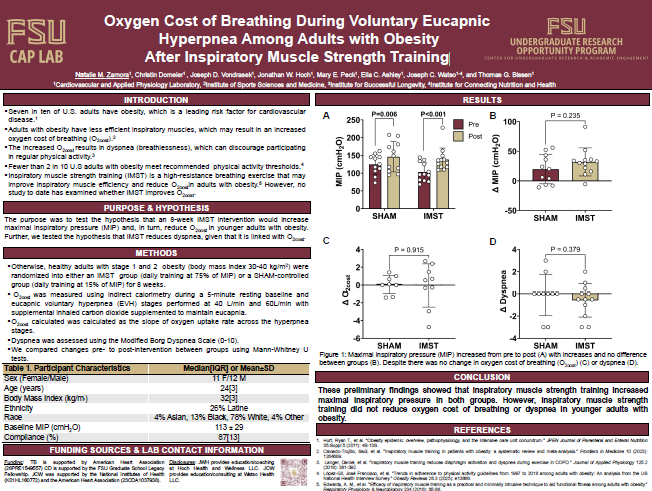
Nearly seven-in-ten of U.S. adults have overweight or obesity, a leading risk factor for cardiovascular disease, and experience breathlessness during physical activity (i.e., dyspnea). This may be partly due to weak inspiratory muscles, leading to ventilatory inefficiency in younger adults with obesity and higher oxygen cost of breathing (V̇O2breathing). However, the impact of inspiratory muscle strength training (IMST) on V̇O2breathing is uncertain. We tested the hypothesis that IMST would reduce dyspnea and V̇O2breathing in younger adults with obesity.
Using a triple-masked, parallel-arm, sham-controlled design, we randomized otherwise healthy adults with obesity (n=23) to daily training at 75% (IMST) or 15% (SHAM) of their maximal inspiratory pressure (MIP) for 8-weeks. Pre- and post-intervention, we assessed dyspnea with the Modified Borg Dyspnea Scale (0-10) and determined the V̇O2breathing by calculating the slope of oxygen uptake, measured via indirect calorimetry, during a 5-minute baseline and the final minute of 5-minute eucapnic voluntary hyperpnea (EVH) stages performed at 40 and 60 L/min. We compared mean changes (Δ; post-pre) using Mann-Whitney U. Normally distributed data reported as mean±SD and non-normally distributed data as median[IQR].
Participants baseline characteristics 24[3]yrs; BMI 32[3]kg/m2, MIP 113±29cmH2O were not different between groups (Ps≥0.07). Training compliance was not different between groups (P=0.45). Both groups increased MIP (Ps≤0.006). ∆MIP (IMST:34[13] vs. SHAM:20[35]cmH2O, P=0.23); dyspnea, and ΔV̇O2breathing slope during EVH did not differ between groups (Ps>0.92).
These preliminary findings demonstrate that IMST increased MIP in both groups; however, IMST did not change dyspnea or V̇O2breathing in younger adults with obesity.
Keywords: IMST(Inspiratory Muscle Strength Training), Obesity, Cardiovascular Physiology