
Research Symposium
26th annual Undergraduate Research Symposium, April 1, 2026
Hanah Niazi Poster Session 1: 9:30 am - 10:30 am / Poster #61

BIO
Hanah Niazi is a third-year double major in Behavioral Neuroscience and Biology at Florida State University and is expected to graduate in Spring 2027 with a Bachelor of Science. She is a Directed Independent Study student in Dr. Colleen Ganley’s Math Thinking and Learning Lab, where she uses longitudinal statistical modeling to examine gender differences in math anxiety and academic self-concept. Her research experience also includes neuromarketing work in FSU’s Cognition and Emotion Lab, where she explored the cognitive and emotional mechanisms underlying decision-making. In addition to her work at Florida State University, Hanah has gained valuable international experience through a research collaboration in Taiwan and clinical shadowing at Hospital Universitario Infanta Elena in Madrid, Spain. These experiences broadened her understanding of global approaches to science, medicine, and patient care.
Hanah’s research interests lie at the intersection of neuroplasticity, pain science, sensory processing, and the gut-brain axis. She is particularly interested in how discoveries in basic science can be translated into meaningful clinical applications. Outside of research, she volunteers at Big Bend Hospice providing direct patient care and works in the palliative care unit at Tallahassee Memorial Hospital, experiences that continue to strengthen her commitment to compassionate, patient-centered medicine. After graduation, Hanah plans to pursue an MD/PhD and a career as a physician-scientist, integrating research and clinical care to advance the understanding and treatment of complex neurological conditions.
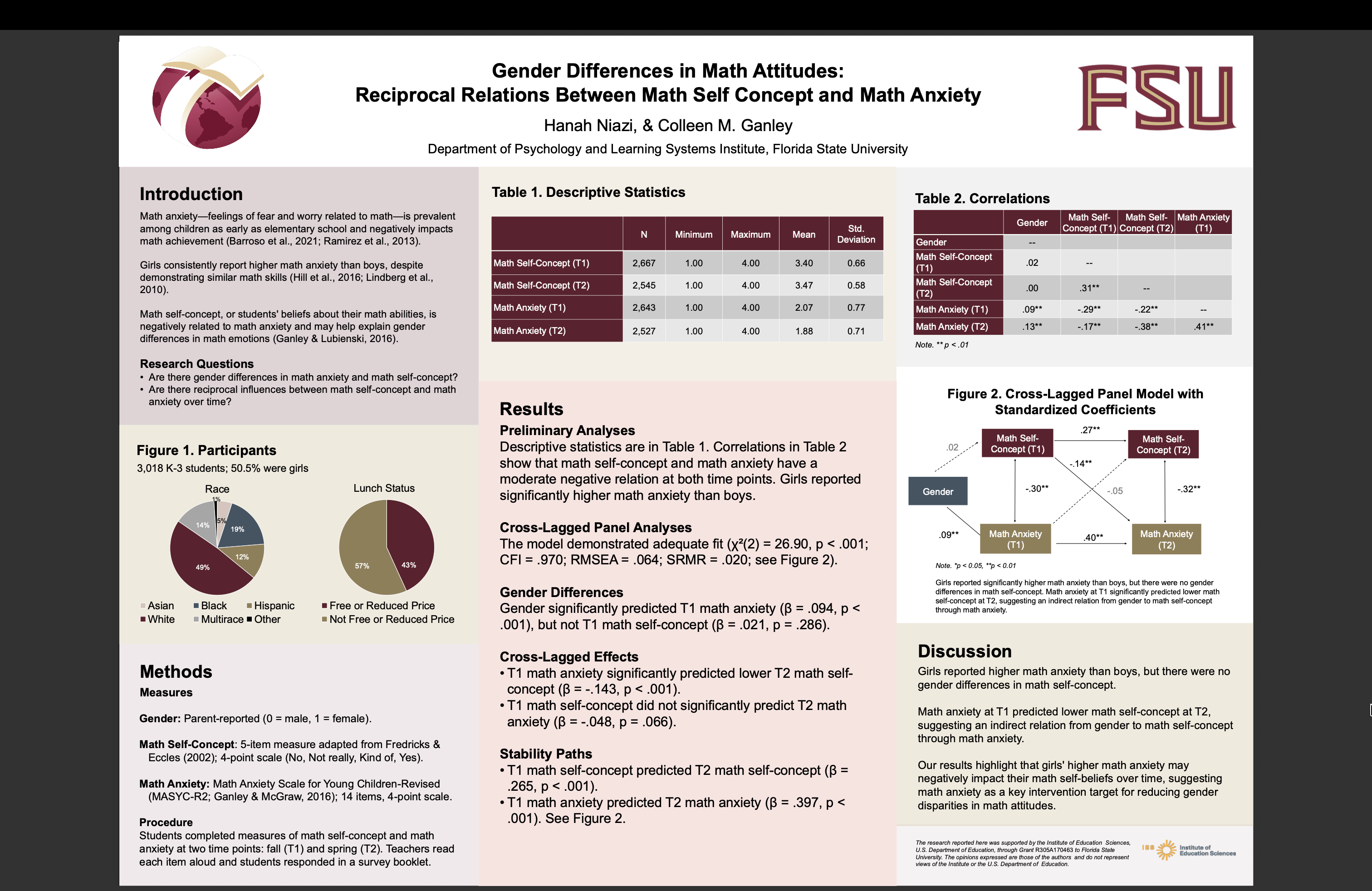
Gender Differences in Math Attitudes: Reciprocal Relations Between Math Self Concept and Math Anxiety
Authors: Hanah Niazi, Dr. Colleen GanleyStudent Major: Neuroscience, Biology
Mentor: Dr. Colleen Ganley
Mentor's Department: Psychology Mentor's College: College of Arts and Sciences Co-Presenters:
Abstract
Research consistently shows that girls report lower math self-concept and higher math anxiety than boys despite similar math achievement levels. Research also shows that math self-concept and anxiety are strongly linked to one another. Understanding the mechanisms underlying these gender differences is critical for developing effective interventions. The present study used a cross-lagged panel model (CLPM) to test gender differences in math self-concept and math anxiety and if math self-concept and math anxiety would show reciprocal cross-lagged effects over time in elementary school students. Data were drawn from the REALM (Research on Experiences, Attitudes, and Learning in Math) longitudinal study. Participants were 3,018 students in kindergarten through third grade from 29 public elementary schools. Students completed measures of math self-concept and math anxiety at two time points (fall and spring). The model demonstrated adequate fit (RMSEA = .06, CFI = .97, SRMR = .02). Results indicated that girls reported significantly higher math anxiety at Time 1 (β = .09, p < .001), but there was no significant gender difference in math self-concept (β = .02, p = .29). Time 1 math anxiety significantly predicted lower Time 2 math self-concept (β = -.14, p < .001), but Time 1 math self-concept did not significantly predict lower Time 2 math anxiety (β = -.05, p =.07). These findings highlight the importance of addressing math anxiety early, especially for girls, as it negatively predicts math self-concept over time.
Keywords: gender differences, math anxiety