
Research Symposium
26th annual Undergraduate Research Symposium, April 1, 2026
Aleksandra Grechanik Poster Session 2: 10:45 am - 11:45 am / Poster #20

BIO
Aleksandra Grechanik is a third year undergraduate student at Florida State University majoring in behavioral neuroscience with minors in chemistry and criminology. She’s involved in Dr. Dewan's laboratory as a lab assistant and Dr. Martins Memory Lab. In the Martin Memory Lab, Aleksandra is pursuing an honors thesis through the Honors in the Major Program, studying the interplay between music and cognition. In addition to Dr. Chris Martin as her thesis director, Aleksandra receives mentorship from Dr. Ashley Pieper and Dr. Lori Gooding, both of whom are on her supervisory committee.
Aleksandra is preparing for a future in medicine and plans to apply to medical school within the upcoming years. She is passionate about integrating scientific research with clinical practice and hopes to contribute to advancements in patient care through a deeper understanding of the mind.
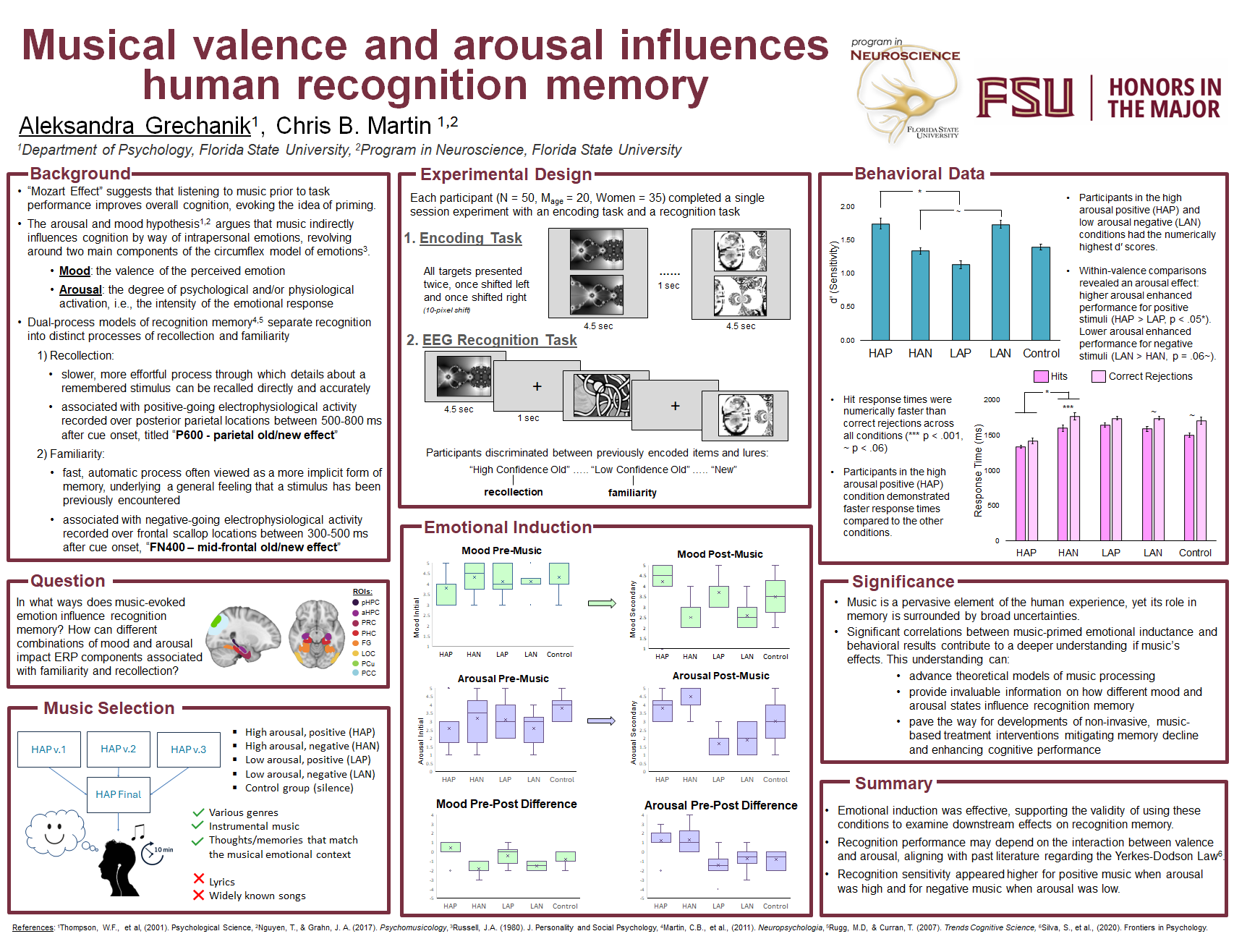
Effects of Music-Evoked Emotion on Recognition Memory: An EEG Study
Authors: Aleksandra Grechanik, Dr. Chris MartinStudent Major: Behavioral Neuroscience
Mentor: Dr. Chris Martin
Mentor's Department: Department of Psychology Mentor's College: College of Arts and Sciences Co-Presenters:
Abstract
Music is widely recognized for its overall neurocognitive benefits, yet the specific mechanisms of music processing in the brain remain poorly understood. This study investigates how music-evoked emotion influences recognition memory using behavioral and EEG data. Grounded in the arousal and mood hypothesis and dual-process model of memory, it explores how different combinations of mood and arousal modulate human recognition memory performance. Four music-induced emotional conditions (high arousal/positive, high arousal/negative, low arousal/positive, low arousal/negative) are used to examine their effects on recognition accuracy, reaction time, and event-related potentials (ERPs) associated with familiarity (FN400) and recollection (P600).
Participants are randomly assigned to one of four conditions or a silent control group. Following a 10 minute music induction period designed to induce a target emotional state, participants enter the encoding phrase, being exposed to 40 monochrome abstract shapes. They then complete a subsequent recognition memory test while EEG data is recorded. Self-reported mood and arousal ratings verify emotional induction, and behavioral performance is assessed using statistical tools and ERP analysis. It’s hypothesized that participants in higher arousal and positive mood conditions will elicit optimal recognition accuracy and stronger P600 amplitudes, while low arousal negative conditions may hinder performance. These anticipated findings have the potential to advance neuroscience research, design targeted music-therapy interventions, and study the overall neurocognitive processing of music in the brain.
Keywords: music, eeg, memory, recognition