
Research Symposium
26th annual Undergraduate Research Symposium, April 1, 2026
M.J. Pierre Poster Session 3: 1:45 pm - 2:45 pm / Poster #41
BIO
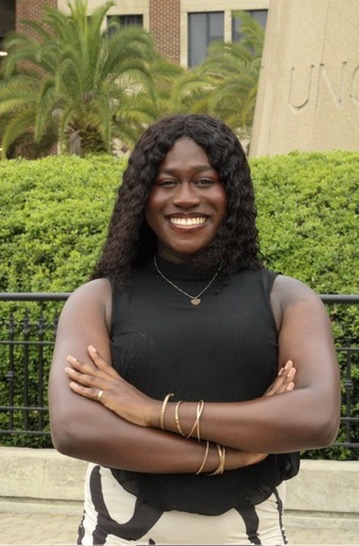
MJ Pierre is a third year student at Florida State University and is beyond grateful for the opportunity to present her research at the Undergraduate Research Symposium. She is currently pursuing her Bachelor of Science in Psychology with a minor in Sociology. Her ultimate goal is to earn her PhD in Social Psychology after her undergraduate studies, with a specific concentration on mentorship and nontraditional family systems. Through this experience, she has refined her research skills, engaged in meaningful discussions, and contributed to studies that deepen our understanding of bias, group dynamics, and social belonging. She is excited to present her Honors in the Major thesis and share the project she's been working on all year!
Spontaneous Evaluations of Non-Traditional Couples and Family Systems
Authors: M.J. Pierre, Irmak Olcaysoy Okten, PhDStudent Major: Psychology
Mentor: Irmak Olcaysoy Okten, PhD
Mentor's Department: Psychology Mentor's College: Arts and Sciences Co-Presenters:
Abstract
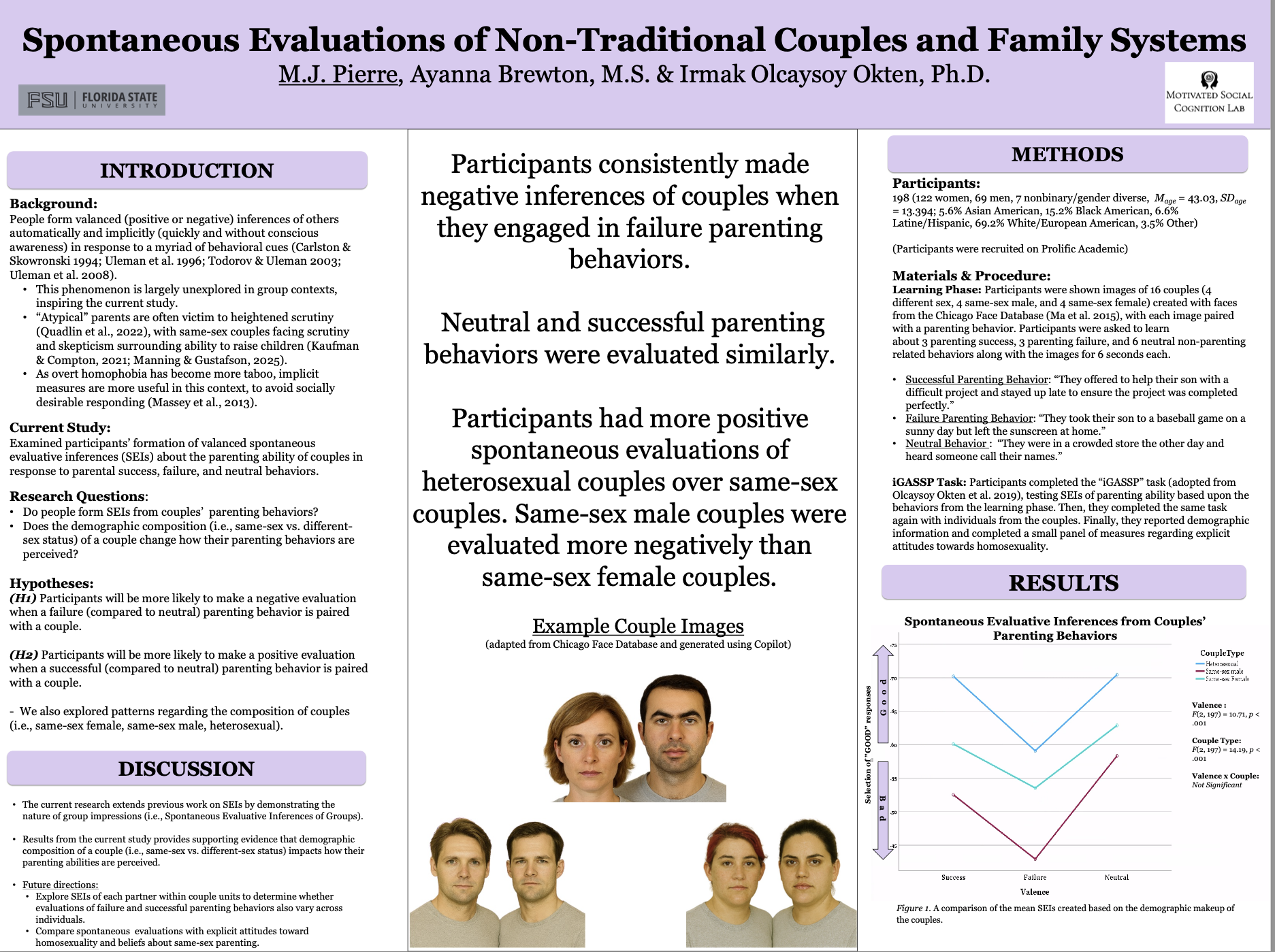
Throughout modern history, public perceptions of what constitutes a family have changed rapidly. While previous research has looked at explicit attitudes about families (Manning & Gustafson, 2025), there is limited research regarding implicit (i.e., spontaneous) impressions of family dynamics. Particularly, while spontaneous trait inferences for groups (STIGs) are previously documented (Hamilton et al. 2015), spontaneous evaluative inferences (i.e., global evaluations of positivity and negativity) made about groups (SEIGs) of any sort have gone largely unexplored. The current work investigated spontaneous evaluative inferences (SEIs) specifically surrounding traditional and nontraditional couples’ parental abilities. Prolific Academic users (N= 200) completed the iGASSP task to assess SEIs of everyday parenting behaviors (including small failures and successes) across couples from different demographic compositions. We also explored those same participants explicit opinions surrounding traditional and nontraditional families. Our findings provide evidence that (1) participants form SEIGs from couples’ parenting behaviors with more positive evaluations of successful and neutral behaviors than failure behaviors, and (2) SEIGs from couples’ parenting behaviors differ based on their demographic compositions. Our work provides insight into the ways various family units are perceived as they navigate parenthood.
Keywords: First Impressions, Family, Parenting