
Research Symposium
26th annual Undergraduate Research Symposium, April 1, 2026
Pia Dinamarca Poster Session 3: 1:45 pm - 2:45 pm / Poster #175

BIO
Pia Dinamarca is a senior Chemical Engineering honors student with a strong passion for energy systems and advanced materials. Originally from Santiago, Chile, she moved to the United States to pursue her bachelor’s degree and expand her academic and professional opportunities. She is currently completing her Honors in the Major thesis, where she focuses on research involving thermal transport and material behavior.
Her research interests include heat recovery systems and solid polymer electrolytes for battery applications, driven by a broader goal of improving energy efficiency and advancing sustainable technologies. Through her work, she aims to contribute to the development of safer, higher-performance batteries and innovative energy solutions.
Looking ahead, Pia plans to pursue graduate studies and build a career at the intersection of research, manufacturing, and energy, where she can make a meaningful impact on the future of sustainable engineering.
Thermal Gradient Infrared Spectroscopy of Polymer Electrolytes for Sodium Batteries
Authors: Pia Dinamarca, Daniel HallinanStudent Major: Chemical Engineering
Mentor: Daniel Hallinan
Mentor's Department: Chemical and Biomedical Engineering Mentor's College: College of Engineering Co-Presenters:
Abstract
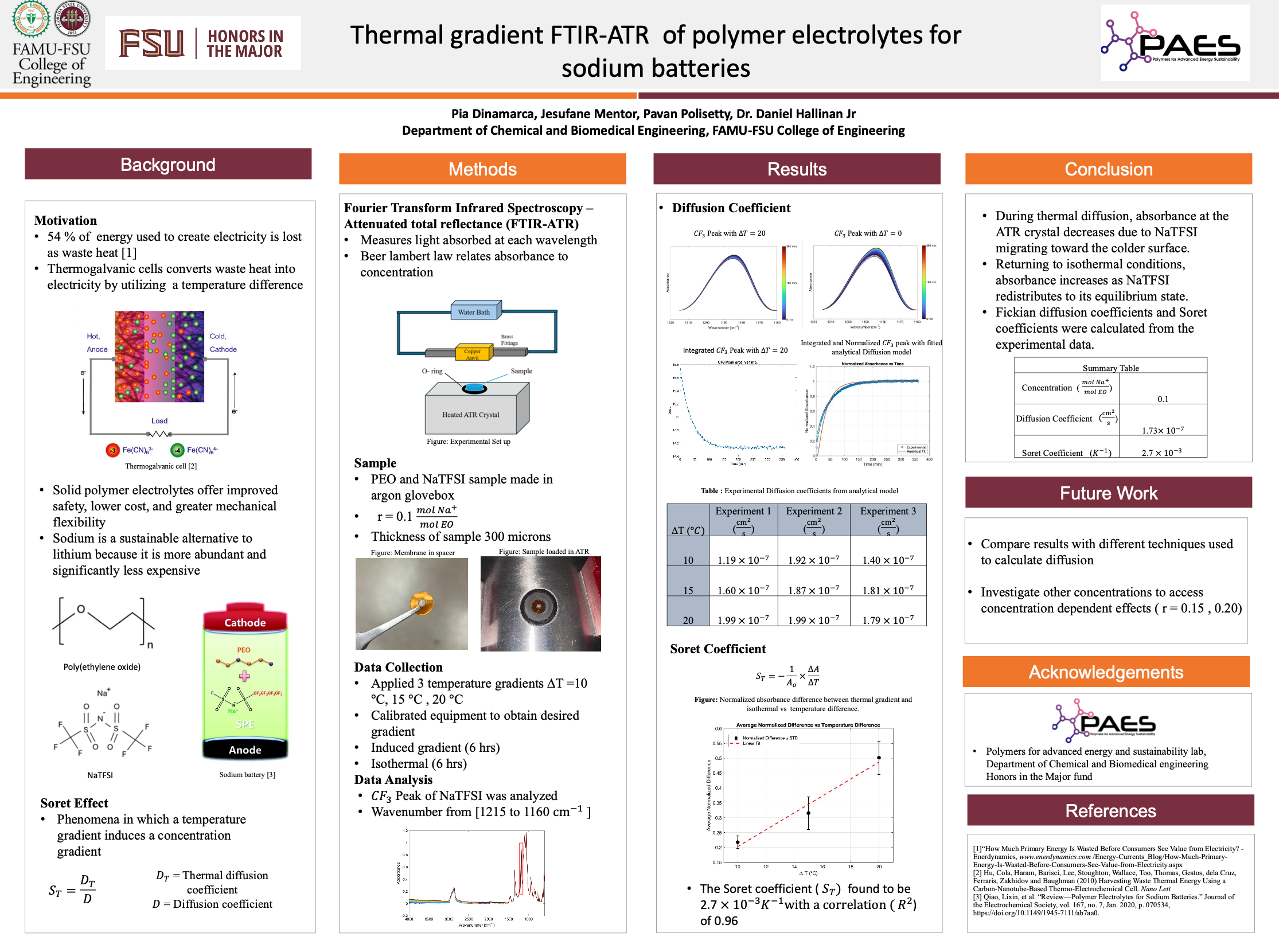
Fourier Transform infrared – attenuated total reflectance (FTIR-ATR) spectroscopy was used to measure salt diffusion in solid polymer electrolytes for sodium batteries. The polymer electrolyte was poly(ethylene oxide) (PEO) mixed with sodium bis-trifluoromethanesulfonylimide (NaTFSI) salt. This approach presents an induced temperature gradient to observe thermally driven mass diffusion (via the Soret Effect). The system is then returned to isothermal state to measure Fickian Diffusion. Concentration changes due to mass diffusion driven by temperature and salt concentration gradients are tracked using FTIR-ATR absorbance that is related to concentration through the Beer-Lambert Law. This study covered one molar ratio and three different temperature gradients 10 C, 15 C , 20 C. Even though lithium provides higher energy density, costs are higher and availability is limited, making sodium a proposed alternative. This technique provides a systematic framework to investigate the potential of sodium in both batteries and thermogalvanic cells for waste heat recovery.
Keywords: Batteries, polymers , solid polymer electrolytes, FTIR-ATR