
Research Symposium
26th annual Undergraduate Research Symposium, April 1, 2026
Jordan Faskowitz Poster Session 4: 3:00 pm - 4:00 pm / Poster #46

BIO
Jordan Faskowitz is from Tampa, Florida. She is set to graduate Bachelor of Science in Economics with a Minor in Criminology May 2026. She will then start her Masters in Applied Economics at FSU in Fall 2026.
How does a municipality’s National Flood Insurance Program class rating influence, if at all, median property values across Florida?
Authors: Jordan Faskowitz, Crystal TaylorStudent Major: Bachelor of Science in Economics with a Minor in Criminology
Mentor: Crystal Taylor
Mentor's Department: Economics Mentor's College: Florida State University COSSPP Co-Presenters:
Abstract
Background: In 2023, Florida experienced two major flooding events causing more than $26 billion in damages (NOAA, 2026). To balance disaster costs, FEMA offers flood insurance premiums that typically range from $700 to $900 annually per household (FEMA, 2025). Prior research shows that, outside highly desirable coastal areas, buyers tend to avoid flood-prone properties due to perceived risk. Given Florida’s already high housing costs, mandatory flood insurance may further discourage homeownership in areas vulnerable to flooding. The National Flood Insurance Program, offered by FEMA, addresses flood risk, also offering a voluntary Community Rating System (CRS), which rewards local governments that adopt flood-mitigation efforts with insurance premium discounts. This study brings attention to how mitigation efforts themselves influence housing markets.
Research Question: With asking the following: How does a municipality’s National Flood Insurance Program’s class rating influence, if at all, property values across Florida?
Methodology: Using municipality-level data from 403 Florida municipalities pulled from FEMA, the U.S. Census Bureau, and NOAA, this study conducts ordinary least squares regressions. Median property value serves as the dependent variable, while preliminary explanatory variables include CRS class rating, coastal location, population, and median household income.
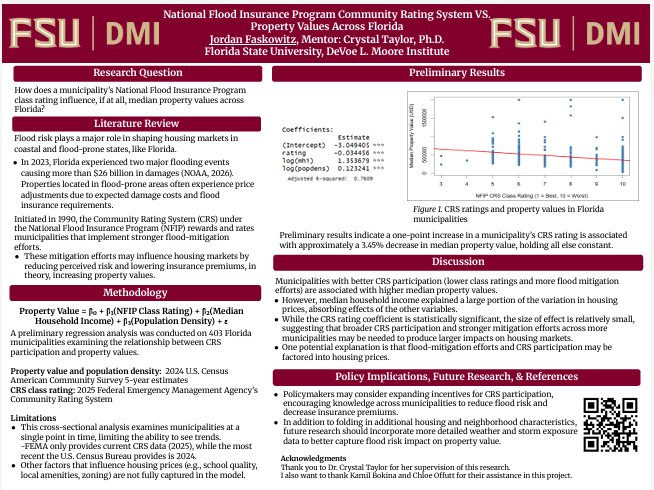
Results: Preliminary results show a negative relationship between CRS ratings and property values, suggesting that stronger mitigation efforts are associated with lower property values. Coastal municipalities, however, exhibit higher property values, reflecting strong demand for coastal amenities despite flood risk. These findings suggest CRS participation may decrease flood risk but does not necessarily generate housing market benefits as suspected.
Keywords: FEMA, Flooding, Property Value