
Research Symposium
26th annual Undergraduate Research Symposium, April 1, 2026
Camille Crump Poster Session 1: 9:30 am - 10:30 am / Poster #303

BIO
Camille Crump is a junior pursuing a Bachelor of Science in Mechanical Engineering. She is an undergraduate researcher at the High Performance Materials Institute, where she conducts research under Dr. Zhiyong Liang and is mentored by Dr. Cecil Evers, Dr. Murray Gibson, and Dr. Joshua DeGraff. Her research investigates the effects of thermal processing on the thermoresistive properties of carbon nanotube yarns, with an emphasis on their potential as high-temperature sensing materials. Her broader interests include the design and processing of advanced materials for use in extreme environments for aerospace applications.
Study of High-Temperature Carbon Nanotube Yarn Sensor
Authors: Camille Crump, Dr. Zhiyong LiangStudent Major: Mechanical Engineering
Mentor: Dr. Zhiyong Liang
Mentor's Department: Industurial and Manufacturing Engineering Mentor's College: Florida State University Co-Presenters:
Abstract
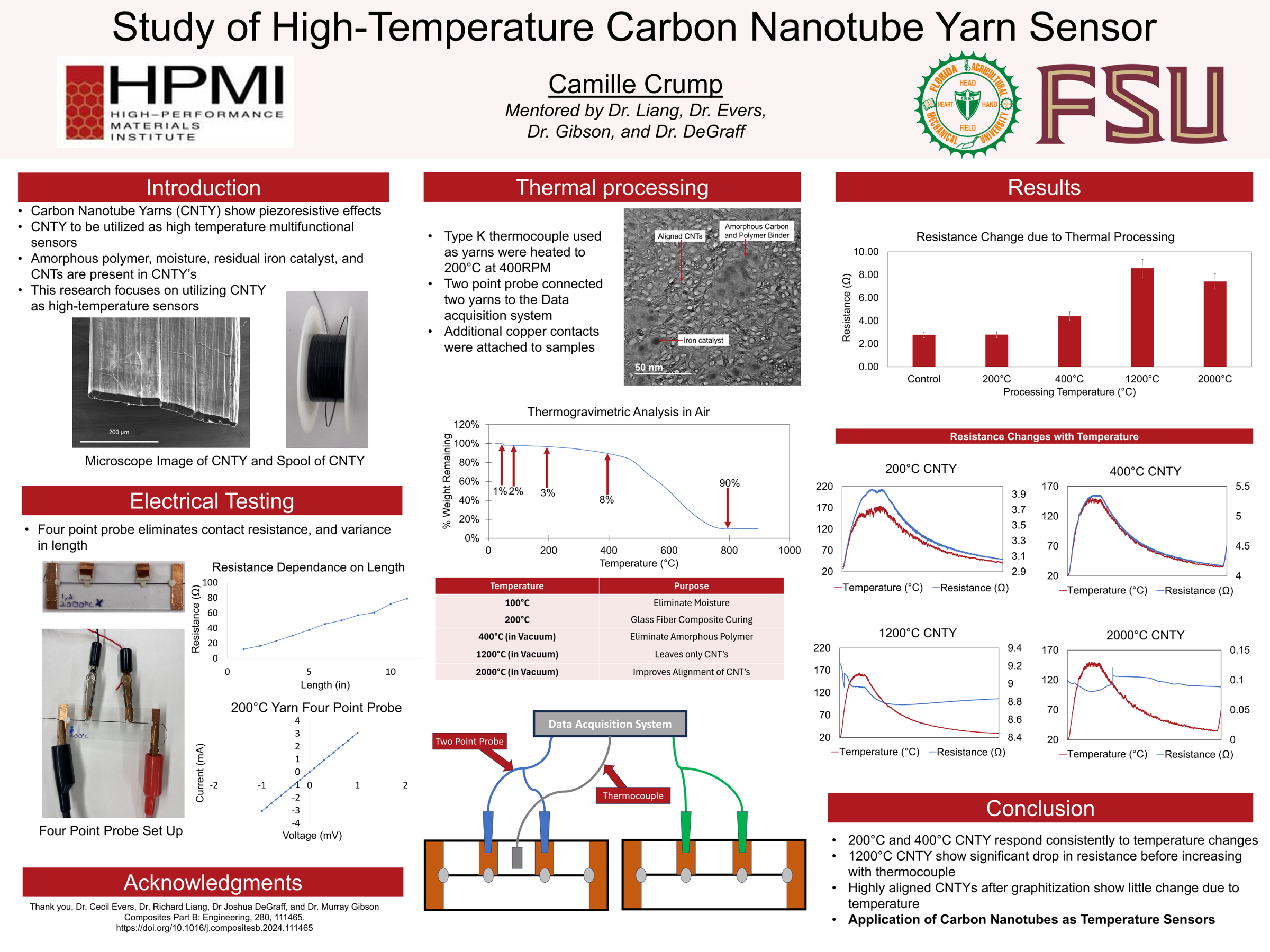
Carbon nanotube yarns are over 80% aligned bundles of carbon nanotubes. The resistance in the yarns is limited not by the resistivity in the individual carbon nanotubes, but by the geometric changes between tubes and their bundles. This geometry-dependent resistance makes CNT yarns promising multifunctional sensors. Currently, CNT yarns are used as strain sensors at room temperature, enabling real-time collection of resistance changes. This research aims to study the impact of thermal processing on the thermoresistive reliability of carbon nanotube yarns for use as temperature sensors outside of a composite laminate. Thermogravimetric analysis indicates an 8% mass loss at 300°C and oxidation at 400°C. CNT yarns will undergo thermal processing at 100°C and 200°C in air, and 400°C, 1200°C, and 2000°C in a vacuum to avoid oxidation. At these temperatures, the reliability of the yarns is determined by compositional and microstructural purification, including the removal of moisture, amorphous polymer, and iron, as well as by structural changes in the yarns. Four-point probe data of thermally processed yarns show an increase in resistance from 2.77Ω to 8.58Ω after carbonization; however, after graphitization, resistance falls to 7.42Ω. Repeatable resistance response will then be tested with continuous thermal cycling while monitoring real-time changes in resistance. Introductory results show increased sensitivity in thermally processed yarns, along with improved repeatability between cycles for yarns processed at 400°C. These results support the use of carbon nanotube yarns as temperature sensors, with additional multifunctional sensing capabilities.
Keywords: Carbon nanotube Thermoresistive Materials Sensors