
Research Symposium
26th annual Undergraduate Research Symposium, April 1, 2026
Daniel Adams Poster Session 1: 9:30 am - 10:30 am / Poster #9

BIO
Daniel Adams is a fourth-year student, majoring in Psychology with minors in Statistical Methodology and General Business. His research involvements include completing an undergraduate Honors Thesis and working as a lab coordinator in the Motivated Social Cognition (MSC) Lab under Dr. Irmak Olcaysoy Okten. His primary research interests include furthering the understanding of positive psychology, its use in applied settings, and the effects of lifestyle interventions on mental health outcomes. His desire to continue contributing valuable work to the field has led him to apply to Counseling Psychology doctoral programs and various Master's level programs.
Does Intellectual Humility Predict the Discernment of Mental Health Information Quality?
Authors: Daniel Adams, Dr. Irmak Olcaysoy OktenStudent Major: Psychology
Mentor: Dr. Irmak Olcaysoy Okten
Mentor's Department: Psychology Mentor's College: FSU College of Arts and Sciences Co-Presenters:
Abstract
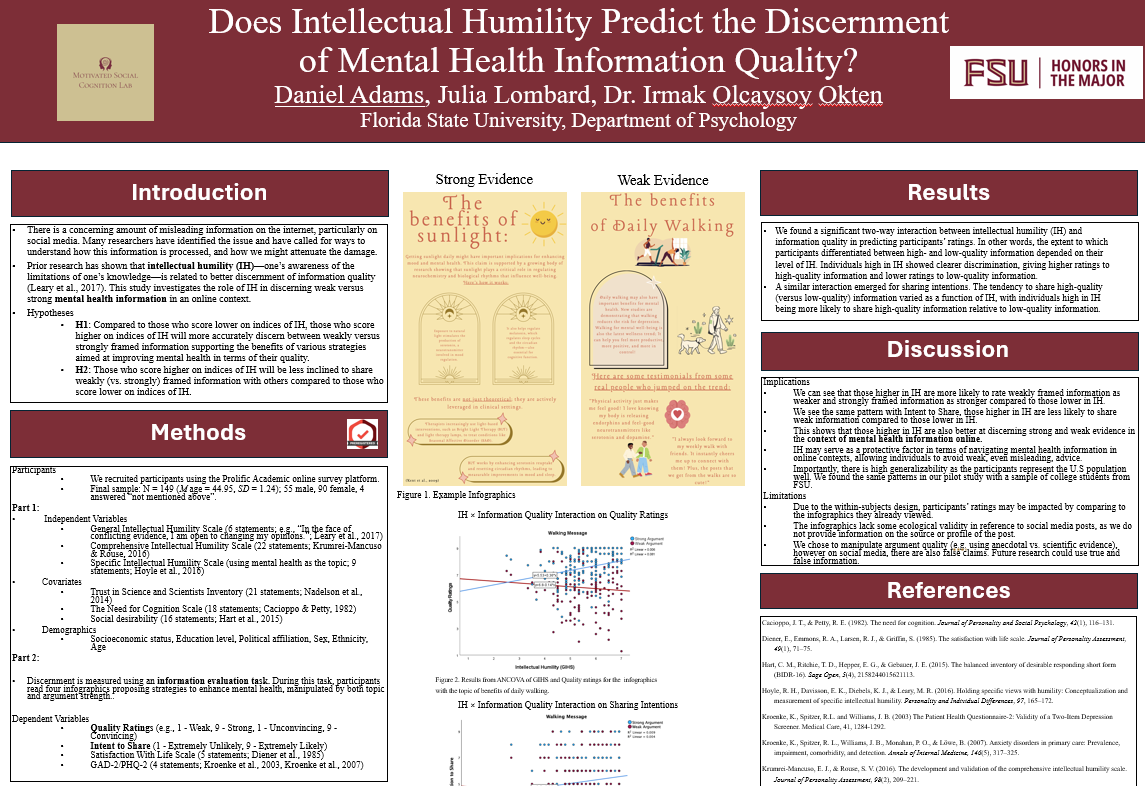
There is a concerning amount of misleading information on the internet, particularly on social media. Many researchers have identified the issue and have called for ways to understand how this information is processed, and how we might mitigate the damage. Prior research has shown that intellectual humility (IH)—one’s metacognitive awareness of limitations of one’s knowledge—is related to better discernment of information quality. This study uniquely investigated the role of IH in discerning weak from strong mental health information in online contexts. In this study, 149 participants from the Prolific Academic platform engaged in a two-part study. In the first, participants completed IH scales along with covariates of interest. In the second part, participants read four social media-style infographics containing information, manipulated by strength and strategy to enhance mental health, then rated the information on metrics of quality and likelihood to share. We found a significant two-way interaction between IH and information quality in predicting participants’ ratings. In other words, the extent to which participants differentiated between high‑ and low‑quality information depended on their level of IH. Individuals high in IH showed clearer discrimination, giving higher ratings to high‑quality information and lower ratings to low‑quality information. A similar interaction emerged for sharing intentions. This study may indicate the importance of cultivating this intellectual virtue as a means of safeguarding social media users against weak or misleading claims about mental health.
Keywords: Intellectual Humility (IH), Mental Health