
Research Symposium
26th annual Undergraduate Research Symposium, April 1, 2026
Janevia Davis Poster Session 2: 10:45 am - 11:45 am / Poster #310

BIO
Janevia is a sophomore in college from Fort Lauderdale, Florida, with a strong passion for supporting children and adolescents through education, advocacy, and mental health care. Her
academic interests center on child development, literacy, behavior, and the long-term impact of early intervention on children’s success. Janevia is especially interested in how literacy influences children’s cognitive development, behavior, and overall outcomes, including the ways early support can shape future academic and personal achievement. Her research interests focus on the relationships among literacy, IQ, behavior, and early intervention for children and adolescents, and she is passionate about exploring how access to educational resources and developmental support can improve outcomes for young people and help them thrive both in and out of the classroom. Janevia is also interested in understanding how these factors affect emotional well-being and future opportunities. Her career goals are to become a child therapist, open my own practice serving adolescents, and eventually become a professor to educate and inspire others in this field. Through both clinical work and teaching, she hopes to make a lasting impact on the lives of children and families while contributing meaningful research that supports healthier developmental outcomes.
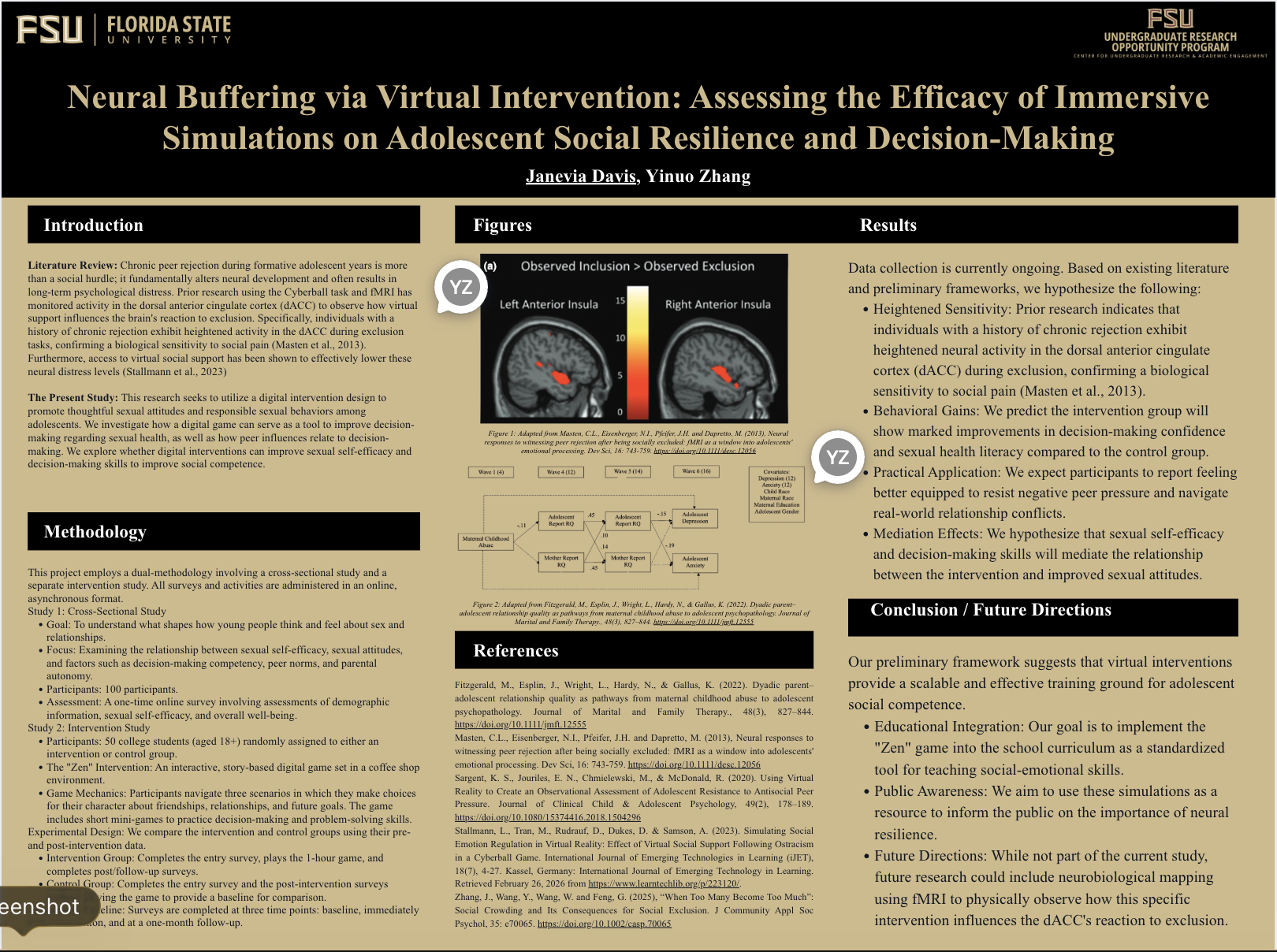
Neural Buffering via Virtual Intervention: Assessing the Efficacy of Immersive Simulations on Adolescent Social Resilience and Decision-Making
Authors: Janevia Davis, Yinuo ZhangStudent Major: Psychology
Mentor: Yinuo Zhang
Mentor's Department: Human Development and Family Sciences Mentor's College: Annes Spencer Daves College of Education, Health, and Human Sciences Co-Presenters:
Abstract
This research investigates how chronic peer rejection shapes adolescent neural development
and whether virtual reality or specific communication frameworks can mitigate these
negative social effects. We explore these questions because social isolation during
developmental years often leads to long-term psychological distress, making it vital to
identify interventions that foster resilience. This is relevant to readers because it highlights
how digital tools and relationship theories like the Five Love Languages can improve
emotional health in youth. To conduct this study, we analyzed longitudinal data and utilized
virtual reality simulations, such as the Cyberball task with adolescent participants, to observe
social emotion regulation in real time. Our methodology employed a neurobiological
framework to measure brain activity alongside observational assessments of peer pressure
resistance. Results showed that individuals with a history of chronic rejection exhibited
significantly higher activity in the anterior cingulate cortex during social exclusion,
indicating a heightened sensitivity to pain. However, findings also demonstrated that virtual
social support effectively lowered distress levels, suggesting that digital environments can
buffer the impact of ostracism. These results suggest that while early rejection creates
biological vulnerabilities, virtual interventions offer a practical way to build social
competence. Future research should investigate how these virtual support models can be
implemented in schools to help students navigate antisocial peer pressure and improve
overall relationship quality.
Keywords: chronic peer rejection, virtual reality interventions