
Research Symposium
26th annual Undergraduate Research Symposium, April 1, 2026
Matthew Baca Poster Session 3: 1:45 pm - 2:45 pm / Poster #173

BIO
Matthew Baca is a first-year undergraduate student at Florida State University pursuing a Bachelor of Science in Exercise Physiology on the pre-health track. Originally from Miami, Florida, he graduated from MAST@FIU with both a high school diploma and an Associate of Arts degree from Florida International University.
Matthew has gained early clinical exposure through shadowing experiences in dermatology and ear, nose, and throat (ENT), where he observed patient care, diagnostic processes, and treatment planning. He is also actively involved on campus as a University Ambassador, where he leads campus tours and engages with prospective students and families. Additionally, he has participated in and facilitated the Service Leadership Seminar, contributing to service initiatives such as supporting the Food for Thought pantry and working with Habitat for Humanity.
His interests include human health, community engagement, and improving patient experiences. Matthew plans to pursue medical school and a career as a physician.
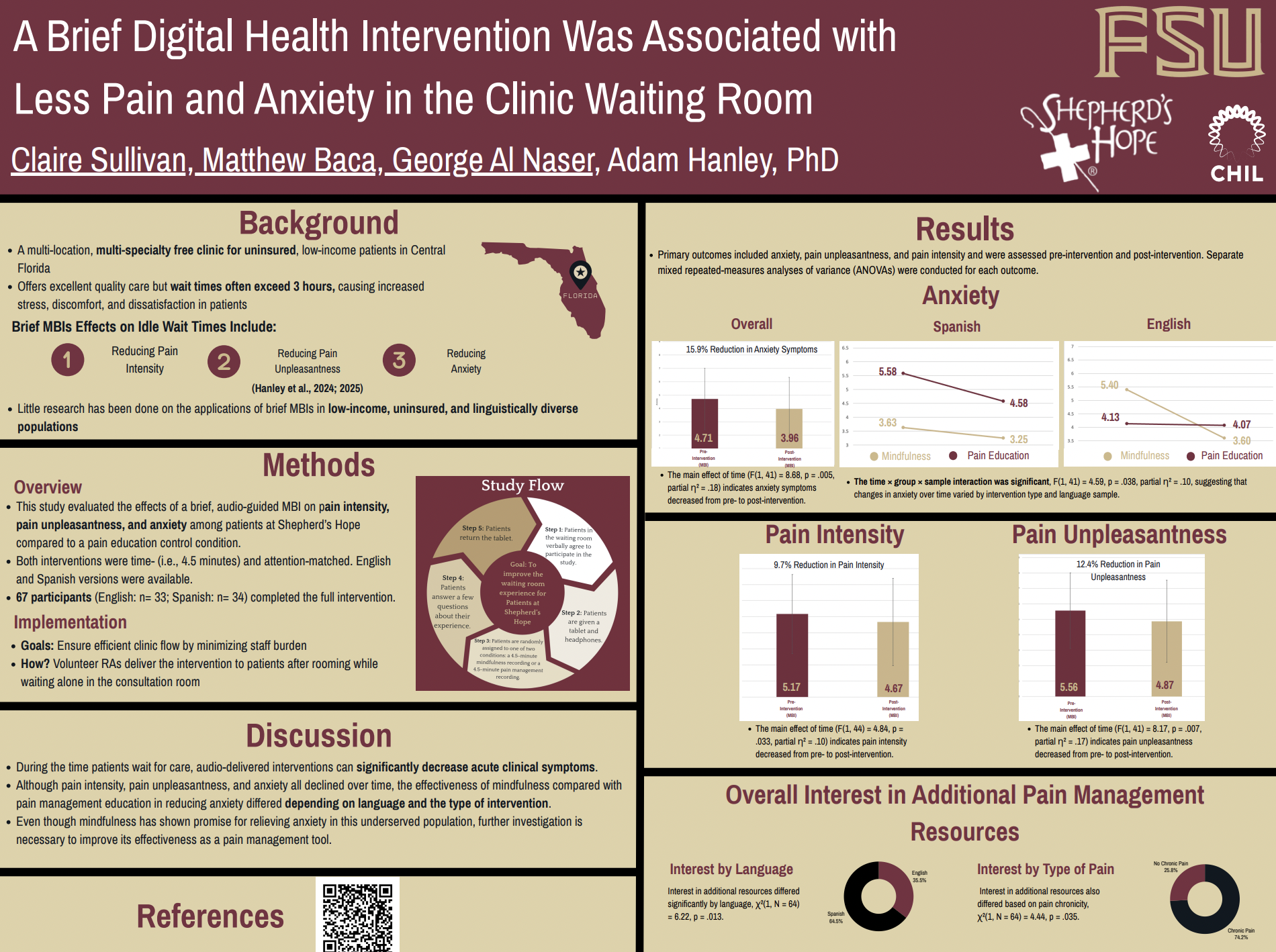
A Brief Digital Health Intervention Was Associated with Less Pain and Anxiety in the Clinic Waiting Room
Authors: Matthew Baca, Adam HanleyStudent Major: Exercise Physiology
Mentor: Adam Hanley
Mentor's Department: Nursing Mentor's College: College of Nursing Co-Presenters: Claire Sullivan and George Al Naser
Abstract
Shepherd’s Hope is a multi-specialty free clinic serving uninsured, low-income patients in Central Florida. While the quality of care is excellent, wait times at the clinic often exceed 3 hours, contributing to stress, discomfort, and dissatisfaction in patients. Brief mindfulness-based interventions are effective in reducing pain intensity, pain unpleasantness, and anxiety during idle wait times, though little research has been done on the efficacy of brief MBIs in low-income, uninsured, and linguistically diverse populations. This study evaluated the effects of a 4.5-minute, audio-guided MBI on acute pain and anxiety symptoms among patients at Shepherd’s Hope (n=67) relative to a pain education control condition. The main effect of time for anxiety, (F(1, 41) = 8.68, p = .005, partial η² = .18), pain unpleasantness (F(1, 41) = 8.17, p = .007, partial η² = .17), and pain intensity (F(1, 44) = 4.84, p = .033, partial η² = .10) indicates that anxiety and pain symptoms decreased from pre- to post-intervention. For anxiety, there was a significant time × group × sample interaction (F(1, 41) = 4.59, p = .038, partial η² = .10), indicating that changes in anxiety over time varied by intervention type and language sample. Interest in additional pain management resources also differed significantly depending on language (χ²(1, N = 64) = 6.22, p = .013) and pain chronicity (χ²(1, N = 64) = 4.44, p = .035). The results suggest that brief, audio-delivered interventions can meaningfully decrease clinical symptoms during the idle time spent waiting for care.
Keywords: Health Intervention Mindfulness