
Research Symposium
26th annual Undergraduate Research Symposium, April 1, 2026
Madelyn Thompson Poster Session 1: 9:30 am - 10:30 am / Poster #245

BIO
Madelyn Thompson is a 3rd year Psychology major and an aspiring Clinical Psychologist. After finishing her undergraduate career with a Bachelor of Science in Psychology, she hopes to join a Clinical Psychology PhD program to continue research in the field of Clinical Psychology. Madelyn’s current research interests include the areas of anxiety, anxiety sensitivity, as well as the development of anxiety and related disorders throughout the lifespan, with hopes to expand to etiology research in other domains of maladaptive psychopathologies. Madelyn currently assists with research in the Platypus Lab under The Florida Center for Reading Research, The Anxiety and Behavioral Health Clinic, and is a Registered Behavioral Therapist for children diagnosed with Autism Spectrum Disorder.
Disentangling Genetic and Environmental Influences on the Development of Childhood Anxiety Symptoms
Authors: Madelyn Thompson, Madison PoisallStudent Major: Psychology
Mentor: Madison Poisall
Mentor's Department: Psychology Mentor's College: Arts and Sciences Co-Presenters:
Abstract
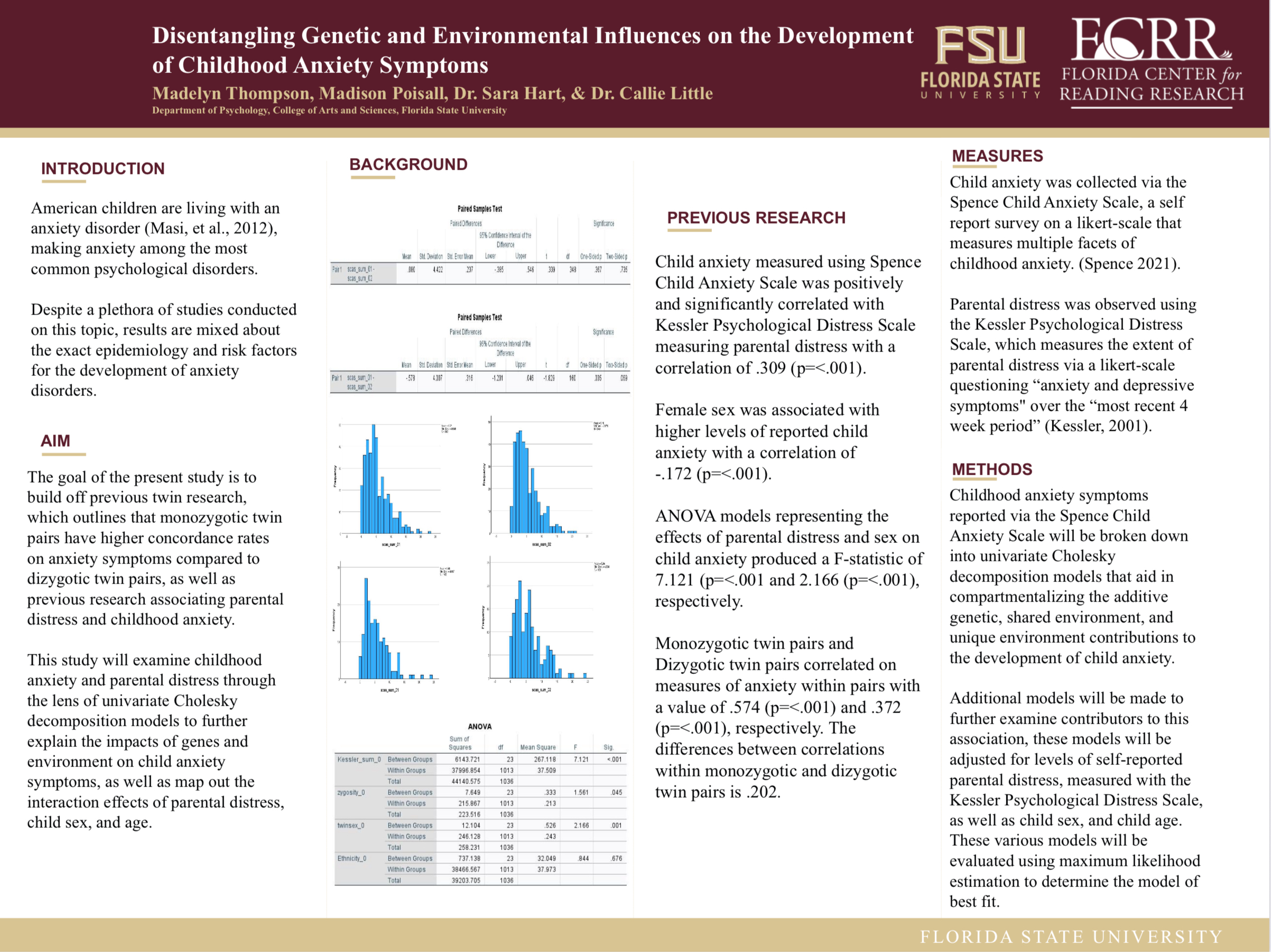
Previous research outlines that 10-20% of children worldwide live with maladaptive psychological disorders, including anxiety; which continues to develop and persist into adulthood (Durbeej, et al., 2019). In the context of anxiety, 20% of American children are living with an anxiety disorder (Masi, et al., 2012), making anxiety among the most common psychological disorders. Despite this, little is known about the exact epidemiology and risk factors for the development of anxiety disorders. Initial findings from personal research conducted via a correlational twin study yielded that monozygotic twin pairs correlated significantly higher with each other than dizygotic twin pairs on measures of childhood anxiety, which suggests genetic effects on the development of anxiety symptoms. Results also showed a positive and significant correlation between parental distress and
childhood anxiety, and significant sex differences, with females scoring higher on measures of anxiety symptoms. This suggests that there are many components to the development of child anxiety symptoms which includes: genetic variations, parental distress, and sex differences. The current study will build off this preliminary background to outline future statistical methods that will further research within the field. This will be achieved through the proposed statistical analyses, which will include univariate Cholesky
decomposition models, utilized to break down the effects of genetic contributions, shared environmental, and unique environmental influences on the development of anxiety symptoms via twin study. These models will also be adjusted to better understand how sex differences, age, and measures of parental distress contribute to the development of childhood anxious psychopathologies
Keywords: Child anxiety and twin study