
Research Symposium
26th annual Undergraduate Research Symposium, April 1, 2026
Jenna Haupert Poster Session 1: 9:30 am - 10:30 am / Poster #37

BIO
Hi, my name is Jenna Haupert. I am a third-year Behavioral Neuroscience and Business Management dual major from Parkland, Florida. I am on the premedical track with the goal of owning my medical practice one day. I am currently conducting research at FSU’s Coastal and Marine Laboratory under the mentorship of Dr. Alyssa Andres, studying the thermal tolerance of different fish species through metabolic and behavioral analysis. Additionally, I serve as a Crew Leader for FSU’s Medical Response Unit, where I volunteer as an EMT, gaining hands-on emergency medical experience. I am also a member of FSU’s Honors Program and Student Association.
A Comparison of Atlantic Stingray and Hardhead Catfish Thermal Tolerance
Authors: Jenna Haupert, Dr. Alyssa AndresStudent Major: Behavioral Neuroscience and Management
Mentor: Dr. Alyssa Andres
Mentor's Department: FSU Coastal and Marine Laboratory Mentor's College: College of Arts and Sciences Co-Presenters:
Abstract
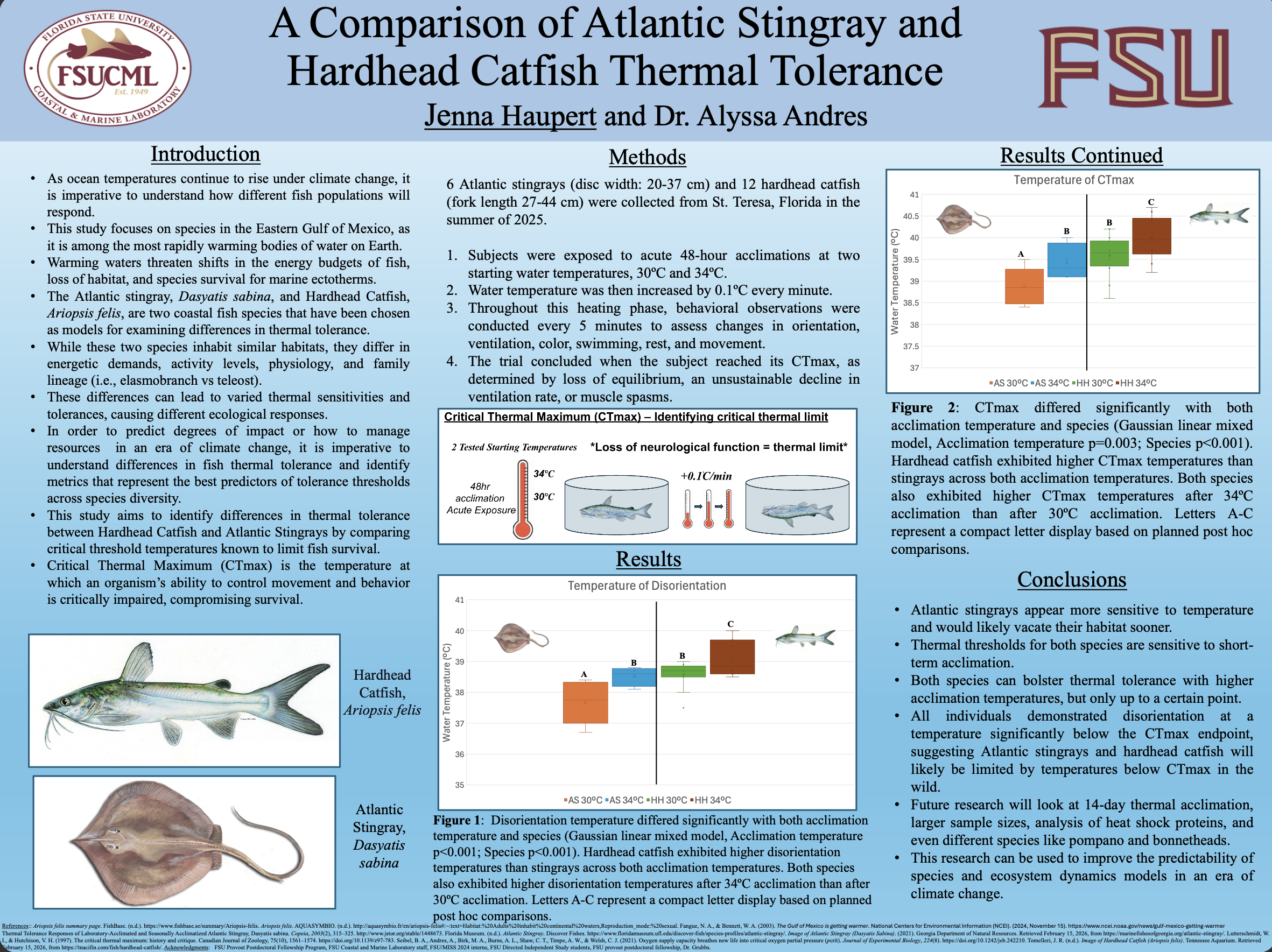
As ocean temperatures continue to rise under climate change and the frequency and prevalence of marine heatwaves increase, it is imperative to understand the diversity of fish species' responses and the vulnerability of fish populations to these environmental stressors. The Atlantic stingray (Dasyatis sabina) and hardhead catfish (Ariopsis felis) are two coastal fish species that have been chosen as models for examining differences in thermal tolerance since they inhabit similar habitats but differ in energetic demands, activity levels, and family lineage. This study aims to identify differences in thermal tolerance between model species by comparing critical threshold temperatures known to limit fish survival. Critical thermal thresholds were defined by the temperature at which each individual experienced neurological and behavioral impairment, known as the critical thermal maximum (CTmax). Subjects were exposed to acute 48-hour acclimations at two starting water temperatures, 30ºC and 34ºC. Water temperature was increased by 0.1ºC until their CTmax was reached. We found that, despite hardhead catfish having a higher CTmax on average than Atlantic stingrays across both starting temperatures, both species had higher CTmax after 34ºC acclimation than after 30ºC acclimation. These findings suggest that Atlantic stingrays appear more sensitive, and would likely vacate habitat sooner, and that thermal thresholds are sensitive to short-term acclimation. This suggests that both species can bolster thermal tolerance with higher acclimation temperatures, up to a point. This research can be used to improve the predictability of species and ecosystem dynamics models in an era of climate change.
Keywords: Fish, temperature, physiology,