
Research Symposium
26th annual Undergraduate Research Symposium, April 1, 2026
Matthew Hutchins Poster Session 1: 9:30 am - 10:30 am / Poster #165

BIO
Matthew Hutchins, originally from Titusville, Florida, is currently a senior Biomedical Engineering student in the Honors in the Major program at Florida State University with a strong interest in cell and tissue engineering. He is constantly drawn to the forefront of scientific innovation and hope to channel my background into an industry role in medical device development, product strategy, or technical support that contributes to meaningful advances in human health. His commitment to advancing biotechnological solutions reflects his ambition to leave a lasting impact on global health.
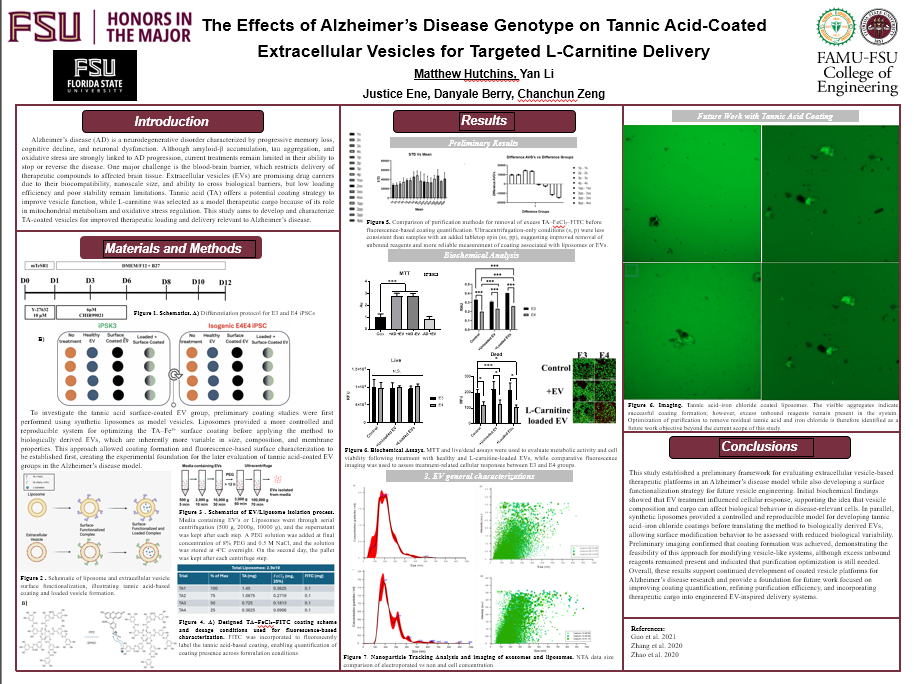
The Effects of Alzheimer’s Disease Genotype on Tannic Acid-Coated Extracellular Vesicles for Targeted L-Carnitine Delivery
Authors: Matthew Hutchins, Dr. Yan LiStudent Major: Biomedical Engineering
Mentor: Dr. Yan Li
Mentor's Department: Chemical and Biomedical Engineering Mentor's College: Engineering Co-Presenters:
Abstract
Alzheimer’s disease (AD) is a progressive neurodegenerative disorder that affects millions of individuals worldwide and currently lacks an effective cure. A major obstacle in therapeutic development lies in the restricted permeability of the blood–brain barrier (BBB), which prevents most drugs from reaching targeted neural regions. Nanomedicine-based approaches have emerged as promising solutions, with extracellular vesicles (EVs) offering biocompatible and naturally derived carriers capable of crossing biological membranes. However, inconsistent stability and limited drug loading efficiency have hindered their widespread application in neurodegenerative therapy. This research aims to enhance vesicle stability and therapeutic potential through the development of a tannic acid (TA) and iron chloride (FeCl₃)–based coating, forming metal–phenolic complexes on the surface of lipid vesicles. These coatings are designed to improve membrane robustness and enable controlled binding of therapeutic molecules such as L-carnitine, a neuroprotective compound known to mitigate oxidative stress and support mitochondrial function. Fluorescent liposomes will serve as model systems to optimize coating parameters and assess fluorescence uniformity using fluorescein isothiocyanate (FITC) functionalization. It is anticipated that TA–Fe³⁺ coated liposomes will exhibit improved coating uniformity and enhanced encapsulation stability compared to uncoated controls. Results from these preliminary studies will provide foundational data for translating this coating approach to biologically derived EVs, advancing the development of targeted nanocarriers for Alzheimer’s therapy.
Keywords: EV, Coating, Tannic Acid