
Research Symposium
26th annual Undergraduate Research Symposium, April 1, 2026
Gabriella Virga Poster Session 2: 10:45 am - 11:45 am / Poster #94

BIO
Gabriella Virga is a third-year Behavioral Neuroscience student from Fanwood, New Jersey. This is her fifth semester as a DIS student in the Florida Center for Reading Research on the National Project for Achievement in Twins. Her research interests include psychopathology and the physiological, behavioral, and cognitive responses to stress and mental disorders. She is a pre-medical student who aspires to be a psychiatrist in the future.
ADHD Symptoms, Executive Dysfunction, and Perceived Stress
Authors: Gabriella Virga, Madison PoisallStudent Major: Behavioral Neuroscience
Mentor: Madison Poisall
Mentor's Department: Department of Psychology Mentor's College: College of Arts and Sciences Co-Presenters:
Abstract
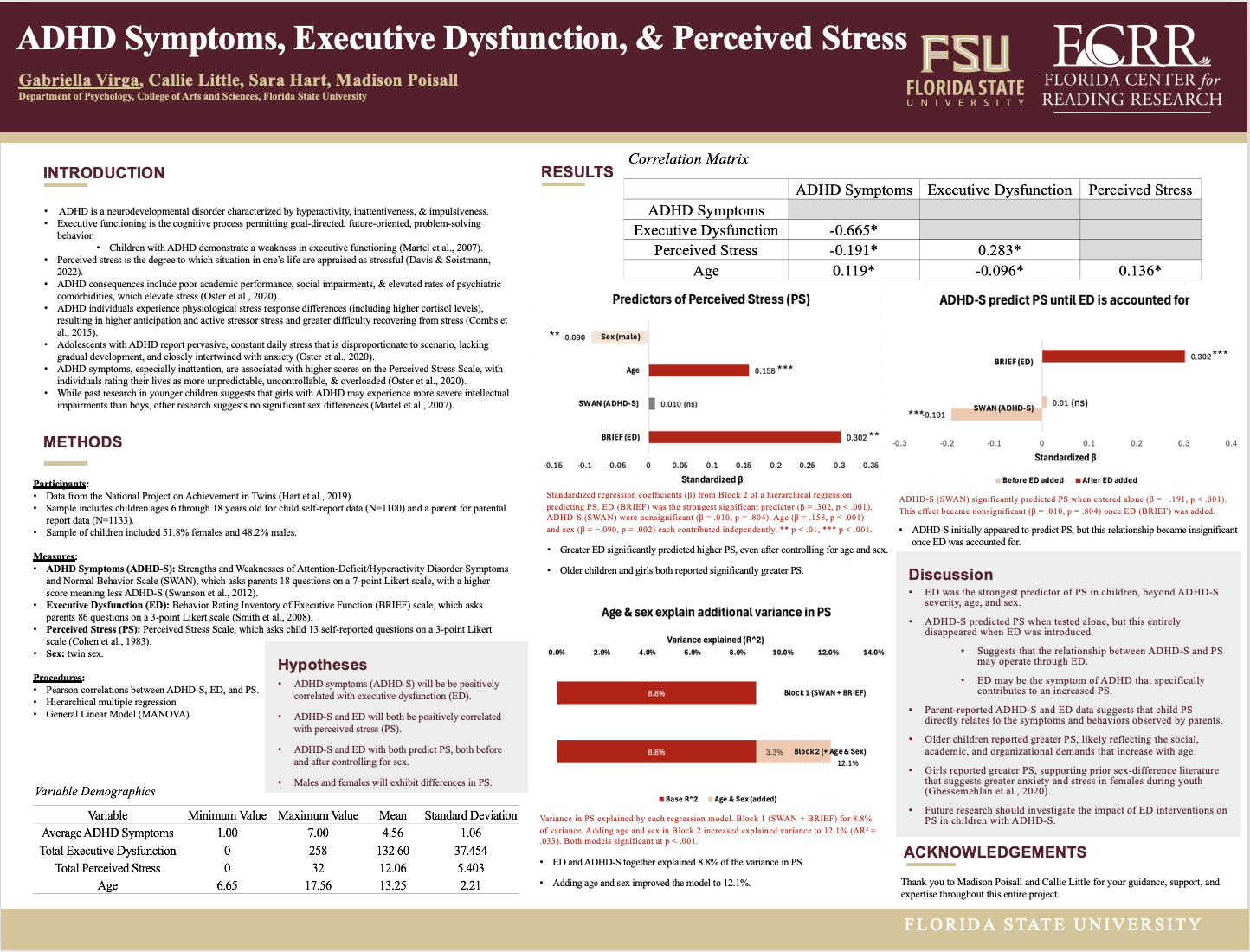
Attention Deficit Hyperactivity Disorder (ADHD) symptoms and executive dysfunction are key indicators of ADHD (Combs et al., 2015). Prior research suggests that individuals with ADHD may experience persistent chronic stress disproportionate to situations that impact daily life (Oster et al., 2020). Additionally, research suggests a disparity in recognition of ADHD symptoms by sex between teachers and parents. Findings show that while teachers and parents tend to agree on male ADHD symptom reports, teachers tend to rate females significantly lower, with parents actually reporting higher female inattention (Isaksson et al., 2016). The relationship between children presenting ADHD symptoms and executive dysfunction with elevated levels of perceived stress is not fully understood, especially when accounting for sex differences. The present study aims to investigate the relationship between ADHD symptoms, executive dysfunction, and perceived stress, and the role of sex in these associations. Using data from the National Project on Achievement in Twins (NatPAT; Hart et al., 2019) study, we will examine associations between ADHD symptoms, executive dysfunction, and perceived stress using Pearson correlations, linear regressions, and general linear models to further explore these associations, before and after controlling for age and sex. We hypothesize that ADHD symptoms and executive dysfunction will both be positively correlated with perceived stress, and that males and females will exhibit differences in perceived stress. This research will help inform better in-school and at-home mental health support for students struggling with ADHD symptoms and executive dysfunction.
Keywords: ADHD, Executive Dysfunction, and Perceived Stress