
Research Symposium
26th annual Undergraduate Research Symposium, April 1, 2026
Lanie Klein Poster Session 1: 9:30 am - 10:30 am / Poster #207

BIO
Lanie Klein is a second-year student at Florida State pursuing a major in Psychology and a minor in Business. This is her first year participating in the UROP program under research mentor Trey Wood, but she plans to continue doing research in the years to come. After graduation, Lanie hopes to pursue a PhD in Clinical Psychology with hopes of becoming a Clinical Psychologist.
An Investigation of the Relationship Between Personality, Self-Talk, and Quiet Eye in Target Performance
Authors: Lanie Klein, Trey WoodStudent Major: Psychology
Mentor: Trey Wood
Mentor's Department: Sports Psychology Mentor's College: Anne's College Co-Presenters:
Abstract
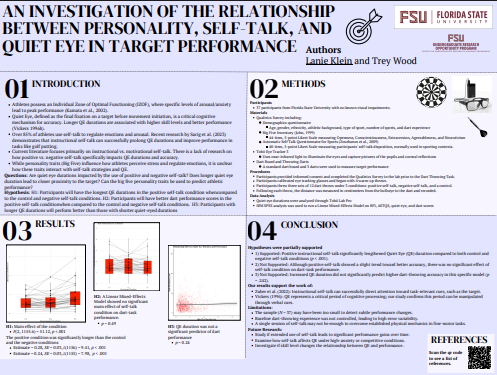
In target sports, accuracy is heavily dependent on the "Quiet Eye" (QE) period—the final fixation on a target before the initiation of a motor response. While QE is a known marker of focus, the psychological precursors that influence its duration remain under-explored. This study investigated how self-talk and personality traits (the Big Five) impact QE duration and performance accuracy. Participants completed three primary assessments: a demographic survey, the Big Five Inventory (BFI), and the Automatic Self-Talk Questionnaire for Sports (ASTQS). Performance was measured through 3 sets of 12 dart throws under varying conditions: control condition, positive self-talk, and negative self-talk. To capture gaze behavior, participants wore mobile eye-tracking glasses. Data were processed using Tobii software and analyzed through SPSS to correlate QE duration with personality scores and performance proximity to the target. Preliminary analysis indicates that positive self-talk significantly increases QE duration compared to negative or control conditions, suggesting a more stabilized focus. These findings advance the field of sports psychology by highlighting how internal dialogue and personality profiles can be leveraged to optimize gaze behavior. Understanding these relationships offers practical applications for coaches and athletes to refine skill development programs through targeted psychological interventions.
Keywords: Psychology, Performance, Personality