
Research Symposium
26th annual Undergraduate Research Symposium, April 1, 2026
Taras Chornyy Poster Session 2: 10:45 am - 11:45 am / Poster #190

BIO
Taras Chornyy is a sophomore at Florida State University pursuing a Bachelor of Science in Biology with a minor in Chemistry. He is involved in Alzheimer’s disease research in the Wilber Lab under the mentorship of Dr. Aaron Wilber, where he studies mechanisms of neurodegeneration. Originally from Orlando, Florida, he plans to pursue a career in emergency medicine.
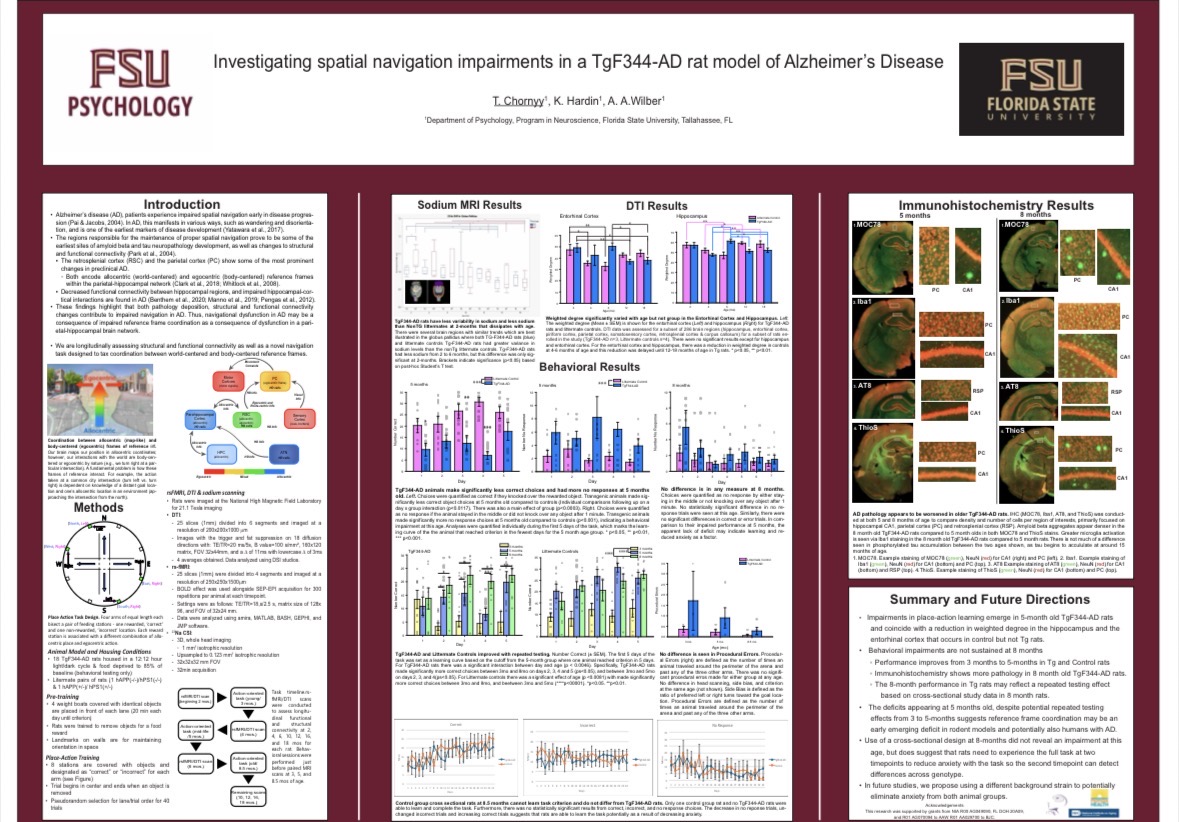
Investigating spatial navigation impairments in a TgF344-AD rat model of Alzheimer’s Disease
Authors: Taras Chornyy, Dr. Aaron WilberStudent Major: Biological Science
Mentor: Dr. Aaron Wilber
Mentor's Department: Psychology Mentor's College: College of Arts and Sciences Co-Presenters:
Abstract
Alzheimer’s Disease (AD) is a neurodegenerative disease that drastically affects an individual’s memory, learning and spatial navigation. Egocentric and allocentric are two spatial reference frames that get disrupted as this disease progresses. Egocentric is perceived to be a body-centered type of navigation, while allocentric is world-centered. Combining these two types of spatial navigation contributes to how we perceive and navigate in the world. The parietal (PC) and the retrosplenial (RSC) cortex are known to encode and transmit information between these reference frames. The PC and RSC are also brain regions that become impaired in adults with AD and rodents with genetics that mimic Alzheimer’s Disease. This study aims to examine the effects of learning and spatial navigation abilities using TgF344-AD and littermate control rats. These rats undergo several pretraining stages, at 3, 5, 8.5 months old, and an action-orientation task, followed by a sodium magnetic resonance imaging (MRI) and a diffusion tensor imaging (DTI) scan at the National High Magnetic Field Laboratory (NHMFL) when they turn 10 months old. Once the animals return from the NHMFL, they are then perfused and undergo an extensive immunohistochemistry procedure. This process is used to analyze the behavior results, neuroimaging findings and visualize the pathological changes (plaques, amyloid deposits, phosphorylated tau tangles, etc.) in the brain. The findings that we will collect from the current study will shed additional insight on how the cognition and brain regions of these animals are affected from Alzheimer’s Disease.
Keywords: Alzheimers, TgF-344AD, spatial navigation