
Research Symposium
26th annual Undergraduate Research Symposium, April 1, 2026
Ellyn Cross Poster Session 3: 1:45 pm - 2:45 pm / Poster #247

BIO
Ellyn Cross is currently a sophomore at Florida State University achieving a Bachelor's of Music in Music Therapy with a Psychology and Child Development minor, and is currently under the research mentorship of Dr. Lori Gooding and Dr. Dawn Iwamasa. As a Music Therapy major, she is aware of the multitude of different interventions coming from many different fields, practices, and minds that can make a life changing impact on many populations around the globe. However, these practices can not be established, respected, refined, or utilized to the best of their ability without proper research. Through research one can not only discover what does and doesn't work, but also observe new phenomena that may not have been considered before, that can lead us into an endless cycle of further research. Through research, we are able to equip diverse populations through many different dimensions, and foster a community of support for various practitioners and clients. Ellyn holds leadership positions in Alpha Mu Alpha (the music therapy student organization), Disabled Student Union, is the president-elect of SER-AMTAS, and is a member of Psi Chi and Pi Kappa Lambda. Ellyn hopes to pursue a career in music therapy while continuing to perform, and to eventually go to graduate school for music therapy and art therapy.
Stutter Articulation in Brass Instruments
Authors: Ellyn Cross, Lori GoodingStudent Major: Music Therapy
Mentor: Lori Gooding
Mentor's Department: Music Therapy Mentor's College: College of Music Co-Presenters:
Abstract
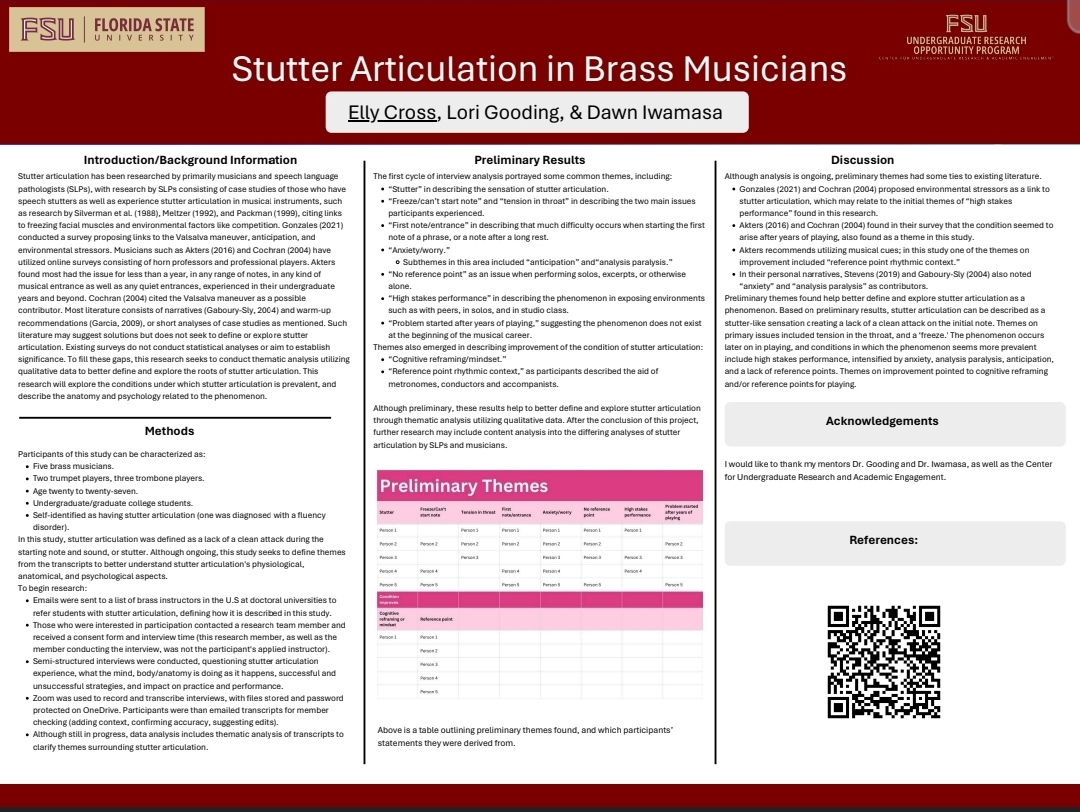
Throughout the past thirty years, there has been little research on issues related
to stutter articulation (also referred to as musical stuttering). Existing literature
references the Valsalva maneuver, warm-ups to work through stutter
articulation, case-studies of ‘musical stutterers’ and initial surveys with no
statistical analysis or established significance. However, current research on
defining and exploring causes of stutter articulation is limited. To further define
and explore stutter articulation, this project utilized semi-structured video
interviews of undergraduate music students which were later transcribed, with
questions on stutter articulation experience, what the body and mind is doing
during stutter articulation, utilized successful or unsuccessful strategies, and
impact on practice and performance. After being interviewed, the interviewees
reviewed transcripts for accuracy and provided additional context to their
statements. Transcripts are currently being analyzed. Although this project is still
in process, preliminary results reveal themes of discussion around stutter
articulation including: freeze, tension in throat, entrance/first note, anxiety/worry,
analysis paralysis, anticipation, high stakes performance, occurrence of the issue
later in musical career, and improvement upon cognitive reframing, and
reference points (like a metronome). Further research could examine the
differences in how speech language pathologists and musicians differ in
defining and considering solutions to stutter articulation, and the deeper
pathological or physiological devices behind the phenomenon.
Keywords: Music, Brass, Stutter, Instrument, Instruments, Musical, Articulation