
Research Symposium
26th annual Undergraduate Research Symposium, April 1, 2026
Dina Aouita Poster Session 3: 1:45 pm - 2:45 pm / Poster #227
BIO
Dina is a sophomore at Florida State University. She is majoring in Biological Sciences and minoring in Biomedical Physics. She plans on going to medical school after she graduates and hopes to become a doctor.
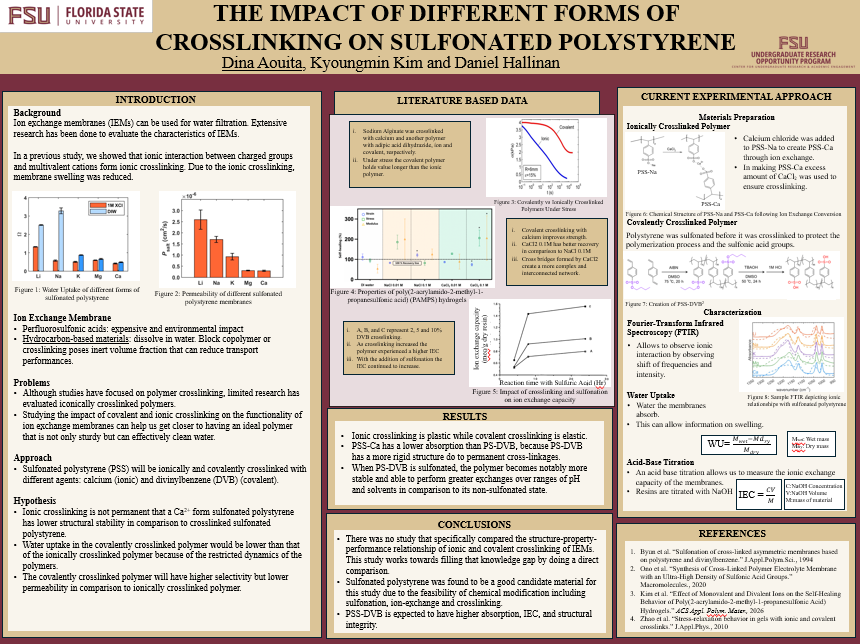
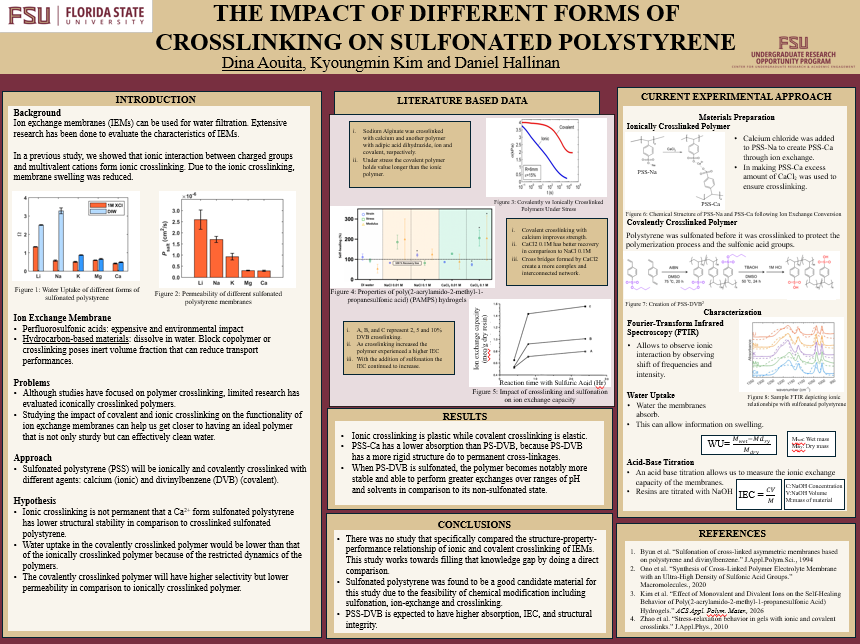
The impact of different forms of crosslinking on sulfonated polystyrene
Authors: Dina Aouita, Kyoungmin KimStudent Major: Biological Sciences
Mentor: Kyoungmin Kim
Mentor's Department: Chemical Engineering Mentor's College: FSU/FAMU College of Engineering Co-Presenters:
Abstract
Ion exchange polymers are membranes that can be used in water filtration. Studying them is important since we can use plastic to be able to clean and provide water in a way that is cost efficient. Polymers can be made by covalent and ionic crosslinking. By comparing two forms of polymers: covalently crosslinked Sulfonated Polystyrene divinylbenzene (PSS-DVB) and ionically crosslinked Sulfonated Polystyrene Calcium (PSS-Ca), we can see advantages and disadvantages of both forms of polymers. We will test water uptake, filtration and ion exchange capacity using titration techniques and gravimetric analysis. Based on literary analysis we can hypothesize that the PSS-DVB will be stronger and have better measurements of water uptake and ion exchange, while the PSS-Ca will have greater permeability, but less selectivity. These results could mean that we are able to develop ways to filter water that is long lasting and efficient. Since both polymers are expected to have positives and negatives, moving forward we can combine both ionic and covalent crosslinking to create the most ideal polymer. Further research that can be done can involve changing other aspects of the polymer. We can change the percent of sulfonation, the mediums we test the polymers in, and even what we specifically crosslink the polymers with.
Keywords: Polymer, Crosslinking, Calcium, DVB