
Research Symposium
26th annual Undergraduate Research Symposium, April 1, 2026
Dale Naylor Poster Session 4: 3:00 pm - 4:00 pm / Poster #30

BIO
Dale Naylor is a second-year undergraduate student at Florida State University pursuing a Bachelor of Science in Biochemistry on the pre-medical track. He is interested in chemistry and its role in medicine.
Through the Undergraduate Research Opportunity Program (UROP), Dale conducts research under Dr. Mohd Bilal Khan investigating the magnetophoresis of paramagnetic and diamagnetic nanoparticles. His work examines how magnetic fields influence particle behavior, with potential applications in biomedical technologies such as targeted drug delivery. This experience has strengthened his laboratory techniques, data analysis skills, and scientific reasoning.
In addition to his research, Dale is a certified pharmacy technician, where he gains hands-on experience in patient care, medication management, and healthcare communication. These experiences have reinforced his goal of attending medical school and pursuing a career as a physician.
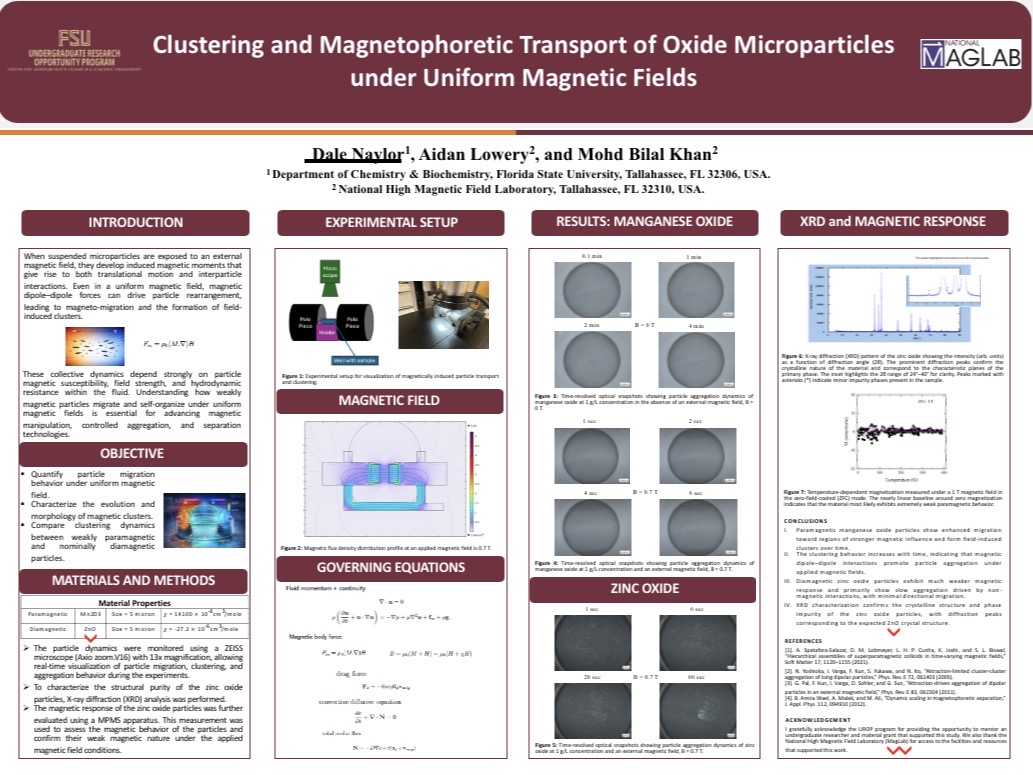
Clustering and Magnetophoretic Transport of Oxide Microparticles under Uniform Magnetic Fields
Authors: Dale Naylor, Mohd Bilal KhanStudent Major: Biochemistry
Mentor: Mohd Bilal Khan
Mentor's Department: National high magnetic field laboratory Mentor's College: Arts and sciences Co-Presenters:
Abstract
The magnetically driven transport of microparticles in liquid media is governed by
the interplay between magnetic forces, hydrodynamics, and interparticle
interactions. In this study, we experimentally investigate the magnetic response of
manganese oxide (Mn₂O₃, 5 µm) and zinc oxide (ZnO, 5 µm) microparticles
suspended in aqueous media under externally applied uniform magnetic fields up to
0.7 T using a yoke magnet configuration. Manganese oxide particles exhibit directed
migration toward the applied magnetic field and progressively form field-induced
aggregates. At later stages, the particles organize into web-like network structures
rather than classical dipolar chains, indicating the dominance of collective
interactions and hydrodynamic coupling over simple head-to-tail dipole alignment.
The absence of linear chaining suggests that particle–particle interactions, finite size
effects, and local flow recirculation influence the clustering morphology under
uniform field conditions.
Unexpectedly, zinc oxide particles, nominally diamagnetic, also demonstrate
migration toward the magnetic field region instead of repulsion. To resolve this
discrepancy, structural and magnetic characterization was performed. X-ray
diffraction analysis indicates the presence of impurity phases, while magnetic
response measurements reveal a weak paramagnetic signature consistent with
unpaired electronic states. These findings suggest that trace paramagnetic impurities
or defect-induced magnetic moments significantly alter the effective magnetic
susceptibility of the ZnO microparticles. The results highlight the sensitivity of field-
driven particle transport to intrinsic material properties and microstructural defects.
Keywords: Magnetophoresis, magnetic field, nanoparticles